Tuesday, December 3, 2013

Turtle Power

So after a long streak of dismal performances at Monday Pauper Deck Challenge, yesterday I finally managed to fight my way back into the Top 8 of MPDC 23.07, actually finishing in 2nd place with my recent Izzet deck that I affectionately dubbed Turtle Power. The name is a nod to the perennial favorite Magic card Horned Turtle, which is a 1/4 Blue creature for 3.

While the archetype is nothing new, this build is closer to a pure Control/Burn list than the Izzet decks from earlier this year. Here's what my list consisted of:

Turtle Power
2nd place in MPDC 23.07 by gwyned
Creatures
4 Minotaur Skullcleaver
4 Nivix Cyclops
8 cards

Other Spells
4 Annihilating Fire
4 Cancel
4 Essence Scatter
4 Inspiration
4 Lightning Strike
4 Razortip Whip
4 Shock
28 cards
Lands
9 Island
9 Mountain
4 Izzet Guildgate
2 Unknown Shores
24 cards

Sideboard
4 Dispel
3 Negate
3 Lava Axe
3 Frostburn Weird
2 Voyage's End
15 cards
Nivix Cyclops

Overall I was pretty happy with the deck. However, there are a couple quick changes I would make:
  • Drop to 23 lands. Even as a Control deck, with its low curve, 24 Lands is probably too much.
  • Replace some, if not all, of the Inspirations with Divination.
  • Take out 2 Dispels and a Negate from the Sideboard, and replace them with Archaeomancer to fight back against MonoBlack's hand disruption.
If you have other thoughts on how this deck could be improved, I'd love to hear them!

Friday, November 29, 2013

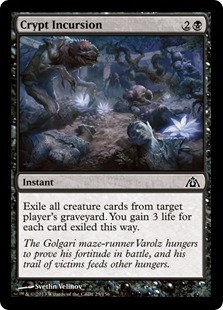
Crypt Incursion

Anyone who complains that Wizards of the Coast doesn't print powerful Commons anymore hasn't taken a good look at Crypt Incursion.

The first effect of this card is pretty typical stuff for a Black Common. Black typically has the means to interact with the Graveyard, particularly to return creatures to hand from there, and thus it makes good design sense to have an answer to that particular ability. Interestingly enough, the ability to remove multiple cards from a Graveyard has fallen from favor with the design team. One has to look all the way back to Scars of Mirrodin block to find such an ability - namely, Nihil Spellbomb.

So while the first effect is good, the second effect is potentially back-breaking. I was curious about what similar effects existed in the past, so I did a quick Gatherer search. In the past, cards that could gain a variable amount of life equal to some resource have (with 1 exception) been either White or Green, with the most common such spell using creatures on the battlefield as this resource. Gnaw to the Bone is the most recent example, providing a similar effect without exiling the creatures. On the one hand, it uses a 2x multiplier instead of 3x. But on the other hand, it does have Flashback, allowing it to be cast twice.

Based on that research, this effect is not so far outside the boundaries of what is normally acceptable power-level at Common. However, the fact that Black gets access to such a large amount of Life seems to be a mistake. Sure, Black certainly gets access to lifegain, in the form of removal spells, drain-effects or the like. Black even gets the ability to gain a variable amount of Life. But this has always been tied to the number of Swamps in play, or more recently, the amount of Black mana symbols in play. And even then, such effects have been pushed back to Uncommon as of late - such as Corrupt.

Here's my main issue. Given its access to the best removal, Black lends itself well to Control archetypes. Such archetypes intrinsically play more powerful cards, but take longer to gain access to these effects. Thus the simplest way to beat them is to play an Aggro archetype, denying your opponent the time to take control of the game. But when Black has access to large amounts of Lifegain, this strategy is significantly weakened. And when this happens, you end up with a deck like Dimir Mill, which is well on its way to dominating the current Standard Pauper metagame. If you're interested in why I think this card has made this deck so overpowered, you can find some discussion here.

For this reason, I believe this card would have been better as a multicolor Golgari Common, with a casting cost of 1BlackGreen or even 2BlackGreen. Given its dual effect and power-level, such a casting cost would be more in line with what this card can do. Alternatively, one could also simply drop the variable lifegain, changing the card so that the caster simply gains 3 Life.

What do you think of my analysis? Am I overreacting? Let me know in the comments below.

Thanks for reading

Tuesday, November 26, 2013

The Thousand Names

While this blog has primarily become a source for much of my Magic the Gathering musings, I still am very much interested in the world of fantasy fiction. While I have taken the time to review some of my favorite fantasy authors, I have yet to ever write a book review for my blog. So what better time to start than now?

In particular, I am always interested to see what is selling in the fantasy market, particularly by a new author who hasn't made a name for him or herself yet. The Thousand Names, by Django Wexler, is just such a book. (As an aside - you know an author is new to the scene when he has yet to have an entry at Wikipedia).

The novel follows the story of two officers assigned to a colonial garrison in a remote part of an empire. One is a gentleman among rogues and scoundrels, the other a young girl masquerading as a soldier. Save for brief interludes between sections, the book alternates between these two perspectives. Their lives are forever changed when a new colonel arrives to take command. Under his military genius, they undertake an impossible campaign to recapture a rebellious city. But along the way, it soon becomes clear that this conflict is overshadowed by a struggle to take possession of a power to reshape the world and bring the empire to its knees.

The Thousand Names is unique in its setting, its historical period, and its attention to military detail. Rather than the typical medieval Europe, this reads more like a Napoleonic campaign in Africa, complete with cannon, cavalry, and muskets. It is decidedly low-magic, but tips off the reader very early that there is a supernatural element to what appears to be a mundane military conflict. The characters are vivid, unique, and interesting, each with secrets that are slowly revealed as the story progresses. The story itself is well-crafted, doesn't get bogged down in the middle, and balances action, intrigue, and character conflict.

The Thousand Names is highly recommended. If you enjoy a more historical, low-magic fantasy story rich with details about military campaigns of the Napoleonic era, this is the perfect book for you. But there is enough here that almost any avid fantasy reader will enjoy this book.

But don't take my word for it. Check out the excellent reviews posted on Amazon.com, and buy yourself a copy today! You won't regret it.

Finally, if you're still on the fence, you can check out for free a short story that serves as a prequel of sorts to The Thousand Names, although obviously it isn't required prior reading. Check it out here!

Friday, November 22, 2013

Mono Red-Blitz

So the other day, as I was browsing the latest content from ChannelFireball, I came across a video by Caleb Durward featuring a list he called Standard Mono-Red Blitz. While as a rule I don't follow much Standard, I still enjoy watching content on this format and sometimes even pick up ideas for Standard Pauper.

As the video began, I was intrigued by Durward's list. With only a few exceptions, the deck was mostly Commons. Take a look for yourself:


So immediately I wanted to find out whether this archetype would work in Standard Pauper. Obviously I had to remove the non-Commons, which included the playsets of Firedrinker Satyr, Legion Loyalist, Rakdos Cackler, and Ash Zealot. The only replacement one-drop worth playing is Bellows Lizard, but Rakdos Shred-Freak, Skinbrand Goblin, and Goblin Shortcutter seemed natural replacements, along with a full set of Gore-House Chainwalkers.

I tested and tweaked the deck, finally arriving at this list:


So what do you think of this list? How well do you think it would fare in the current metagame? As always, I'd love to hear your thoughts.

Tuesday, November 19, 2013

Azorius Control

The new Standard Pauper metagame is shaping up nicely, with a fairly wide variety of decks still in contention for top spots. While Dimir Mill seems to be the clear front-runner, Hexproof, Mono Black, Orzhov, and RDW are all producing good results.

None of these have really captured my attention though, despite their strengths. Instead, I've returned to my roots in Blue White, and testing out a build that I believe has the potential to carve out a place in the emerging metagame.

Here's the list I'm currently playing:


With 25 Instants (including creatures with Flash), this deck is about as close as one gets in Standard Pauper to 'draw-go,' firmly pushing the deck into the role of Control. It also has eight different Scry effects as well as 3 draw spells, giving the deck the ability to dig deep to search for answers. Furthermore, between Deputy of Acquittals and Voyage's End, this decklist can sidestep a surprising amount of removal, while also potentially ambushing attackers as well. Basilica Guards is also a cornerstone of the deck, allowing you to recover from early aggression and get extra value out of your spells. And, perhaps best of all, the deck has some solid options for playing against Dimir Mill, even to the point of being able to 'out-mill' your opponent.

I've spent quite a bit of time fine-tuning this list, but there certainly could be room for improvement. I'd love to hear your thoughts on this build.

Thanks for reading.

Friday, November 15, 2013

The Sky Is (Not) Falling

Unless you've been disconnected from the virtual world for the last week or so (or don't follow what's going on in the world of Magic Online), by now you've no doubt heard about the horrific problems Wizards of the Coast had with Magic Online last weekend and the ensuing decision to shutdown most of the major events until further notice.

Problems with Magic Online resulting in cancelled events are nothing new, but in this particular case Pro Magic player Brian Kibler, understandable frustrated by his experience, called for the community to stop playing Magic Online until the problems were fixed. The post went viral, and while not officially confirmed, it seems likely that this firestorm of negative publicity was at the least a contributing factor to Wizards of the Coast's decision.

Twitter went crazy as this all went down. Just search under hashtag #mtgo or better yet #blamekibler to see just what I mean. You could also check out StarCityGame's The Magic Show, which in an entertaining ten-minute segment gives a decent overview of the whole situation.

Personally, the best response I've read so far comes from Pete Jahn's State of the Program for today. I encourage you to check it out for yourself. But here's the big takeaway: Don't panic. Yes, Magic Online has serious problems. Yes, it's going to take some time to fix it. Yes, some of the previous features won't be available for the foreseeable future, and may be dramatically different once they return. But this is familiar ground. It's happened before. Sadly, it will probably happen again. And in the end, Magic Online will survive, its audience will continue to grow, and we will continually find new things to frustrate us about the program. Because despite all its flaws, Magic Online gives us an experience that we can't find anywhere else.

And, for us casual players, there is a huge silver-living. Now is the time to really push Standard Pauper as a format. Let's double our attendance at the weekly PREs. Let's publish more on PDCMagic's Standard forums, on Twitter, and YouTube. Let's take this opportunity to really see Standard Pauper shine.

See you next time.

Tuesday, November 12, 2013

Clan Standard Pauper Players

The other day I was asked why I have never joined a clan.

Wait. Let me back up for a moment. On Magic Online, there exists something called Community Clans. Currently a clan can be any number of players, restricted only by whomever the current clan captain chooses to invite. Magic Online keeps track of the number of packs won within each clan, and gives each clan its own chat-room. By clicking on any other player, you can view what clan he or she belongs to. But otherwise, there is little difference between being in a clan and not.

While I have, in fact, been part of two different clans during my time on Magic Online, they have been brief memberships. I'm on at odd hours, really only play one format - and a casual one at that - and thus never really found a clan that suited me. Certainly not one that was worth some of the odd requirements or restrictions that exist among the various Magic Online clans.

But recently I was introduced to a clan called Standard Pauper Players that, for obvious reasons, immediately caught my attention.


I was amazed to discover that such a clan existed. It was centered around Standard Pauper, boasted over 50 members from all across the world, and was dedicated to seeing the format gain official sanction from Wizards of the Coast. They even had their own blog.


If ever there was a clan for me, this certainly seems to fit the bill.

But before I jump into anything, I have a question: As the host of Monday Pauper Deck Challenge, one of the most popular Player Run Events, does the fact that I belong to a particular host somehow disqualify me from membership in a clan? Do I run the risk of appearing to favor my fellow clan-members? I don't think so, but I'd love to hear what you guys think.

Don't forget that my second update of the week is now on Fridays instead of Thursdays. And thanks for reading.