Showing posts with label Mark Rosewater. Show all posts

Tuesday, July 5, 2016

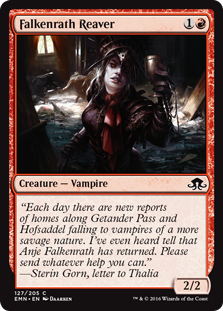
Why Would Wizards Spoil Falkenrath Reaver?

We're deep into the spoiler season for Eldritch Moon, with new cards being revealed every day, leading up to the paper Prerelease Weekend on July 16-17 and its eventual online release on August 1. The idea behind such spoilers is to build increasing excitement for the set, revealing some of the  marquee cards and mechanics and saving the more mundane cards for the full spoiler, which should come out sometime next week.

So imagine my surprise today when one of the newly revealed cards was Falkenrath Reaver. It's hard to imagine a less exciting card. It's a vanilla 2/2 for 2, with a creature type consistent with what we've already seen, that certainly doesn't seem to play any special role in the format. Why would Wizards want to use this card as a way to create excitement for the upcoming set.

As it turns out, this card was spoiled on the Magic Development Tumblr page in response to the question, "Will we ever see a vanilla 1R 2/2?". In fact, this is the first 2/2 for 2 converted mana (outside of Rares; even then I believe those cost RR) that has ever been printed without a drawback. Two good examples of this card type at Common are Mage-Ring Bully and Valley Dasher, which both come with the drawback of having to attack each round. Granted, it's arguable that Mage-Ring Bully is superior to Falkenrath Reaver, but that's neither here nor there. The point is, this is a statement from development about what we can expect from Red Commons in the future. In fact, it wouldn't surprise me if we saw such cards even with one of the set's mechanics without a drawback in the future.

As Mark Rosewater has said many times, the hardest part of design is Commons. But now, the design mentality has shifted. And in my opinion, better creatures at Common can only be good for the format.

Amazing what you can glean from a vanilla 2/2 for 2! Guess that's why Wizards thought it was worth spoiling.

Thursday, November 19, 2015

Long Odds...

Today I sent the following E-mail to Mark Rosewater. Figured, what have I got to lose?

Mark,

I figure my odds of you actually reading this are pretty slim. Nonetheless, here goes nothing:

I don't know if you're aware, but Magic Online recently killed a very fun format known as Standard Pauper. As you'd expect, it's identical to Standard, but using only Commons. There's a big online community that supports it, with free events every week that award prizes donated by online vendors.

It's mostly supported by people who love Magic but don't have the finances to compete in the sanctioned formats. Yet it's competitive, lots of fun, with a rich metagame. And if the hallmark of any set is its Commons, then it's also one of the quintessential ways to experience this great game.

I'm not expecting you to design or develop for it or anything like that. But I do want you to know that the format exists, and its existence was one of the great aspects of Magic Online. You should try it sometime with your team. I think you might be surprised by just how fun and accessible it is. And who knows? Maybe if it's something you and your team enjoy internally, the format might someday return to Magic Online.

If you're still reading this, thank you. Thanks for all you do to contribute to the Magic community. Thanks for all your efforts in keeping Magic going. Keep up the good work.

George

PS - I blog and publish articles on Standard Pauper regularly. My blog is writeradept.blogspot.com, and I publish under the username gwyned at PureMTGO.com (where Ryan Spain used to publish his articles before he was hired).

Tuesday, October 13, 2015

Rute of Jeirast

Back in June, I wrote about a PhD candidate who had created a deep neural network designed to evaluate all the existing Magic the Gathering cards and from that data design new cards. It inspired a Twitter account called RoboRosewater that publishes one such card every day. I highly encourage you to check it out.

While its not unusual to see cards that look like something that might actually see print, the real fun ones are those that are totally wacky, such as the one from today.

I literally could not stop laughing after seeing this, especially as I scrolled through the comments:

DESTROY ALL PLAYERS. So, with the printing of this card, blue power creep reached critical mass and literally killed Magic.

So, this triggers in the edge case that you have an origins planeswalker and somehow flip it back to a creature when attacked

go home rute, you're drunk

This is interesting, it' a may ability to destroy all players so you only use it when you are behind, makes the players think

As I said last time, Mark Rosewater probably doesn't need to worry about this computer putting R&D out of existence. On the other hand, they should probably still offer this PhD candidate a job. Not that they could afford him...

Saturday, June 20, 2015

Do Bad Cards Need to Exist?

As a proponent of Standard Pauper, one of the downsides of the format is that for any given new set, so many of the Commons simply aren't good enough to see play. Worse, a smaller subset of them aren't just unplayable, but are complete garbage. So why do these cards exist?

Interestingly enough, the same question has been asked in Hearthstone. A well known streamer by the handle of Kripparian recently posted a video discussing an idea that Blizzard should periodically go back and change unplayable cards to mix up the metagame and improve the overall health of the game. Surprisingly enough, Ben Brode, Senior Game Designer for Hearthstone, responded with a video of his own essentially debunking this idea. While I encourage you to check out this video for all the details, here are his essential points:
  • It's impossible not to have bad cards. Cards aren't judged in a vacuum, but in relation to other cards. Make one card better, and all you do is shift which cards are considered "bad."
  • Changing cards is bad for the game. Not only does it take a significant amount of time to rebalance a card for a new environment, it also penalizes older players who have to relearn how things work.
  • Different kinds of cards are good for different types of players. So-called bad cards may have marginal effects that are good in the right situation, may appeal to certain types of players, or help teach and illustrate concepts to new players.
Obviously in Magic, Wizards doesn't have the luxury of going back and changing cards once they've seen print. But otherwise, Brode's arguments are as true for Magic as they are for Hearthstone. Indeed, his comments are right in line with comments Mark Rosewater has made in the past.

Sorry, Kripparian. As it turns out, bad cards not only do need to exist, but are actually good for the game. Who knew?

Saturday, June 13, 2015

Designing Magic Cards using a Neural Network

Today I came across a fascinating article that actually made national news about a PhD candidate researching deep neural networks in computer science. This candidate designed to create such a network, input the data of all current Magic cards, and have this network design new cards based on this process.

According to the article, about 2 hours into the process, the network was already generating such fantastic cards as:

Slidshocking Krow - U
Creature - Dragon
Tromple,Mointainspalk
4/2
#Slidshocking Krow is ridiculously overpowered. A 4/2 for 1? In blue? With Mointainspalk AND Tromple? I see power creep is alive and well.


and

Grirerer Knishing - 4G
Instant - Arcane
Exile target creature you control.
#The price is a little steep on this one, but maybe it's worth it for the synergy with other Arcane spells...


Interestingly enough, by letting it run overnight, the network soon began to create actual meaningful and unique cards, such as:

Gravimite - 1(G/W)(G/W)
Creature - Dryad
1(G/W): Regenerate $THIS.
When Gravimite enters the battlefield, draw a card.
2/3
#I think this is a reinterpretation of Carven Caryatid.


or

Shring the Artist - 2BB
Legendary Creature - Cat
Flying
Whenever you cast a spell, you may return target creature card from your graveyard to your hand.
2/2


This of course amused me to no end. I think I actually giggled as I read some of the cards. But it gets better. Apparently a member of MtgSalvation named pickfifteen later created a Twitter account (named "RoboRosewater" naturally) that generates full cards using this network. It's definitely worth checking out.

Of course, the system still isn't perfect. It apparently also likes to generates cards like this:


I don't think R&D needs to worry about being replaced by this network in the near future. However, they may want to offer this guy a job...

Thursday, June 4, 2015

What's Missing At Common?

If you've been around in the Standard Pauper community long enough, you are probably acquainted with joekewwl. While he's a tireless champion for the format, he is best known for his ongoing involvement in the Magic Online Beta team as well as being a member of the 2011 Community Cup Team. Incidentally, he also controls the Prize Pool for MPDC, which means he's the guy to see to pick up any cards from our Prize Pool as well as the tickets for Top 8 finishers.

Due to his long involvement with the Magic Online Beta and his relationships with Wizards of the Coast staff from the Community Cup, joekewwl gets the opportunity to sometimes communicate directly with the company regarding what he's hearing in the Pauper community. As such, he recently posted at pdcmagic.com in the Standard forums that he has been approached by one of the developers asking for feedback about what's missing at the Common slot in recent sets. Specifically, he's looking for ideas about what should or could appear in future new releases.

So I encourage you to head over to this thread and make your opinion heard. But as you do so, it will help to keep a few things in  mind:
  • Commons have an important role to play in Limited, so future cards will have to function well in that environment.
  • Mark Rosewater has outlined some strict complexity guidelines regarding Commons that play a major role in what can and cannot be printed. While I have argued that recent sets have been pushing the boundaries of these constraints, these are still something you should keep in mind when making suggestions.
  • Even designers struggle to come up with appropriate Commons. Rosewater has stated that Commons are the toughest cards to get right. Take a moment and consider whether what you are suggesting is really appropriate for a Common.
Nonetheless, this is a great opportunity. There's been some discussion thus far, but I'd love to see more people make their opinions known. So what are you waiting for?

Saturday, November 1, 2014

Redflagging

Earlier this year, I took an entire series of blogposts to write about the design process for Commons as detailed by Mark Rosewater. In my initial article, I discussed a process called redflagging, in which Wizards Design and Development marks cards that violate the principles of New World Order, which is a design document adopted to govern all Commons going forward.

In episode #144 of Rosewater's popular Drive to Work podcast, he went into further detail about the factors that cause a Common to be redflagged. For today's post, I wanted to highlight these factors:
  1. Does it continuously affect other permanents? Rosewater uses Samite Healer as the poster-child for this kind of complexity. Since it can prevent 1 damage from any source at any time, it greater increased the mental math one has to do before attacking or blocking. However, not all cards that affect other permanents will be redflagged. A card like Akroan Mastiff, which taps another target creature, actually decreases complexity, as it reduces the decisions your opponent has to make. But in general, these type of cards will be flagged.
  2. Does it have four or more lines of rules text? Rosewater says that this is a sign that the card is either too wordy or too complex. If it's the former, that's fine. But if it's the latter, the card is judged to be too confusion to be at Common, and thus will be flagged.
  3. Does it create on-board card advantage by itself? Rosewater uses examples like killing two creatures, or killing another creature when it enters the battlefield, or creates the potential for repeatable damage. Cards like Flametongue Kavu or Prodigal Pyromancer are perfect examples of these type of effects.
  4. Does it create a loop? Rosewater stresses that having the same thing happen over and over again is not a desirable state, and thus wants to minimize the chances that this occurs. This is the factor that led Gravedigger to be moved to Uncommon, since you could often chain Gravediggers into one another, such that every time one died, you used another to bring it back into your hand.
  5. Does this card get more powerful in multiples? In Odyssey block, there was a cycle of cards at Common that gave you an additional effect if you already had a copy of that card in your graveyard. Accumulated Knowledge is another popular example of this type of effect. Such effects will always get a card redflagged now.
  6. Does this card cause confusing interactions? This is perhaps the most nebulous of the factors. But essentially, Rosewater explains it as any card that new players almost always misunderstand, especially in the context of a complicated rule or interaction. The example Rosewater uses is the combination of Deathtouch and Trample on the same creature. It is counter-intuitive that a creature with both abilities only has to deal a single point of damage to whatever creature blocks it, and the rest is applied to the player. Since the average player probably gets this interaction wrong, it shouldn't come up at Common, and thus is redflagged.
Now, it's important to remember that just because a Common is redflagged doesn't mean it can't see print at Common. But it does mean that the card has to have a strong reason to remain at Common in the set, and will require approval from both Design and Development. And in general, only about 20% of the Commons in a set can violate these principles.

Obviously, this has enormous impact  on the type of cards we will see in Standard Pauper. So what do you think of this list? Which one do you feel is too restrictive? How have these factors changed the landscape of cards at Common? Let me know in the comments below. Thanks for reading.

Saturday, August 30, 2014

WotC Changes Standard

Surprisingly, there are still players in our Standard Pauper community who don't pay any attention to what;s going on over at Wizards. While I will be the first to admit that most of the time what's trending over at WotC doesn't pertain much to the Standard Pauper format, this is still a mistake. After all, if Standard is the most popular format, it should go without saying that whatever Wizards decides to do to that format will definitely spill-over into Standard Pauper in one way or another.

So in case you missed it, last week Mark Rosewater announced a major change to the way that they are structuring Magic sets. Currently, Wizards releases two Expert blocks a year, each of which is three sets, as well as a Core block, for a combination of ten sets a year. This also means that Standard, at most, includes eight sets, since Standard doesn't rotate until the third Expert block is released (and thus includes two Core sets, just like it does now). But all that is going to change.

Starting in the fall of 2015, each Expert block will only be two sets instead of three. Furthermore, by the time the spring of 2016 rolls around, Wizards will be releasing three Expert blocks a year instead of two. Additionally, this means that something had to be eliminated, and that something is the Core set. Finally, Standard will now rotate after six sets, which works out to twice a year instead of just once. This also means that Standard will now always be either five or six sets, rather than ranging from five to eight as it does now.

If you want the full details, I strongly suggest you read the full article here, which is accompanied by some handy graphics. But my overall impression of this change is quite positive. Here's why:
  • With Standard rotating more often, the metagame will change more quickly. Format-warping cards will rotate faster, and established decks will have to adapt to this more rapid pace. While I maintain that the metagame is already fairly healthy, this change can only improve that.
  • With the Core Set gone, the overall complexity of the format will increase slightly, since the Core Set had more stringent restrictions on what could be printed at Common. While the total number of cards will be smaller, the overall quality of the cards we do have should be higher.
What about you? What do you think of this change? Let me know in the comments below.

Saturday, June 28, 2014

Common Design Part 3: What to Expect in Standard Pauper

This week, I am writing a series on Commons. Specifically, I am focusing on the design aspects that Wizards of the Coast considers when it comes to creating Commons. To do this, I will primarily be relying on Mark Rosewater's Making Magic column, as well as his recent Drive to Work podcasts.

Earlier in the week, I discussed New World Order, which is a specific design philosophy that governs what is acceptable at Common. Then, last time, I discussed the role that Commons play in the design of a set. Today, for my final entry in this series, I want to talk about what we should expect from Standard Pauper based on what we learned from the previous two entries.

Standard Pauper is a great format. It's cheap to play, uses the most popular format, is well-supported by Player Run Events, and enjoys a deep metagame. In fact, I wrote a whole article a couple years back about exactly why it's good for both players and for Wizards of the Coast. However, the specific constraints that go into Common design have a significant impact on the kind of cards we can expect going forward.

So here's the good news:
  • Standard Pauper will always include the themes and mechanics of a new set. Since a central tenet of design is that these needs to be present at Common, the format will always include the key elements of a set. This is good, as it keeps the format from going stale.
  • Standard Pauper will always have access to certain types of effects. To make a balanced Limited environment, a new set will always include removal, pump-effects, mana-ramp, counterspells, card draw, and the like. Because of the inclusion of these elements, playing Standard Pauper will continue to be an experience that is representative of the game as a whole.
  • In Standard Pauper, the power-level will be relatively flat. No one card should warp the format so strongly as to negatively affect the overall metagame, all other things being equal. Additionally, this keeps the format accessible to new players and the prices of individual cards low.
But here's the bad news:
  • Standard Pauper will include a lot of cards that aren't playable. According to the tenets of New World Order, 80% of the Commons will be simple, 1-for-1 effects, that have only a minor effect, if any, on any other cards in play. Thus, only around 20% of the Commons will be considerable playable in the format, and only a handful of those will see widespread play.
  • Even the best of the cards in Standard Pauper will be relatively simple  The 20% that get pushed from any set will only get pushed so far. Compared to even the Uncommons in the set, the complexity of the strongest cards will be low.
  • Standard Pauper will include a lot of the same cards, with only minor variation, from set to set. Since every Limited environment needs certain types of effects, those effects will be present in every set.
Now, that said, I still reject the assertion is uninteresting or mostly luck-based. I wrote a whole blogpost on this, and would encourage you to read it if you'd like to know more.

I hope you enjoyed this look at Common Design. See you next week.

Thursday, June 26, 2014

Common Design Part 2: The Role of Commons in a Set

This week, I am writing a series on Commons. Specifically, I am focusing on the design aspects that Wizards of the Coast considers when it comes to creating Commons. To do this, I will primarily be relying on Mark Rosewater's Making Magic column, as well as his recent Drive to Work podcasts.

Last time, I discussed New World Order, which is a specific design philosophy that governs what is acceptable at Common. Today, I want to discuss the role of Commons in a given set.

Believe it or not, Commons have a very important role in the success of a set. In fact, Rosewater has stated that Commons are actually the hardest card type to design; so hard, in fact, that most of the cards that designers turn in at Common end up seeing print as Uncommons and Rares!

So what do Commons need to accomplish for a set to be successful?
  1. Commons need to be simple. Commons make up the bulk of a set. In order to provide space and appreciation for what the set is trying to accomplish, the Commons need to be simple. To use a metaphor, Commons are the cake, while the other rarities are the frosting.
  2. Commons need to communicate the theme. Rosewater states that, "if the theme of your set isn't in Common, it isn't your theme." Again, since Commons make up the bulk of a set, it falls to them to communicate the theme of the set. Ideally, one should be able to flip through a booster or two of a given set, and by looking at the Commons, easily identify the big idea the set is trying to communicate.
  3. Commons are where you fit in the most important aspects of the set. Whatever the most important mechanics, cycles, or card types are for a set, they need to exist at Common. Otherwise, you run the risk of not being able to fit them in as the set grows larger and larger. Whenever you are trying to fit a large number of things into a tight space, the most efficient method is to start with the largest thing. And for a Magic set, that is the Commons.
  4. Commons provide the known to highlight the unknown. In any given set, you will tend to find certain kinds of cards - pump effects, iconic creatures for a color, removal, etc. Commons provide most of this material. By doing so, they keep the focus squarely on what is new and different in the set.
As you can see, Commons actually have a major role to play. They may seem simple, but that simplicity masks a very complicated balance.

Next time, I'll conclude my look at Common design by analyzing how these design constraints impact the Standard Pauper format.

Also, I wanted to highlight a special event this weekend. There will be a Standard Pauper tournament going on at a local shop in South Carolina, and they will be providing video coverage of the event on Twitch. You can get all the details here, and can also click here to view their coverage from the last Standard Pauper tournament they held.

Tuesday, June 24, 2014

Common Design Part 1: New World Order


This week, I want to do a series on Commons. Specifically, I want to focus on the design aspects that Wizards of the Coast considers when it comes to creating Commons. To do this, I will primarily be relying on Mark Rosewater's Making Magic column, as well as his recent Drive to Work podcasts.

Today, I want to start by discussing New World Order, which is a specific design philosophy that governs what is acceptable at Common.

At its heart, New World Order is about limiting the complexity that new players are faced with. Since Commons make up the bulk of the cards that new players will interact with, if you limit the amount of complexity at Common (and shift it to higher rarities), you effectively lower the learning curve for new players without reducing the overall complexity of the game.

Rosewater identifies three kinds of complexity:
  1. Comprehension Complexity - How difficult it is to understand what a single card does.
  2. Board Complexity - How difficult it is to understand how a card or group of cards affects all of the other cards in play.
  3. Strategic Complexity - How difficult it is to identify the most advantageous line of play given a particular game state.
The goal of New World Order is to minimize the first two without adversely affecting the third.

So how is that done? Rosewater uses the term "red-flag" to identify a Common that violates the simplicity requirements of New World Order. While he did not provide a full set of parameters, here are some of the ways a Common can find itself "red-flagged."
  • Is the card too wordy or complex? A typical cut-off is whether or not the card has more than 4 lines of rules text.
  • Does the card affect other cards in play? For example, a creatures that taps to prevent one damage potentially affects every combat phase, and thus increases board complexity.
  • Does the card create a 2-for-1 on the board? In other words, does the card give a new permanent while also taking away an opponent's permanent.
  • Does the card force you to track information that normally is irrelevant? For example, having to know exactly how many cards are in your opponent's graveyard is not typically information that a player needs to know. 
Now, an important caveat. Just because a Common is "red-flagged" doesn't necessarily mean that it won't be printed. But it does mean that the card has to justify its existence in some way. Maybe it features the new mechanic for the set. Maybe it actually simplifies the choices that a player has to make. In fact, Rosewater states that in any given set, approximately 20% of the Commons violate New World Order in some way or another. But the point is that they do so intentionally in order to accomplish something that the set otherwise could not accomplish.

If you're interested in reading more about New World Order, check out Rosewater's article on it here, and his more recent podcast on the topic here. Thanks for reading.

Next time, I will discuss the role that Commons need to serve in a Magic set.

Friday, December 27, 2013

Understanding the Color Pie

Way back in March, I discussed what is termed the color pie for Magic the Gatherling, which essentially is an underlying philosophy and theme that unites cards of a particular color. There is an excellent article on the color pie and its philosophy over on the MTG Salvation Wiki, as well as an excellent podcast by Mark Rosewater on the subject. In fact, it was this podcast that sparked the idea for the original post.

While an in-depth understanding of the color pie philosophy behind Magic is hardly necessary to enjoy the game, I find that the better I understand the design behind it, the better Magic player I become. And, as I mentioned previously, this color pie is also an excellent tool one can use to characterize different personality types or even archetypal characters, thus making it an excellent tool for a fantasy fiction writer to have in their toolbox.

Since I wrote that post in March, Mark Rosewater has also completed his podcast series on color philosophy. Because he tends to jump around from topic to topic, it took over 50 episodes to finally complete this series. Thus, today I want to link you to each of the podcasts on each color. They are interesting and well-done, and if you're reading this blog, it's a good bet you'll enjoy them:
  1. White
  2. Blue
  3. Black
  4. Red
  5. Green
And, in case you can't get enough of his podcasts, you can check out the full archive of Drive to Work.

See you next time.

Thursday, March 14, 2013

Characters in the Color Pie

I am frequently amazed at how often my two major hobbies seem to support one another. I have mentioned in previous articles how my love for Magic the Gathering provides inspiration for my fantasy writing. Today, I want to talk about an integral part of that great game and how it can be used as a tool to help develop great characters for science fiction or fantasy works. As you might have guessed from the adjacent image, I am talking about what is known as the Color Pie.

Last week I was listening to an episode of Mark Rosewater's excellent Drive to Work podcast where he discusses how the Color Pie is one of the fundamental elements that makes the game so brilliant. More as an aside than anything else, he mentioned how certain characters in fiction could be analyzed in terms of how their personality and traits matches up with the traits of the different colors in the Color Pie. I immediately was intrigued by the idea, and haven't been able to stop thinking about it for the past several days.

At their heart, the five colors can be broken down into five dominant characteristics:
Organization

 Intelligence
 Selfishness

 Emotion

 Instinct

As seen above, these can be further divided into specific emotions or traits:
Morality, Order, Uncreative, Law, Peace

 Logic, Technology, Intellect, Omniscience, Inaction
 Parasitism, Amorality, Self Concern, Omnipotence, Paranoia

 Impulse, Chaos, Freedom, Action, Short-Sightedness

 Community, Interdependence, Naive, Growth, Nature

And then to really add complexity, one must also consider the ten different two color combinations and their own resulting nuance from such a combination. Technically, one could even stretch to include the five tri-color shards from Alara, but such a level of complexity is probably not necessary.

So how does this apply to writing good characters? These fifteen different traits (the 5 colors + the 10 2-color combinations) can easily be used as a diverse set of character archetypes for fiction. In doing so, you must keep in mind, however, that simply having one or more of these traits is not enough to define a character by that color. For example, just because a character is part of a community does not make him Green. Instead, a character can be said to be one of these archetypes if he or she values these traits above others in his or her life and actively strives to achieve them in daily living. Let me show you what I mean.

Imagine a scribe named Gerald, a low ranking official in the sprawling Empire of Yreth. As part of a large and complex hierarchy of government, Gerald takes his duties quite seriously. He is intimately familiar with the judicial codes, and believes that strict adherence to the law is the best way to protect the Empire. Even at home he insists the family eat together each evening, observing polite table manners on all occasions. He follows the same routine each day, and is quite perturbed when he arrives at his post one day to discover his desk overturned and the partially digested corpse of a giant rat lying on the floor in a pool of vomit and blood. What color archetype best fits Gerald?

So what do you think of this concept? Does the Magic the Gathering Color Pie function as a useful set of character archetypes, or does its rigid structures stifle creativity? I'd love to hear your thoughts. Thanks for reading.