Showing posts with label Commons. Show all posts

Friday, January 6, 2017

Improvising an Aether Revolt

We're not even through the first week of spoilers, and already most of Aether Revolt has already been revealed. Last time, I took a look at three Commons that showcase the new Revolt mechanic. Today, I will once again look back to the Aether Revolt Mechanics article to bring you the other new mechanic: Improvise. Let's take a look at three Commons and see how it plays out.

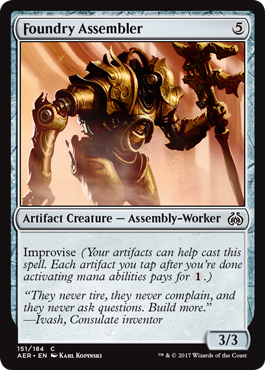
Foundry Assembler is pretty unassuming as a 3/3 for 5 generic mana. In an "artifacts matter" themed set like Aether Revolt, just the fact that this is an artifact does make it better than a vanilla 3/3. Of course, it also has the Improvise mechanic, which means that you can tap other artifacts to help pay for that cost. This card reminds me a lot of Frogmite from Mirrodin, but costs one more mana for another point of Power and Toughness. Obviously the cost reduction from Improvise isn't nearly as powerful as Affinity, but it should be relatively easy to get this down for 3 mana early and potentially for free in the midgame.

Mana Leak returns to Standard with Metallic Rebuke, a card that is good enough to potentially see Modern or even Vintage play. Being able to hold up a soft counter for only one Blue mana (plus two untapped artifacts of any sort) is quite good. And even in situations where you don't have any artifacts - either in play or even in your deck - a slightly more expensive Mana Leak certainly isn't the worst. This card is going to push many players towards an artifact-heavy Blue midrange deck, and I suspect that such a deck will be quite strong in Standard Pauper once Aether Revolt is released. While not great late game, at any other point this card is very strong.

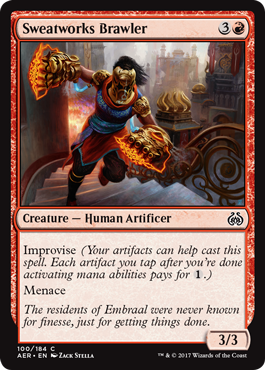
Sweatworks Brawler is another card that would already be decent even without the Improvise mechanic but becomes much better with it. A 3/3 with Menace is already tough to block early on, and it doesn't take much work at all to get this down on Turn 3 or drop this plus another creature once you've reached the mid-game. While even in the best case this card probably won't dominate the game, Sweatworks Brawler could easily play a solid role in a Gruul monsters or Rakdos style deck. On its own though, the payoff isn't quite good enough to be worth running artifacts in your deck without some other strong incentives.

So that's going to do it for my first looks at Aether Revolt this week. However, with how quickly the cards are being spoiled, I suspect I will be working on my first set review of 2017 by this time next week. What cards have impressed you from this set so far? Let me know in the comments below. See you next time.

Wednesday, January 4, 2017

Putting the Revolt in Aether Revolt

I did mention blog posts would be a bit sporadic, right? Sorry about that. In any case, as you probably are aware by now, spoiler season has begun for Aether Revolt, the second set in the Kaladesh block. On Monday Wizards of the Coast revealed the new and returning mechanics for the set, and in doing so spoiled several new Commons for the set. Today, let's look at three of these cards that give us a glimpse of one of these new mechanics - Revolt!

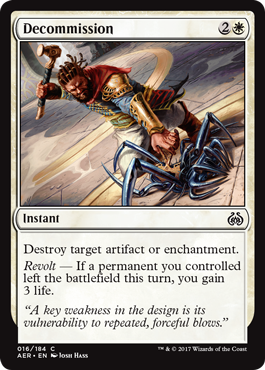
Decommission is another example in a long line of White Enchantment and Artifact hate. While it's great that you get it at Instant speed, you are paying one more mana than similar abilities normally cost, so of course you have to consider what else you're getting for the investment. In this case, if you've had any permanent of yours leave the battlefield (whether by being killed, bounced, sacrificed, or exiled), you gain 3 Life. This is very close to Solemn Offering, a card which at one point was the premiere choice for Enchantment and Artifact destruction. As such, I think Decommission will probably see play.

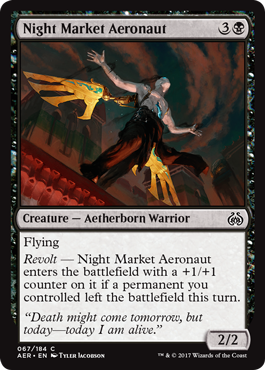
When Black gets access to flyers, they are often undersized for their cost, so Night Mark Aeronaut is right in line with that philosophy. You wouldn't typically be happy with a 2/2 with Flying for 4 mana even in Black, so you'll almost always want to wait until you can trigger Revolt. For that relatively easy requirement, you're getting a +1 / +1 upgrade, which is surprisingly good. The difference between a 2/2 and a 3/3 Flyer is huge, making this card one of the more efficient beaters you can have in Black, with very little downside. Night Market Aeronaut seems pretty good, and will probably find a home in almost any Black-based deck.

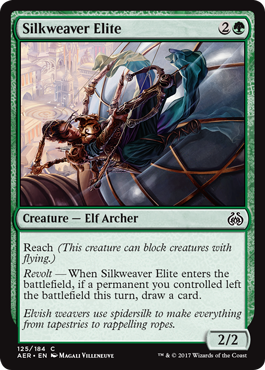
Silkweaver Elite is a bit unusual in Green in that it has Reach but has a relatively small Toughness for its cost. Furthermore, even a 2/3 Reach for 2G probably wouldn't see much play in the format. So, in keeping with our other two examples, you really want to ensure Revolt will trigger before playing this card. And when it does, you gain what is arguably the most powerful secondary ability of all - you get to draw a card! Given that Green rarely if ever has access to these sorts of cantrip abilities, Silkweaver Elite is actually quite strong. There will no doubt be numerous ways to take full advantage of its great ability.

If these three Commons are a good indicator of what we're getting for Standard Pauper in Aether Revolt, it's safe to say this will be a great set for the format. We've already got several more Commons spoiled, and I'll be taking a look at some of those later this week. For now, if you've got thoughts on these three cards, let me know in the comments below.

Tuesday, September 20, 2016

The Thriving Cycle

We've finally gotten our hands on the full spoiler for Kaladesh, and players got their first chance to play with these new cards in paper this past weekend at the Prerelease. While the online release of Kaladesh is still several weeks away, I am already starting to work on my Standard Pauper review for the set. One of the great things about Kaladesh is that it features three full cycles at Common. Last week, I covered the first one - a cycle of Artifacts that produce one small effect when they enter the battlefield and that same effect again when they're sacrificed. Today, we're going to be looking at a cycle of creatures that make use of the brand new energy tokens to grow larger when they attack: the Thriving Cycle.


Energy counters are a brand new type of counter that get placed on players rather than creatures. They function essentially almost like a new type of mana, in that you accumulate them over time and spend them to pay the cost for certain activated abilities. And in the case of this cycle, each of the creatures grants you two energy tokens when it enters the battlefield, and then gives you the option of cashing them in to put a +1 / +1 counter on the creature when it attacks.

It's worth noting, of course, that you can use any energy tokens, not just the ones that the creature produced. Similarly, while each one only gives you two such tokens, if you have others ones, you can place additional +1 / +1 counters on it on subsequent turns, providing you can continue to attack with the creature.

To evaluate these, I would consider them vanilla creatures with Power and Toughness one point higher than their listed stats, but with the downside that they have to attack each round. Their base stats are pretty typical for their color and cost, which means their enhanced stats are above what you would expect for a vanilla creature. The Blue and Green ones are probably the strongest, simply because they are useful enough (the Turtle as a defender, the Green as an attacker) to be worth playing even for their base stats, which means you'll probably be able to attack with them right away. At the end of the day though, they are just vanilla creatures, which means that unless you're already playing a deck looking to take advantage of energy tokens, they probably won't see a whole lot of play. This is particularly true given just how vulnerable they are to removal.

Next Tuesday, I'll be back to cover the third Common cycle in the set. But before then, the first part of my Standard Pauper review should also be up over at PureMTGO. As always, there's so much to cover as a new set comes out!

Wednesday, July 13, 2016

Eldritch Moon First Thoughts

As I mentioned in an earlier tweet, I am currently on the road on vacation, which is certainly an inconvenient time for the full set of Eldritch Moon to be revealed. Finding time to blog, much less work on my set review, is going to be a challenge, but I will do my best to get the content out as fast as I can. But for today, I wanted to offer my first thoughts on Eldritch Moon after going over all of the Commons a few times.
  1. The power level of the Commons is significantly above average. By my count, there are at least two dozen cards that I expect to see regular play in Standard Pauper, and several of those seem good enough to be make a major impact on the format.
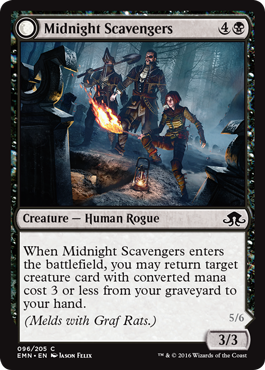
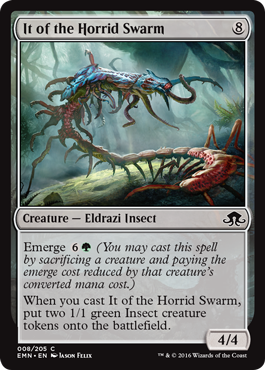
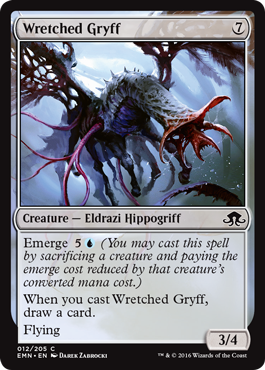
  2. Although they are only present at Common in a handful of cards, all three of the new mechanics should see play in the format. Escalate is the most represented of the three, but Meld's representative Midnight Scavengers is quite strong, as are It of the Horrid Swarm and Wretched Gryff, our two Common Emerge cards.
  3. Of the returning mechanics, Madness got a nice boost from the handful of new cards, while even Delirium and Skulk have some potential new playables.
  4. The "Graveyard matters" theme seems stronger in Eldritch Moon than in Shadows Over Innistrad, at least at Common.
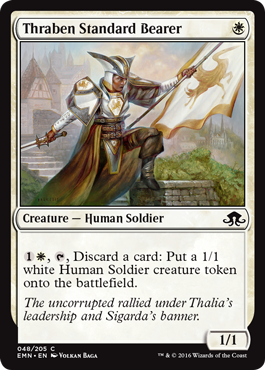
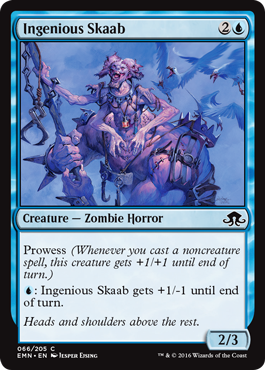
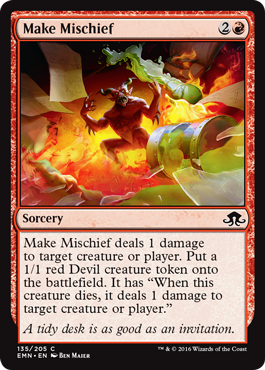
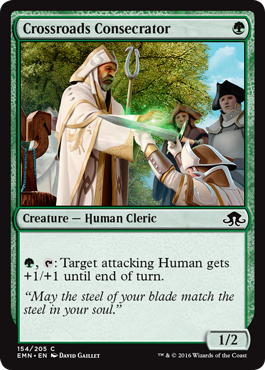
  5.  Not only are the Commons more powerful, but they seem to be unusually complex as well. Thraben Standard Bearer, Ingenious Skaab, Make Mischief, and Crossroads Consecrator are all examples of Commons that would be red-flagged for one reason or another, yet still saw print despite also not being tied to the new set mechanics. While these cards are not necessarily amazing, the level of complexity is remarkable in this post New World Order era.
Anyway, that's enough from me for now to at least whet your appetite for my full set review. No promises on when that will be published, but I will do what I can while I am traveling. At the very least, it will be available prior to the release of Eldritch Moon on Magic Online. I'm definitely looking forward to it!

Tuesday, July 5, 2016

Why Would Wizards Spoil Falkenrath Reaver?

We're deep into the spoiler season for Eldritch Moon, with new cards being revealed every day, leading up to the paper Prerelease Weekend on July 16-17 and its eventual online release on August 1. The idea behind such spoilers is to build increasing excitement for the set, revealing some of the  marquee cards and mechanics and saving the more mundane cards for the full spoiler, which should come out sometime next week.

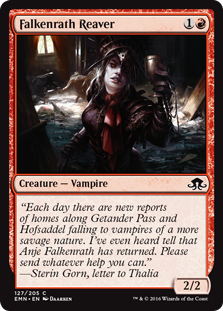
So imagine my surprise today when one of the newly revealed cards was Falkenrath Reaver. It's hard to imagine a less exciting card. It's a vanilla 2/2 for 2, with a creature type consistent with what we've already seen, that certainly doesn't seem to play any special role in the format. Why would Wizards want to use this card as a way to create excitement for the upcoming set.

As it turns out, this card was spoiled on the Magic Development Tumblr page in response to the question, "Will we ever see a vanilla 1R 2/2?". In fact, this is the first 2/2 for 2 converted mana (outside of Rares; even then I believe those cost RR) that has ever been printed without a drawback. Two good examples of this card type at Common are Mage-Ring Bully and Valley Dasher, which both come with the drawback of having to attack each round. Granted, it's arguable that Mage-Ring Bully is superior to Falkenrath Reaver, but that's neither here nor there. The point is, this is a statement from development about what we can expect from Red Commons in the future. In fact, it wouldn't surprise me if we saw such cards even with one of the set's mechanics without a drawback in the future.

As Mark Rosewater has said many times, the hardest part of design is Commons. But now, the design mentality has shifted. And in my opinion, better creatures at Common can only be good for the format.

Amazing what you can glean from a vanilla 2/2 for 2! Guess that's why Wizards thought it was worth spoiling.

Thursday, May 19, 2016

Borderland Marauder and Standard Legality

For the past couple seasons of our Standard Pauper tournaments, we've been experimenting with allowing cards previously printed at Common but reprinted in Standard at higher difficulties as Standard Pauper legal. You can read some of my previous thoughts about that issue here, but basically it comes down to the fact that the official Wizards' databases indicate those cards are legal for both Standard and Pauper.

Recently, a similar issue has arisen with Borderland Marauder, which was a key card in Adner's Red Eye Vampire deck, which captured the trophy for SPDC 33.03. Although this card was not reprinted in Magic Origins or any of the other major expansions that are Standard legal, it was printed in the Welcome Deck 2016, which is a small demo set Wizards of the Coast distributes to game stores. All of these cards are technically Standard legal, and will remain so until Shadows Over Innistrad rotates out of Standard.

This demo set includes three other Commons that are also Standard legal despite not being in any of the marquee expansions: Marked By Honor, Oakenform, and Walking Corpse.

Regardless of your opinion on whether these should be legal or not, the issue is pretty clear: they are Standard legal Commons, and are listed as such in all official card databases. As such, they are legal for play in our Standard Pauper tournaments.

While this may be confusing, Adner's story is a perfect example of why these need to be legal:

I agree this is a bit confusing for brewers indeed, especially when back from a long period away from the game and format. This was the case I faced when brewing this RDW. I just used the STD filter available on MTGO then chose common rarity, and the Borderland Marauders just showed up ! So I gave them a ride. How decisive were they really? Not very much. Reprints, symbols, different rarities, man I can now understand why I am bald tearing off all hairs when it gets so complicated. 

So now you know.

Thursday, April 28, 2016

Common Reprints with Upshifted Rarity in Shadows Over Innistrad

With very little fanfare, it was decided that what I have dubbed the Standard Pauper Experiment would continue into this new season of Standard Pauper tournaments brought about by the release of Shadows Over Innistrad. Our community is continuing to test whether cards previously printed at Common but reprinted at higher rarities in Standard sets should be allowed into the format. Primarily, this is driven by the fact that both online and on the MTGO client, using the official card filtering databases returns these cards as being both Standard and Pauper legal.

With the rotation of Standard, two such cards left the format, namely Arc Lightning and Pyrotechnics, and three new cards came in: Lightning Axe, Mad Prophet, and Reckless Scholar. So today I thought I would take a quick look at these new cards and offer my thoughts on them.

1. It seems appropriate that as two burn spells rotate out, we get another one to take their place. A 5R Instant that deals 5 damage to target creature is nothing to get excited about, being comparable to both Reduce to Ashes and Sarkhan's Rage. Of course, for this card it's all about actually getting to cast it for R instead by discarding a card. And while there are plenty of ways to mitigate that cost (pitching a Land or a Madness card, for example), the effect you're getting still isn't amazing given the setup cost. At best, this is an improved Flame Slash, but one that makes you work hard for that additional value.

Verdict: Grounder - It's a strong removal spell, but it axes a lot of you.

Mad Prophet was a Common back as recently as Avacyn Restored, where it saw only occasional play. At 3R, you're paying a lot for a mere 2/2, even with Haste, and unlike other "looters" you have to discard the card before you get to draw. Obviously now this ability is potentially much better, since if you can discard a Madness card you essentially are negating the downside. It's also worth remembering that since it does have Haste, you can activate its ability right away, even if your opponent immediately targets it with removal. Overall though, I don't expect this to see much play except in a dedicated Madness build.

Verdict: Bunt - You'd be mad to predict amazing things for this card.

I've always found Reckless Scholar to be a bit of an oddball card. The extra point of Power over Merfolk Looter is a nice bonus, but the ability to use its ability on other players always struck me as strange. Nonetheless, the ability to draw and then discard a card is a slow but effective way to gain card advantage, typically worth about half a card per activation, and obviously is even better when you can activate Madness some percentage of the time. That said, Madness seems to be at its best in a more tempo oriented deck rather than straight Control, which makes it hard for this card to earn a spot. So far the Izzet decks have not included it, but perhaps that will change.

Verdict: Bunt - I hate to be reckless, but I don't think this quite gets there.

So there you have it. While Lightning Axe will probably find a spot in a few different decks, I doubt either Mad Prophet or Reckless Scholar will make much of an impact.

Tuesday, February 2, 2016

Changing Standard Pauper Legal Cards

For those who don't follow me on Twitter or regularly check on the Standard forums on pdcmagic.com, you may be unaware that we have recently been discussing changing the definition of Standard Pauper. Specifically, we are evaluating whether or not cards that were printed at Common in previous sets but have been reprinted at higher rarities should now be allowed into the format.

You see, with the removal of the Standard Pauper filter from Magic Online, there is a discrepancy with how both the official Gathering database and the online client display cards when you search for both "Standard" and "Common."In both cases, the database returns cards that were printed at Common in prior sets but existed in the current Standard at other rarities, thus giving the impression that they are Standard Pauper legal. Prior to the implementation of the filter, it was the responsibility of the players to watch out for these cards. Often times, this meant that new players would play a match with an Uncommon and be forced to concede and change their deck. 

In my opinion, the advantages of now allowing these cards into the format can be summarized like this:
  1. It erases all question of card legality. If a card is listed when you select "Standard" and "Common" on any official card database, the card is legal in Standard Pauper. 
  2.  It widens the format and helps combat the perceived "dumbing-down" of Commons since New World Order philosophy changed the design of Commons.
Of course, there are also two potential concerns as well:
  1. In going against Wizards' design decision to move certain Commons to higher rarities, it allows the potential for present or future cards to become unbalancing or unfair. 
  2. It risks having to later remove these cards from the format should Wizards later decide to reimplement the Standard Pauper filter.
If you haven't done so already, I encourage you to check out the discussion and make your opinion heard. As far as MPDC is concerned, I will be making a decision (in coordination with the hosts of SPDC) sometime this week, so don't wait!

And just for reference, here are the current cards that would now be Standard Pauper legal if this change was implemented:

Arc Lightning
Cruel Revival
Death Wind
Fiery Conclusion
Grasp of Darkness
Knightly Valor
Pilgrim's Eye
Pyrotechnics
Rolling Thunder
Runed Servitor
Sigiled Starfish
Strider Harness
Totem-Guide Hartebeest


See you next time!

Thursday, July 23, 2015

Common Design: Why Commons Become Uncommons

I've spent quite a bit of time on my blog writing about the design of Commons, particularly in reference to the New World Order design philosophy and how it affects what we will see at Common in future sets. As is typical with the release of a new set, there is a certain subset of the Pauper community that laments these design constraints, since it typically means that few if any new cards will actually see play in Classic Pauper.

For Magic Origins, at least one player picked up on the fact that several former Commons (Knightly Valor, Sigiled Starfish, and Totem-Guide Hartebeest, among others) saw print as Uncommons in the set, and took this as further proof that New World Order is taking away all the complexity out of print at Common. In response to one such post, a player by the name of casual_melvin posted this response (which I have edited slightly just for clarity):

A) Cards often shift rarities from set to set, sometimes up sometimes down. Sometimes this reflects a change in how WotC handles rarity. More often it reflects the differing needs of the new set. Scion of the Wild was reprinted as a common in Modern Masters 2015 despite two previous printings at rare. This was acceptable because Modern Masters has less restriction on complexity than Standard legal sets.

B) Origins is a core set, and core sets have always had less complexity available than expansion sets. Shimmering Grotto was printed as a common in 2 expansion sets before being printed as an uncommon in M14. Then a functionally equivalent card, Unknown Shores, was printed at common in Theros.

C) Specifically, printing Sigiled Starfish at uncommon in Origins allows them to make a new common card of similar complexity. WotC gives itself a "complexity budget" for use on commons. A certain number of commons each set are allowed to do things that commons can't do too much without unbalancing limited. They use this budget to craft limited play around the set/block's themes so that always powerful things like removal and evasion aren't always taking center stage.

C2) Whether a card like Sigiled Starfish is printed at common or uncommon has less to do with the card itself than how it plays with the cards in the environment.  Apparently, while Origins does have scry, it is less of a focus than it was in Theros, so as a repeatable scry-er, Sigiled Starfish fits better at uncommon. 


As you're evaluating new sets, these are very great points to keep in mind. Thanks for reading.

Friday, July 10, 2015

Making a Creature Renown

I am hard at work on my set review for Magic Origins, and have submitted the first part to PureMTGO just before I sat down to write this post. As I mentioned last week, overall I have been fairly impressed with the set so far, especially with the overall power level and complexity of the Commons, which seems higher than in more recent sets.

Today I want to look at the Renown mechanic from the set and talk about the design that went into these creatures at Common.

The first time a Renown creature deals damage to a player, it receives a number of +1 / +1 counters equal to its Renown (which is only 1 at Common save for a lone exception). Ideally, then, what we want to see on these creatures are decent base stats for its casting cost as well as some form of evasion that will allow you to easily trigger Renown for the extra counter. And when these elements are lacking, the creature probably won't be playable in Standard Pauper. Let's take a look at two contrasting examples.

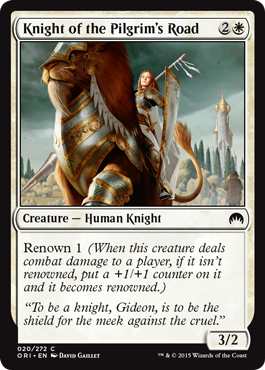
Knight of the Pilgrim Road was spoiled early, and right away it didn't bode well for the mechanic. A 3/2 for 2W isn't all that great, and boosting it up to a 4/3 isn't enough for it to survive against a lot of different threats, including other 3 drops. This would have been much better as a 2/3, where the Renown boost would be enough to protect it against most forms of removal and also make it harder for your opponent to profitably block when it first enters the battlefield. For an additional mana, this really isn't much better than Oreskos Swiftclaw, and that isn't a card that you want to be playing in even a dedicated White Weenie build.

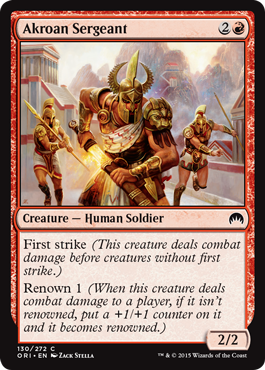
In contrast, Akroan Sergeant is much better. A 2/2 with First Strike for 2R is already pretty good, and might by itself be borderline playable. Even better, First Strike makes it more difficult for your opponent to block and trade with it, increasing the odds that you'll be able to deal damage to him and trigger Renown. Connect with it just once, and you have a very respectable 3/3 First Strike, which is quite strong on either offense or defense in a format dominated by creatures with 2 Toughness or less. While this isn't fast enough to probably suit a RDW style archetype, it might warrant a spot in the recently popular RG Monsters deck or something similar.

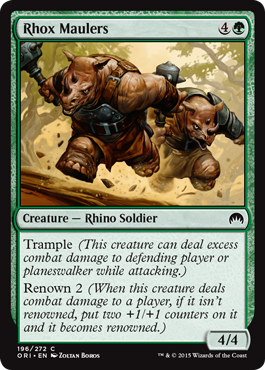
Looking at the entire collection of Renown creatures at Common, I suspect that only Rhox Maulers will see widespread play. However, 4 others might find a home in the right deck, including the aforementioned Akroan Sergeant, especially after Standard rotates in the fall. I for one can't wait to see the impact Magic Origins has on Standard Pauper.

Thanks for reading.

Saturday, July 4, 2015

Magic Origins Full Spoiler Impressions

Perhaps as an early 4th of July present, Wizards released the full spoiler yesterday for Magic Origins. While my full review is in progress and will be forthcoming over at PureMTGO over the next few weeks, I wanted to take a few moments today to discuss my initial impression now that I've had a chance to look over the set as a whole.

As the last of the Core sets to be released, it seems that Wizards went all out on their last chance to get it right. While I will leave it to others to evaluate the set as a whole, overall I have been quite impressed with the Commons. Sure, there are the usual fare of unplayable chaff. But the overall card quality seems to be slightly higher than in more recent sets, and even the typical role-players have generally been tweaked to make them more interesting.

As far as specifics go, the Renown mechanic looks quite strong, with nearly all of the Commons playable at worst, and a few probably will see widespread play. The Spell Mastery keyword is a little more varied, but even here several will probably make an impact on the format. Additionally, there are several excellent reprints returning to the format. Finally, there are numerous cards with interesting and decent 'enters-the-battlefield' type effects or repeatable abilities, which is a level of complexity that has been missing from Commons as of late. In a way these cards harken back to much earlier sets while still feeling balanced at Common, and this does a great job of evoking the idea of going back to Magic's roots.

Now that we have the whole set, what cards are you most excited about?

Saturday, June 20, 2015

Do Bad Cards Need to Exist?

As a proponent of Standard Pauper, one of the downsides of the format is that for any given new set, so many of the Commons simply aren't good enough to see play. Worse, a smaller subset of them aren't just unplayable, but are complete garbage. So why do these cards exist?

Interestingly enough, the same question has been asked in Hearthstone. A well known streamer by the handle of Kripparian recently posted a video discussing an idea that Blizzard should periodically go back and change unplayable cards to mix up the metagame and improve the overall health of the game. Surprisingly enough, Ben Brode, Senior Game Designer for Hearthstone, responded with a video of his own essentially debunking this idea. While I encourage you to check out this video for all the details, here are his essential points:
  • It's impossible not to have bad cards. Cards aren't judged in a vacuum, but in relation to other cards. Make one card better, and all you do is shift which cards are considered "bad."
  • Changing cards is bad for the game. Not only does it take a significant amount of time to rebalance a card for a new environment, it also penalizes older players who have to relearn how things work.
  • Different kinds of cards are good for different types of players. So-called bad cards may have marginal effects that are good in the right situation, may appeal to certain types of players, or help teach and illustrate concepts to new players.
Obviously in Magic, Wizards doesn't have the luxury of going back and changing cards once they've seen print. But otherwise, Brode's arguments are as true for Magic as they are for Hearthstone. Indeed, his comments are right in line with comments Mark Rosewater has made in the past.

Sorry, Kripparian. As it turns out, bad cards not only do need to exist, but are actually good for the game. Who knew?

Tuesday, June 16, 2015

Magic Origins: First Impressions

It's spoiler season once again, this time for Magic Origins. A couple weeks ago Wizards announced both their changes to the evergreen mechanics as well as some of the contents of the Magic Origins Sample Decks, giving us an early glimpse of several Commons in the new set.

At some point I will take the time to start reviewing some of the specific cards. But for today I just wanted to focus on my first impressions.

First of all, the slightly higher complexity level that we saw in Theros block seems to continue in Magic Origins. We've got multiple cards with interesting 'enters the battlefield' effects as well as activated abilities that aren't tied to specific mechanics in the set, which is definitely welcome.

Second, for being the last of the Core sets, the number of actual reprints seems low, at least thus far Even where similar cards exist, it seems Magic Origins will bring us new variations on existing cards rather than simply reprints. At least to me, this certainly makes the set more interesting.

Third, the trend towards expensive and/or conditional removal at Common continues. Based on everything I've heard up to this point, the days of getting multiple cards with cheap, Instant speed removal at Common are far behind us.

Finally, we actually get a decent piece of Equipment at Common, even if it is just +1/+1 for 1. While this probably is seen as marginal in Limited, for Standard Pauper this might actually see play. I point this out mostly as an indicator that Wizards is still willing to experiment somewhat at Common and test out exactly where the power-level is.

Based on all that, I'm pretty excited about the set so far. What do you think? Let me know in the comments below.

Thursday, June 4, 2015

What's Missing At Common?

If you've been around in the Standard Pauper community long enough, you are probably acquainted with joekewwl. While he's a tireless champion for the format, he is best known for his ongoing involvement in the Magic Online Beta team as well as being a member of the 2011 Community Cup Team. Incidentally, he also controls the Prize Pool for MPDC, which means he's the guy to see to pick up any cards from our Prize Pool as well as the tickets for Top 8 finishers.

Due to his long involvement with the Magic Online Beta and his relationships with Wizards of the Coast staff from the Community Cup, joekewwl gets the opportunity to sometimes communicate directly with the company regarding what he's hearing in the Pauper community. As such, he recently posted at pdcmagic.com in the Standard forums that he has been approached by one of the developers asking for feedback about what's missing at the Common slot in recent sets. Specifically, he's looking for ideas about what should or could appear in future new releases.

So I encourage you to head over to this thread and make your opinion heard. But as you do so, it will help to keep a few things in  mind:
  • Commons have an important role to play in Limited, so future cards will have to function well in that environment.
  • Mark Rosewater has outlined some strict complexity guidelines regarding Commons that play a major role in what can and cannot be printed. While I have argued that recent sets have been pushing the boundaries of these constraints, these are still something you should keep in mind when making suggestions.
  • Even designers struggle to come up with appropriate Commons. Rosewater has stated that Commons are the toughest cards to get right. Take a moment and consider whether what you are suggesting is really appropriate for a Common.
Nonetheless, this is a great opportunity. There's been some discussion thus far, but I'd love to see more people make their opinions known. So what are you waiting for?

Tuesday, January 13, 2015

Choice and Complexity

As I continue to work on my set review for Fate Reforged, I have made an interesting note about this set. In the past, I have written extensively about Common Design and the tenets of New World Order limit the kinds of cards we can expect at Common going forward. The whole point of this design constraint is to limit complexity and thereby keep the bar of entry for new players as low as possible while still retaining the essentially elements of the game.

But, at least in my opinion, both Khans of Tarkir and Fate Reforged have been pushing up against the constraints of New World Order more than we have seen in some time. Indeed, I would argue that simply by allowing the Morph mechanic (and now Manifest as well) at Common, signals a shift in what kinds of complexity are allowable.

Now, in Fate Reforged, we have the return of modal abilities in a cycle of creatures at Common. The presence of such cards used to be fairly routine in Magic's history; now, they are quite unusual. So while these abilities never disappeared entirely, giving players the choice of two distinct abilities when a card is cast is an unusually high level of complexity, and one that probably would have been red-flagged and then moved up in rarity save that it ties into a particular theme of the set. Additionally, these creatures also would have been red-flagged simply for the amount of text on the card, which easily exceeds the four line limit.

Choice creates complexity. Board states with hidden or hard-to-discern information also create complexity. And yet, both these elements are present at Common. Is this a shift in New World Order philosophy, or simply an oddity due to the specific needs of this block? Time will tell, but at least for now, I am cautiously optimistic about what this means for future Commons.

Saturday, November 1, 2014

Redflagging

Earlier this year, I took an entire series of blogposts to write about the design process for Commons as detailed by Mark Rosewater. In my initial article, I discussed a process called redflagging, in which Wizards Design and Development marks cards that violate the principles of New World Order, which is a design document adopted to govern all Commons going forward.

In episode #144 of Rosewater's popular Drive to Work podcast, he went into further detail about the factors that cause a Common to be redflagged. For today's post, I wanted to highlight these factors:
  1. Does it continuously affect other permanents? Rosewater uses Samite Healer as the poster-child for this kind of complexity. Since it can prevent 1 damage from any source at any time, it greater increased the mental math one has to do before attacking or blocking. However, not all cards that affect other permanents will be redflagged. A card like Akroan Mastiff, which taps another target creature, actually decreases complexity, as it reduces the decisions your opponent has to make. But in general, these type of cards will be flagged.
  2. Does it have four or more lines of rules text? Rosewater says that this is a sign that the card is either too wordy or too complex. If it's the former, that's fine. But if it's the latter, the card is judged to be too confusion to be at Common, and thus will be flagged.
  3. Does it create on-board card advantage by itself? Rosewater uses examples like killing two creatures, or killing another creature when it enters the battlefield, or creates the potential for repeatable damage. Cards like Flametongue Kavu or Prodigal Pyromancer are perfect examples of these type of effects.
  4. Does it create a loop? Rosewater stresses that having the same thing happen over and over again is not a desirable state, and thus wants to minimize the chances that this occurs. This is the factor that led Gravedigger to be moved to Uncommon, since you could often chain Gravediggers into one another, such that every time one died, you used another to bring it back into your hand.
  5. Does this card get more powerful in multiples? In Odyssey block, there was a cycle of cards at Common that gave you an additional effect if you already had a copy of that card in your graveyard. Accumulated Knowledge is another popular example of this type of effect. Such effects will always get a card redflagged now.
  6. Does this card cause confusing interactions? This is perhaps the most nebulous of the factors. But essentially, Rosewater explains it as any card that new players almost always misunderstand, especially in the context of a complicated rule or interaction. The example Rosewater uses is the combination of Deathtouch and Trample on the same creature. It is counter-intuitive that a creature with both abilities only has to deal a single point of damage to whatever creature blocks it, and the rest is applied to the player. Since the average player probably gets this interaction wrong, it shouldn't come up at Common, and thus is redflagged.
Now, it's important to remember that just because a Common is redflagged doesn't mean it can't see print at Common. But it does mean that the card has to have a strong reason to remain at Common in the set, and will require approval from both Design and Development. And in general, only about 20% of the Commons in a set can violate these principles.
Obviously, this has enormous impact  on the type of cards we will see in Standard Pauper. So what do you think of this list? Which one do you feel is too restrictive? How have these factors changed the landscape of cards at Common? Let me know in the comments below. Thanks for reading.

Tuesday, September 16, 2014

Khans of Tarkir: Morph

In case you somehow missed it, the returning mechanic for Khans of Tarkir is Morph. Morph was first introduced way back in Onslaught, and is certainly one of the stranger mechanics in Magic's history. The ability to essentially play a 2/2 token for 3 mana by putting the card face-down introduces a whole new element of hidden knowledge from your opponent, and the complexity is even higher given that you can flip a Morph card over at any time, assuming you have enough mana to pay the Morph cost. It is also worth pointing out here that the act of turning the card face-up doesn't use the stack, and thus cannot be responded to. In other words, if your opponent pays the Morph cost and goes to flip over her creature, you can't cast Shock to remove it as a 2/2 creature.

As I have been working on the set review for Standard Pauper for Khans of Tarkir, I have had some difficulty in evaluating just how good the Morph cards are in this set. Today, rather than looking at specific cards, I want to evaluate the mechanic as a whole.

Typically, Morph cards have three major advantages over other creatures:
  1. Your opponent doesn't know what creature you played. Since all Morph cards cost the same to play face-down, your opponent has no real information to go on. Unless he is playing Lens of Clarity, the only way your opponent learns what card you played either when you flip it over or when it leaves the battlefield or the game ends.
  2. You can always play the card as soon as you have three mana available. Playing them facedown doesn't require any specific colored mana. Additionally, most of the time this is cheaper than the actual casting cost of the creature, allowing you to get value out of the card much earlier than you otherwise could.
  3. You control when the creature is flipped over. This means that you can effectively surprise your opponent in combat, allowing you to block a creature you might not have been able to block or setup a favorable block that your opponent couldn't foresee.
These are pretty significant advantages. Honestly, given the complexity that this introduces, I am surprised Morph is being reprinted at Common. This also means that we should expect that the Morphs at Common will probably only be vanilla or french-vanilla creatures, since additional complexity would easily push the card into Uncommon or Rare.

For those of you who have played with Morph cards before, what do you think of them in general? Are you excited to get your hands on them in Khans of Tarkir? Let me know in the comments below.

Saturday, September 13, 2014

Khans of Tarkir: Full Spoiler and Contest Results

That didn't take long.

Probably timed to coincide with the start of the Community Cup, the full spoiler for Khans of Tarkir has been released. The timing is also convenient for me, since it allows me to immediately announce the results of the contest I held right here at Write Adept in my previous blog post.

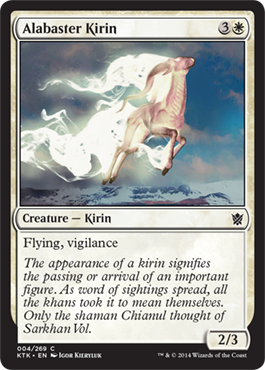
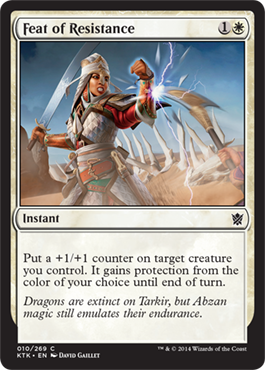
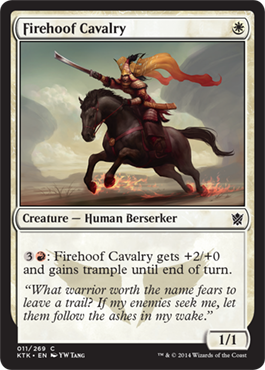
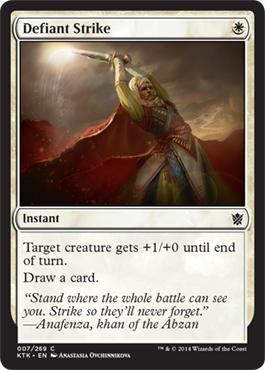
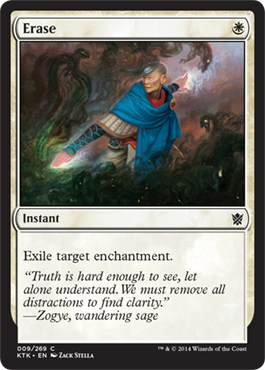
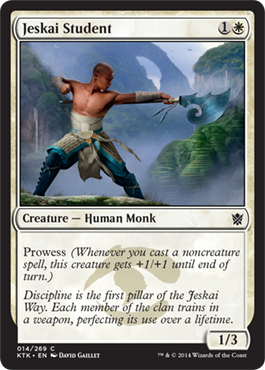
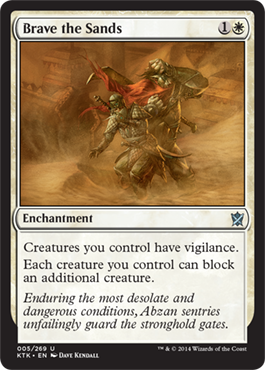
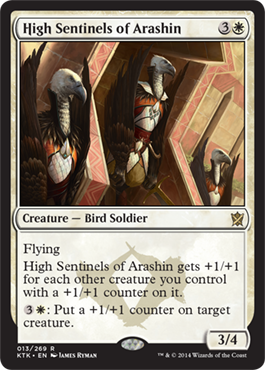
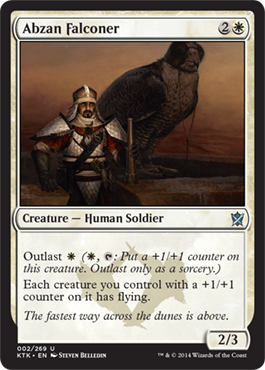
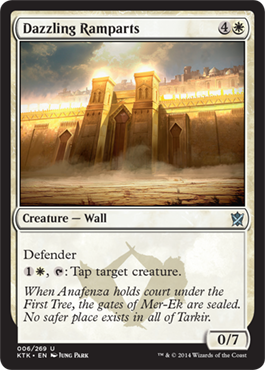
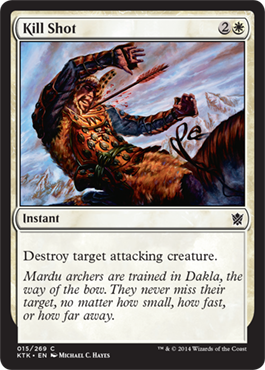
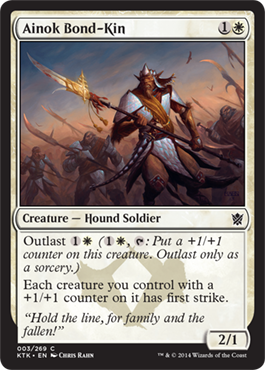
For those who missed it, MTGSalvation had a slew of unofficial spoilers, including a bunch of White cards that included the full rules text but not the rarity of the cards. I posted them and asked my loyal readers to try to figure out which ones could be Common based on power-level. For reference, here are the cards in question (click on the image for a larger version):


For reference, I should have numbered them, particularly since they ended up out of any logical order due to my unusual copy/paste from the site. For today's post, I will simply refer to them from left to right, finishing the whole row before moving down to the next row. The correct rarity for the cards is as follows: Uncommon, Common, Uncommon, Common, Common, Rare, Uncommon, Common, Common, Common, Common, Common.

Out of these eleven cards, I thought six of them were obviously Common: Alabaster Kirin, Feat of Resistance, Firehoof Calvary, Defiant Strike, Erase, and Jeskai Student. These six cards represent elements almost always found at White at Common: simple combat tricks, "fair" costed creatures with a single ability, a single-target protection spell, and a reprinted Enchantment hate. Additionally, both Brave the Sands and High Sentinels of Arashin were clearly not Commons, since both add significant complexity to combat with the latter also requiring you to keep an accurate understanding of the board to determine the Sentinel's Power and Toughness. That left Abzan Falconer, Dazzling Ramparts, and Kill Shot as the more tricky to evaluate.

Under the right circumstances, I would vouch that all three could be potential Commons, at least with minor tweaks. Abzan Falconer is probably too efficiently costed to be a Common, both for its Outlast cost and its casting cost, and granting Flying is arguably too strong at Common. However, it isn't that different than Ainok Bond-Kin, and so is borderline between Common and Uncommon. Dazzling Ramparts is even closer, as White often gets a tapper at Common, and an 0/7 Defender for 1W is not particularly efficient. Finally, Kill Shot, while clearly better than the classic Divine Verdict, is a functional reprint of Rebuke from Innistrad. 

As far as my evaluation, I actually missed only one, placing Dazzling Ramparts as a Common instead of an Uncommon. Chris Baker, one of only two entries, got them all correct, and so Writer Adept will be awarding him a single ticket for his victory!

I hope you enjoyed this exercise. Thanks for reading.

Thursday, September 11, 2014

Khans of Tarkir: Could It Be Common?

Another spoiler season for a new set, another set of unofficial spoilers, this time courtesy of MTGSalvation. In this case user nal2 posted the text of a bunch of cards from Khans of Tarkir, without artwork or even the rarity. As I was perusing the spoiled cards, I found myself trying to figure out which ones could be Common. It was such an interesting exercise, I thought I would post it up here on the blog for my readers. But rather than focusing on all of them, I decided to limit it to White.

Since the information could change quickly (especially with Sealed Clans of Tarkir as a Community Cup event this weekend), here are the White cards that were spoiled in this batch (click on the image for full size resolution):


Based on what we know about Common Design, can you pick out which of these cards are Common? Actually, I would divide them into three categories, based on the fact that sometimes rarity is determined by factors other than power level or complexity.
  1. Probably Common
  2. Definitely Common
  3. Not Common
I've recorded my picks, and I will discuss them on Saturday. Let me know your picks in the comments below. Once these eleven cards  are spoiled, I'll even throw in a small prize for whoever gets them all correct (or randomly select one among multiple winners).

Tuesday, September 9, 2014

Khans of Tarkir: Refuge Lands

It's spoiler season once again, which means we are finally getting our first glance at the Commons for the upcoming fall release of Khans of Tarkir. While the entire Common pool won't be known until the full set is finally spoiled, this week a new Common cycle was disclosed that will have a major impact on the upcoming metagame.

With this set emphasizing multicolor by means of three-color wedges, a major emphasis in the design is mana-fixing. According to Erik Lauer's article this week, at one point R&D was strongly considering actually released three color lands at Common. This would have been a major milestone, but sadly it was not to be, as tri-color lands at Common pushed too many developers to play four or five color decks rather than sticking to one of the wedges. Which meant that these tri-color lands ended up at Uncommon, and instead at Common we got these:


Called 'Refuge Lands' (from an identical cycle of Uncommon Lands from Zendikar), these ten duals will replace the Return to Ravnica Gates when they rotate out of Standard this fall. While not technically strictly better than the Gates (since Gate is a sub-type that affected other permanents), for all intents and purposes these will functional almost exactly the same, other than the small but not insignificant incidental lifegain when they enter the battlefield. 

The inclusion of this cycle is significant for Standard Pauper in at least three ways:
  1. It solidifies that dual-colored, enters-the-battlefield tapped, Lands can be printed at Common, even with a minor beneficial effect.
  2. It weakens Aggro strategies, in that it not only incentivizes players to play multiple colors, it also rewards them with extra life for doing so, helping them to survive early aggression. The latter is particularly potent in a format that already will include Radiant Fountain.
  3. It should allow players to utilize the best of the wedge and/or multicolor cards from the block effectively. Since such cards tend to be stronger (and thus more expensive), this will also push the format away from Aggro.
So what do you think of this cycle of Lands? Let me know in the comments below. See you next time.