In the final part of my Standard Pauper set review for Dragons of Tarkir,
I listed 11 cards that I believed would make the biggest impact in the
format. I thought it would be helpful to look back at these cards and compare my evaluations to how the metagame has turned out thus far. Last time, I discussed how 8 of my 11 picks were seeing consistent play. Today, I want to look at the other 3 cards and look at why I think they aren't seeing much play.
For reference, here are the eleven cards that I highlighted from Dragons of Tarkir:
So of these eleven, the current "stinkers" are Dromoka Dunecaster, Monastery Loremaster, and Student of Ojutai. Let's take a look at each of them.
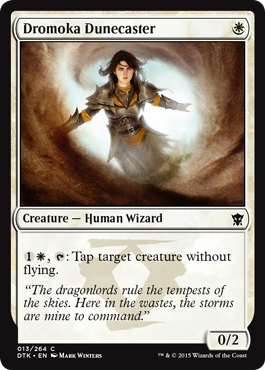
1. In the past, White tappers such as Blinding Mage have traditionally been very good. As of late, Wizards has been making these more conditional, restricting the target by size or other characteristics, such as only non-flying creatures without flying, which is a fairly big restriction. Worse, having to pay two mana is surprisingly significant, choking the mana you have available each turn. But I think the biggest reason this isn't seeing much play is simply than the traditional White Weenie has been overshadowed by Boros Heroic, which plays a lot more combat tricks and protection rather than removal.
2. Both Mnemonic Wall and Archaeomancer saw quite a bit of play in previous formats, and Monastery Loremaster is arguably stronger than either of those cards. The flexibility of Megamorph shouldn't be overstated, giving you the ability to get it down early, then flip it over later and return a key spell back to your hand. However, with the Graveyard being used as a resource with Delve, it is much rarer to have desirable spells just sitting around waiting to be returned. At this point, it wouldn't surprise me if the presence of Treasure Cruise is sufficient to keep this from ever seeing play.
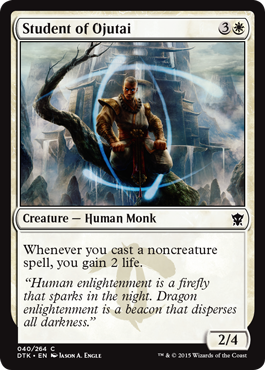
3. Student of Ojutai is probably also being pushed out of the metagame by the dominance of the Heroic decks, which aren't looking to go into the long game with defensive creatures and incidental Lifegain. Additionally, it doesn't quite fit in with a traditional White Weenie deck either, since those decks rarely play much in the way of spells. But a 2/4 for 3W that gives you 2 life whenever you cast a noncreature spell is quite good value for a Common, and once Heroic rotates out of Standard, I wouldn't be surprised if this found its way into a competitive deck.
So that's where things stand with what I recognized as the top cards from Dragons of Tarkir. We still have quite a bit to go before Magic Origins is released, and I wouldn't be surprised to see more innovation prior to that release.
Showing posts with label Dragons of Tarkir. Show all posts
Saturday, May 16, 2015
Thursday, May 14, 2015
Revisting the Top Cards from Dragons of Tarkir
In the final part of my Standard Pauper set review for Dragons of Tarkir, I listed 11 cards that I believed would make the biggest impact in the format. I thought it would be helpful to look back at these cards today and compare my evaluations to how the metagame has turned out thus far. Overall, of these 11 cards, 8 have seen play in decks that have placed in the Top 4 or higher in multiple events, which isn't too shabby. Here's my list:
Of these, four have been all-stars, appearing in virtually every deck that runs those colors: Anticipate, Duress, Epic Confrontation, and Evolving Wilds. Anticipate provides excellent card selection and has been an auto-include in Izzet Control, some versions of Dimir Control, and both Zephyr Scribe Combo and Mono Blue Control. Duress, while typically just in the Sideboard, is an excellent option against Control decks, and is seeing play in both Dimir Control and Mono Black Devotion. Epic Confrontation is one of the best Green removal spells, with every Green deck running 4 copies. And of course, Evolving Wilds is excellent in any deck that runs two or more colors, and is even worth considering in a mono-colored deck.
Less impactful, but still seeing some play, are Pacifism, Twin Bolt, Vulturous Aven, and Zephyr Scribe. These are still fairly solid cards, but they are somewhat niche choices, relying on a deck that synergizes well with them or simply being borderline depending on the metagame.
Next time, I'll look at the remaining three cards and discuss why I don't think they have made as much of an impact as I expected.
Of these, four have been all-stars, appearing in virtually every deck that runs those colors: Anticipate, Duress, Epic Confrontation, and Evolving Wilds. Anticipate provides excellent card selection and has been an auto-include in Izzet Control, some versions of Dimir Control, and both Zephyr Scribe Combo and Mono Blue Control. Duress, while typically just in the Sideboard, is an excellent option against Control decks, and is seeing play in both Dimir Control and Mono Black Devotion. Epic Confrontation is one of the best Green removal spells, with every Green deck running 4 copies. And of course, Evolving Wilds is excellent in any deck that runs two or more colors, and is even worth considering in a mono-colored deck.
Less impactful, but still seeing some play, are Pacifism, Twin Bolt, Vulturous Aven, and Zephyr Scribe. These are still fairly solid cards, but they are somewhat niche choices, relying on a deck that synergizes well with them or simply being borderline depending on the metagame.
Next time, I'll look at the remaining three cards and discuss why I don't think they have made as much of an impact as I expected.
Thursday, April 30, 2015
Monday on MPDC
Monday was fairly eventful (get it, event-full?) for MPDC 29.03, our weekly Standard Pauper Player Run Event. So I thought I would take some time today to talk about what happened.
First of all, after averaging somewhere around 15 players per event, we had 22 players, which is almost enough to get us back to 4 rounds of Swiss plus Top 8. Among them we were fortunate enough to have Jason Moore, who goes by the username BambooRush, join us for the event. In case you don't know, Jason is a regular contributor over at MTGOAcademy on the Pauper format and part of the Pauper's Cage Podcast. In fact, Jason was recording all of his matches, which you can check out here. We were also joined by one totalhate, another well known Pauper player.
Second, based on the surge in attendance, I made the decision that every week in which we have at least 18 players for MPDC, I will give away a single Dragons of Tarkir booster to one random player. All you have to do is play in all of the Swiss rounds, and you'll automatically be entered into the giveaway. Where else can you get value like that?
Finally, I also managed to take 2nd place with a Green "Formidable" deck (based on Gq1rf7's list of the same name) splashing Blue for Anticipate and Treasure Cruise that I called Wintergreen. I am working on an article for PureMTGO covering the deck, but I was also fortunate enough to have the deck mentioned on the latest episode of the MagicGatheringStrat Show, which I encourage you to check out.
Like I said, it was an eventful day for MPDC. Hopefully it's a sign of even better days to come!
First of all, after averaging somewhere around 15 players per event, we had 22 players, which is almost enough to get us back to 4 rounds of Swiss plus Top 8. Among them we were fortunate enough to have Jason Moore, who goes by the username BambooRush, join us for the event. In case you don't know, Jason is a regular contributor over at MTGOAcademy on the Pauper format and part of the Pauper's Cage Podcast. In fact, Jason was recording all of his matches, which you can check out here. We were also joined by one totalhate, another well known Pauper player.
Second, based on the surge in attendance, I made the decision that every week in which we have at least 18 players for MPDC, I will give away a single Dragons of Tarkir booster to one random player. All you have to do is play in all of the Swiss rounds, and you'll automatically be entered into the giveaway. Where else can you get value like that?
Finally, I also managed to take 2nd place with a Green "Formidable" deck (based on Gq1rf7's list of the same name) splashing Blue for Anticipate and Treasure Cruise that I called Wintergreen. I am working on an article for PureMTGO covering the deck, but I was also fortunate enough to have the deck mentioned on the latest episode of the MagicGatheringStrat Show, which I encourage you to check out.
Like I said, it was an eventful day for MPDC. Hopefully it's a sign of even better days to come!
Thursday, April 16, 2015
Answering Combo in Standard Pauper
Last time, I wrote about the new combos in Standard Pauper. It seems like the whole community is buzzing about it. It's on Twitter, showing up in articles, and making appearances in the weekly PREs and practice matches. So you better be prepared to play against it, even if you've jumped on the bandwagon and are playing it yourself. Fortunately, as DrChrisBakerDC put it, the combos are quite fragile.
It's important to remember that the combo actually relies on three different cards to activate, and a fourth card for either combo to actually do anything. This means your opponent will need time to assemble these pieces, and you have multiple avenues of attack. But at its heart, both combos are reliant on untapping a single creature. Which means you can answer the combo by:
1. Taking out the creature. Point your removal of choice at Midnight Guard or Zephyr Scribe, and when it fits the Graveyard, the combo is dead in the water. The Scribe is particularly fragile with only 1 Toughness, but you'll need something a bit more potent to take out the Guard. Unfortunately, there's a wealth of ways to protect creatures - Gods Willing and its variants primarily, but also Glint, which is seeing play right alongside the Zephyr combo. Which means you might want to try...
2. Using counter magic. Counter either creature before it enters the virtual battlefield, or counter whatever spell your opponent uses to protect it. Cancel is probably the best, but Negate and Nullify are also worth considering. Of course, this forces you to hold up mana over multiple turns. Which means the better solution might be...
3. Removing the combo pieces before they're cast. Black has a whole suite of discard effects now, including the newly reprinted Duress, which not only lets you see exactly what your opponent has in hand, but also take out any of the non-creature cards or protection spells. But any of these first three options are better than...
4. Using specific hate cards against the Artifact. Both combos rely upon a mediocre Artifact to combo off, and you could certainly include cards like Naturalize or Shatter to destroy them. The biggest problem with this option, however, is that these cards don't have a lot of good targets in the format right now, and so might be a bit too narrow to include.
So while these two new combinations are both popular and fun, they are most dangerous when people aren't prepared for them. But forewarned is forearmed, as the saying goes. Don't let these combos get you down. Stop them in their tracks!

It's important to remember that the combo actually relies on three different cards to activate, and a fourth card for either combo to actually do anything. This means your opponent will need time to assemble these pieces, and you have multiple avenues of attack. But at its heart, both combos are reliant on untapping a single creature. Which means you can answer the combo by:
1. Taking out the creature. Point your removal of choice at Midnight Guard or Zephyr Scribe, and when it fits the Graveyard, the combo is dead in the water. The Scribe is particularly fragile with only 1 Toughness, but you'll need something a bit more potent to take out the Guard. Unfortunately, there's a wealth of ways to protect creatures - Gods Willing and its variants primarily, but also Glint, which is seeing play right alongside the Zephyr combo. Which means you might want to try...
2. Using counter magic. Counter either creature before it enters the virtual battlefield, or counter whatever spell your opponent uses to protect it. Cancel is probably the best, but Negate and Nullify are also worth considering. Of course, this forces you to hold up mana over multiple turns. Which means the better solution might be...
3. Removing the combo pieces before they're cast. Black has a whole suite of discard effects now, including the newly reprinted Duress, which not only lets you see exactly what your opponent has in hand, but also take out any of the non-creature cards or protection spells. But any of these first three options are better than...
4. Using specific hate cards against the Artifact. Both combos rely upon a mediocre Artifact to combo off, and you could certainly include cards like Naturalize or Shatter to destroy them. The biggest problem with this option, however, is that these cards don't have a lot of good targets in the format right now, and so might be a bit too narrow to include.
So while these two new combinations are both popular and fun, they are most dangerous when people aren't prepared for them. But forewarned is forearmed, as the saying goes. Don't let these combos get you down. Stop them in their tracks!
Tuesday, April 14, 2015
Combo in Standard Pauper
Suddenly I don't recognize Standard Pauper at all.
Well, that's not entirely true. But despite all the careful attention I paid to the new cards from Dragons of Tarkir, I failed to recognize that the addition of just three cards into the format unleashed not one but two potentially viable "infinite" combos onto the metagame. It wasn't until I saw this post by rremedio1 that I understood what I had overlooked.
Both combos are remarkably similar, relying upon a zero cost spell plus a creature than untaps when a certain requirement is met:


For this first combo, you cast the Helix on the Zephyr Scribe, then use the newly granted ability to bounce the Net back into your hand. Then, you cast the Spidersilk Net again for free. Since this is a noncreature spell, it activates the untap secondary ability on the Scribe, untapping it. You can then repeat this indefinitely (assuming your opponent doesn't interact to stop you).
To take advantage of this interaction, all you need is something that generates an effect as often as a noncreature spell is cast. Any Prowess creature will do the trick, but Elusive Spellfist is particularly effective, since it cannot be blocked. You simply repeat the combo until the creature has enough Power to deal lethal damage and then attack with it.


The second combo also utilizes Retraction Helix, but relies upon a different creature with an untap ability. Midnight Guard untaps whenever another creature enters the battlefield. So you use the Helix to bounce the Ornithopter, then replay it for free. Since this is a creature, it triggers the untap ability of the Midnight Guard, untapping it to allow you to again repeat this as many times as you want.
To take advantage of this interaction, you need something that generates an effect whenever a creature enters the battlefield. In this case, Impact Tremors fits the bill, since it deals one damage whenever a creature enters the battlefield under your control. Repeat the combo as many times as it takes to deal lethal damage to your opponent.
Next time, I'll talk more about these two combinations and what you can do to combat them.
Well, that's not entirely true. But despite all the careful attention I paid to the new cards from Dragons of Tarkir, I failed to recognize that the addition of just three cards into the format unleashed not one but two potentially viable "infinite" combos onto the metagame. It wasn't until I saw this post by rremedio1 that I understood what I had overlooked.
Both combos are remarkably similar, relying upon a zero cost spell plus a creature than untaps when a certain requirement is met:
For this first combo, you cast the Helix on the Zephyr Scribe, then use the newly granted ability to bounce the Net back into your hand. Then, you cast the Spidersilk Net again for free. Since this is a noncreature spell, it activates the untap secondary ability on the Scribe, untapping it. You can then repeat this indefinitely (assuming your opponent doesn't interact to stop you).
To take advantage of this interaction, all you need is something that generates an effect as often as a noncreature spell is cast. Any Prowess creature will do the trick, but Elusive Spellfist is particularly effective, since it cannot be blocked. You simply repeat the combo until the creature has enough Power to deal lethal damage and then attack with it.
The second combo also utilizes Retraction Helix, but relies upon a different creature with an untap ability. Midnight Guard untaps whenever another creature enters the battlefield. So you use the Helix to bounce the Ornithopter, then replay it for free. Since this is a creature, it triggers the untap ability of the Midnight Guard, untapping it to allow you to again repeat this as many times as you want.
To take advantage of this interaction, you need something that generates an effect whenever a creature enters the battlefield. In this case, Impact Tremors fits the bill, since it deals one damage whenever a creature enters the battlefield under your control. Repeat the combo as many times as it takes to deal lethal damage to your opponent.
Next time, I'll talk more about these two combinations and what you can do to combat them.
Saturday, April 11, 2015
UB Exploit
During the spoiler season for Dragons of Tarkir, I wrote several posts regarding the new mechanic Exploit for the set. Now, with all the cards at my disposal on Magic Online, a Blue/Black Exploit deck is definitely the first build I want to experiment with. UB Control was already a pretty strong deck in the metagame, although it relied more on the synergy built around Black Devotion, and particularly Gray Merchant of Asphodel, to power out its wins. With the Exploit Commons fairly evenly split between Black and Blue, it turns out that utilizing that same synergy will be much more difficult.
Here's the current build that I am testing:
Essentially I am running cheap creatures to sacrifice with Exploit, including the excellent Pharika's Chosen for early defense, and both Palace Familiar and Jeskai Sage, which draw you a card when they die. Additionally, between Exploit in general and Gurmag Drowner in particular, you should be quickly filling up your Graveyard, creating easy fuel for Treasure Cruise and Sultai Scavenger. This also allows the deck to quickly draw through its cards, especially utilizing Anticipate and the excellent Vulturous Aven. This build is definitely light on removal, with only three Whisk Away in the main deck, supplemented with two copies of Silumgar Butcher. Finally, I added a few "silver-bullets" with Benthic Giant, Eternal Thirst, Font of Return, and Servant of Tyramet.
I have a few questions I'm still trying to answer:
Here's the current build that I am testing:
UB Exploit
by gwyned
| Creatures 4 Palace Familiar 4 Pharika's Chosen 4 Vulturous Aven 3 Jeskai Sage 3 Sultai Scavenger 2 Gurmag Drowner 2 Silumgar Butcher 1 Benthic Giant 1 Servant of Tymaret 24 cards Other Spells 4 Anticipate 4 Treasure Cruise 3 Whisk Away 1 Eternal Thirst 1 Font of Return 13 cards |
Lands 4 Dismal Backwater 4 Evolving Wilds 7 Swamp 8 Island 23 cards
Sideboard
3 Duress 3 Festergloom 3 Pharika's Cure 2 Negate 2 Returned Phalanx 1 Benthic Giant 1 Flesh to Dust 15 cards |
Essentially I am running cheap creatures to sacrifice with Exploit, including the excellent Pharika's Chosen for early defense, and both Palace Familiar and Jeskai Sage, which draw you a card when they die. Additionally, between Exploit in general and Gurmag Drowner in particular, you should be quickly filling up your Graveyard, creating easy fuel for Treasure Cruise and Sultai Scavenger. This also allows the deck to quickly draw through its cards, especially utilizing Anticipate and the excellent Vulturous Aven. This build is definitely light on removal, with only three Whisk Away in the main deck, supplemented with two copies of Silumgar Butcher. Finally, I added a few "silver-bullets" with Benthic Giant, Eternal Thirst, Font of Return, and Servant of Tyramet.
I have a few questions I'm still trying to answer:
- Is this the right mix of Exploit creatures to play?
- Is it a mistake to not run enough Black creatures to make Gray Merchant viable?
- Can the deck get away with so little removal?
Saturday, April 4, 2015
Tokens with Dragons of Tarkir
As I'm finishing off Part 3 of my Standard Pauper review of Dragons of Tarkir, two cards have really stood out to me as really pushing you to play a dedicated Tokens build. With Dragons of Tarkir, we have 13 cards that generate tokens, primarily focused in both Red and White. Generally speaking, for a Tokens build, you want cheap spells that generate multiple creatures, of which five really stand out: Dragon Fodder, Mardu Hordechief, Raise the Alarm, Sandsteppe Outcast, and Triplicate Spirits. That's a pretty decent set of cards. So what's our incentive?
1. Foul-Tongue Shriek looks like a really strong card. It's cheap, Instant speed, and even with only 3 creatures, you're getting a six point life swing, which certainly is significant in almost any game state. But the real problem with this card is that it has no actual effect on the board itself, and does absolutely nothing unless you have creatures with good attacks in the first place. This obviously seems perfect for such a tokens strategy, but requires you to splash for Black in order to cast it. In the right scenario, this card could be amazing. But what about the rest of the time? Does this give you a good enough payoff to be worth playing?
2. Impact Tremors is the other card clearly designed to synergize with token strategies. If you take Lightning Strike as a baseline, it takes a minimum of three activations to at least get an equivalent amount of damage. Worse though, the damage can only be used on your opponent, not on opposing creatures. There certainly seem to be enough token generators to get some value out of this, but it remains to be seen whether its enough to really make this worthwhile. There's a ton of value to be had in the right deck in the right circumstances; but again, is the average payoff good enough to be worth playing even in a dedicated token strategy?
To be honest, I have my doubts. What do you think?
1. Foul-Tongue Shriek looks like a really strong card. It's cheap, Instant speed, and even with only 3 creatures, you're getting a six point life swing, which certainly is significant in almost any game state. But the real problem with this card is that it has no actual effect on the board itself, and does absolutely nothing unless you have creatures with good attacks in the first place. This obviously seems perfect for such a tokens strategy, but requires you to splash for Black in order to cast it. In the right scenario, this card could be amazing. But what about the rest of the time? Does this give you a good enough payoff to be worth playing?
2. Impact Tremors is the other card clearly designed to synergize with token strategies. If you take Lightning Strike as a baseline, it takes a minimum of three activations to at least get an equivalent amount of damage. Worse though, the damage can only be used on your opponent, not on opposing creatures. There certainly seem to be enough token generators to get some value out of this, but it remains to be seen whether its enough to really make this worthwhile. There's a ton of value to be had in the right deck in the right circumstances; but again, is the average payoff good enough to be worth playing even in a dedicated token strategy?
To be honest, I have my doubts. What do you think?
Saturday, March 21, 2015
More Exploits in Dragons of Tarkir
As I continue the process of working through the entire collection of Dragons of Tarkir Commons, I have been writing all week about what impact these new cards will have on the format. As I mentioned last time, by far my favorite new mechanic in this set is Exploit. While I don't think all five of these Commons will see widespread play in the format, I don't think it's premature to state that this mechanic will probably make the biggest impact as a whole.
Let's take a look at two more of them:
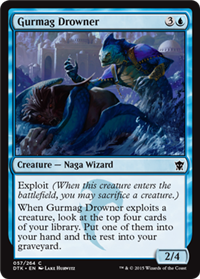
Gurmog Drowner harkens back to one of my favorite cards, Forbidden Alchemy. While it costs an extra mana, and is Sorcery speed as well, this is still a powerful effect, especially given the extra synergy you get from placing the other cards in your Graveyard with Delve. A 2/4 for 3U is decent, but not that exciting; such cards typically only see play with a relevant ability. In a dedicated Delve deck, this probably slots right in, giving you the spell ability most of the time, but also a 2/4 when you need it. Or, if you have tokens or other abilities that trigger on death, this is also well worth considering.
At 4, Silumgar Butcher is both a 3/3 creature and dealing -3/-3 is overcosted by one mana, so you're definitely paying extra for the flexibility here. Lash of the Whip has not seen much play in Standard Pauper, since if you're paying that much for removal you want less conditional removal like Flesh to Dust, even if it is a bit more expensive. However, if Black can find enough creatures with relevant 'enters the graveyard' abilities, it shouldn't be too difficult to get both sides of this card. And in that scenario, this card is quite strong. As such, this should see play in decks with these type of effects.
Given how strong the Dimir Control deck already was, these Exploit cards may be enough to push that deck to dominate the metagame going forward. We shall see.
In other news, the Standard Pauper Sealed League came to an end this week, with _ShipIt_ taking home the trophy with his Boros build. Congrats to him, and thanks to everyone who participated! I've had several people ask if I plan on running it again, and I would love to do it again in the future.
Let's take a look at two more of them:
Gurmog Drowner harkens back to one of my favorite cards, Forbidden Alchemy. While it costs an extra mana, and is Sorcery speed as well, this is still a powerful effect, especially given the extra synergy you get from placing the other cards in your Graveyard with Delve. A 2/4 for 3U is decent, but not that exciting; such cards typically only see play with a relevant ability. In a dedicated Delve deck, this probably slots right in, giving you the spell ability most of the time, but also a 2/4 when you need it. Or, if you have tokens or other abilities that trigger on death, this is also well worth considering.
At 4, Silumgar Butcher is both a 3/3 creature and dealing -3/-3 is overcosted by one mana, so you're definitely paying extra for the flexibility here. Lash of the Whip has not seen much play in Standard Pauper, since if you're paying that much for removal you want less conditional removal like Flesh to Dust, even if it is a bit more expensive. However, if Black can find enough creatures with relevant 'enters the graveyard' abilities, it shouldn't be too difficult to get both sides of this card. And in that scenario, this card is quite strong. As such, this should see play in decks with these type of effects.
Given how strong the Dimir Control deck already was, these Exploit cards may be enough to push that deck to dominate the metagame going forward. We shall see.
In other news, the Standard Pauper Sealed League came to an end this week, with _ShipIt_ taking home the trophy with his Boros build. Congrats to him, and thanks to everyone who participated! I've had several people ask if I plan on running it again, and I would love to do it again in the future.
Thursday, March 19, 2015
Exploit in Dragons of Tarkir
Of all the mechanics in Dragons of Tarkir, Exploit is probably my favorite. This mechanic essentially ask you to make a choice between getting either
get a vanilla creature or a Sorcery speed spell effect. The flexibility of this choice
is quite valuable. And even better, if you have a creature with an
ability that triggers on dying, or just one that has been rendered
irrelevant, you can sacrifice it instead and get both halves of the
Exploit card.
Allow me to illustrate the design simplicity with one of the new Commons:
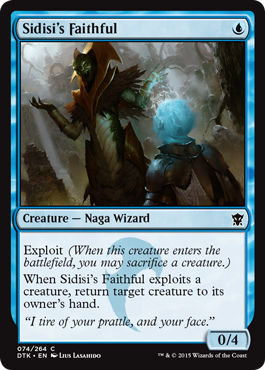
Sidisi's Faithful is the perfect example of the flexibility of Exploit. Against an aggressive archetype, the ability to drop an 0/4 on the first turn provides some great early defense. Or, later in the game, it instead can be used as a Sorcery speed Unsummon, perhaps getting your opponent's best creature out of play. While you can't use it to dodge most forms of removal, it does allow you to get rid of pesky Auras or get a blocker out of the way. While neither the creature nor the ability are amazing, at worst this is a great Sideboard option against aggressive decks. In that spot, it might even be better than Voyage's End against hyper-aggressive decks.
With Sidisi's Faithful, most of the time you're quite happy getting either effect without needing to sacrifice another creature. But sometimes, you really want the ability to get both the creature and the spell. Let's take a look at my favorite of these Exploit creatures:
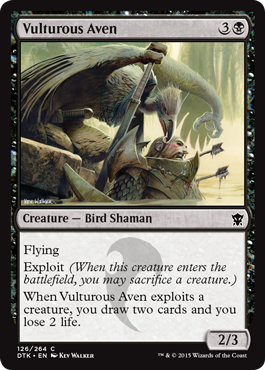
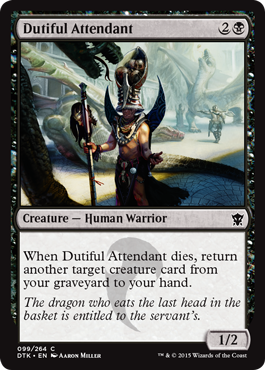
Both halves of Vulturous Aven are quite good, giving you either a 2/3 Flyer in Black or a Sign in Blood effect, although you're paying a considerable premium on the spell-effect. Black rarely sees high Toughness in Flying creatures, so even without the Exploit ability, this card is already borderline playable. As such, you will almost never want to Exploit itself to trigger the Sign in Blood ability. But in combination with cheap creatures like Typhoid Rats or enters the graveyard effects like Black Cat (or the newly released Dutiful Attendant), you have the potential to get some phenomenal value out of this card. If you're playing Black, you should probably be playing this card.
I am definitely excited to get my hands on these cards in the near future. What do you think of Exploit?
Allow me to illustrate the design simplicity with one of the new Commons:
Sidisi's Faithful is the perfect example of the flexibility of Exploit. Against an aggressive archetype, the ability to drop an 0/4 on the first turn provides some great early defense. Or, later in the game, it instead can be used as a Sorcery speed Unsummon, perhaps getting your opponent's best creature out of play. While you can't use it to dodge most forms of removal, it does allow you to get rid of pesky Auras or get a blocker out of the way. While neither the creature nor the ability are amazing, at worst this is a great Sideboard option against aggressive decks. In that spot, it might even be better than Voyage's End against hyper-aggressive decks.
With Sidisi's Faithful, most of the time you're quite happy getting either effect without needing to sacrifice another creature. But sometimes, you really want the ability to get both the creature and the spell. Let's take a look at my favorite of these Exploit creatures:
Both halves of Vulturous Aven are quite good, giving you either a 2/3 Flyer in Black or a Sign in Blood effect, although you're paying a considerable premium on the spell-effect. Black rarely sees high Toughness in Flying creatures, so even without the Exploit ability, this card is already borderline playable. As such, you will almost never want to Exploit itself to trigger the Sign in Blood ability. But in combination with cheap creatures like Typhoid Rats or enters the graveyard effects like Black Cat (or the newly released Dutiful Attendant), you have the potential to get some phenomenal value out of this card. If you're playing Black, you should probably be playing this card.
I am definitely excited to get my hands on these cards in the near future. What do you think of Exploit?
Tuesday, March 17, 2015
Playing White in Dragons of Tarkir, Part Two
Last time, I quickly reviewed why White is so often the best color in Standard Pauper. Quite simply, White is fast, efficient, has access to removal, and has good options against a variety of decks. Then I took a look at two of the stronger White Commons from Dragons of Tarkir. Today I want to take a look at three others that have caught my attention, beginning with the return of a favored staple.
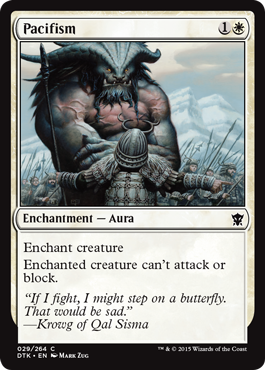
After a long absence, Pacifism has returned to Standard Pauper. This is premium removal, being cheap, effective against any creature, and nearly unconditional (save, of course, that it is vulnerable to Enchantment-hate). Pacifism harkens back to the day when removal at Common was cheap and plentiful. With those days now behind us, Pacifism is all the more valuable. Even better, with Heliod's Pilgrim still in the format, you'll even be able to search it up. I expect that you will see this card in every deck that's playing White once Dragons of Tarkir is released.
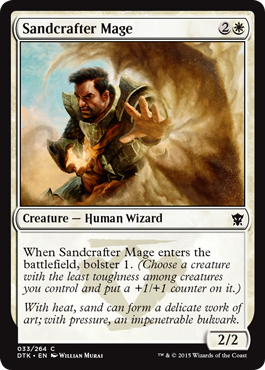
Sandcrafter Mage is easily the best of the Bolster cards at Common. Paying 2W for a 2/2 isn't unreasonable, and most of the time you play this it will be the recipient of the counter, giving you a 3/3 creature for 3 mana, something you typically only see in Green. It's also cheap enough that you can instead bolster one of your early flyers or Heroic creatures, giving you a significant edge going forward. This is certainly worth testing out in most of the White Weenie builds, and might even find a spot in the Boros or Azorius Heroic decks that are so popular right now.
It is rare to find creatures with static abilities at Common anymore; rarer still do you find them attached to a creature with a reasonable body and casting cost. Student of Ojutai embodies both of these as a 2/4 for 3W that has the potential to gain you quite a bit of life in the right build. Several Heroic and Control decks are running a high number of cantrips or cheap spells right now, and this card is perfect for just such a deck, giving you a considerable Life boost while also presenting a relevant blocker. While it won't see play in every White deck, it should still make a big impact.
I hope to have Part One of my set review out soon, with the other two installments to come quickly afterwards. With over a hundred cards to analyze, it's a big task! Don't forget you can keep up with all my work over on Twitter. Just search for the username gwyned42 and click Follow. Thanks for reading.
After a long absence, Pacifism has returned to Standard Pauper. This is premium removal, being cheap, effective against any creature, and nearly unconditional (save, of course, that it is vulnerable to Enchantment-hate). Pacifism harkens back to the day when removal at Common was cheap and plentiful. With those days now behind us, Pacifism is all the more valuable. Even better, with Heliod's Pilgrim still in the format, you'll even be able to search it up. I expect that you will see this card in every deck that's playing White once Dragons of Tarkir is released.
Sandcrafter Mage is easily the best of the Bolster cards at Common. Paying 2W for a 2/2 isn't unreasonable, and most of the time you play this it will be the recipient of the counter, giving you a 3/3 creature for 3 mana, something you typically only see in Green. It's also cheap enough that you can instead bolster one of your early flyers or Heroic creatures, giving you a significant edge going forward. This is certainly worth testing out in most of the White Weenie builds, and might even find a spot in the Boros or Azorius Heroic decks that are so popular right now.
It is rare to find creatures with static abilities at Common anymore; rarer still do you find them attached to a creature with a reasonable body and casting cost. Student of Ojutai embodies both of these as a 2/4 for 3W that has the potential to gain you quite a bit of life in the right build. Several Heroic and Control decks are running a high number of cantrips or cheap spells right now, and this card is perfect for just such a deck, giving you a considerable Life boost while also presenting a relevant blocker. While it won't see play in every White deck, it should still make a big impact.
I hope to have Part One of my set review out soon, with the other two installments to come quickly afterwards. With over a hundred cards to analyze, it's a big task! Don't forget you can keep up with all my work over on Twitter. Just search for the username gwyned42 and click Follow. Thanks for reading.
Saturday, March 14, 2015
Playing White in Dragons of Tarkir, Part One
Have I mentioned that White is generally the best color to play in Standard Pauper? With the full spoiler out now for Dragons of Tarkir, it's easy to see that this set will be no exception. Indeed, within only a few hours of the spoiler being released, at least one player was already complaining about one new White Common.
White has the following advantages when it comes to the format:
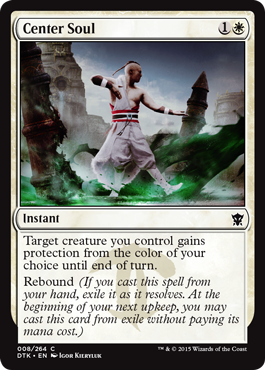
Center Soul is our White protection variant for the set, and with Heroic still in the format, it's particularly powerful. While the Scry on Gods Willing, along with the cheaper cost, might still give it the edge, getting to protect two of your creatures for the cost of 1W at Instant speed is quite strong. Granted, the second casting won't be as good as the first, since it's not like it will be dodging removal or the like. But most of the time it will at least make that creature virtually unblockable, which is still great value. The dream, of course, is getting to enable Heroic with both castings, getting two activations for the price of one.
And after a long absence, White once again gets a solid tapper at Common in Dromoka Dunecaster. While not quite as good as the reliable Blinding Mage, the ability to tap down your opponent's best non-flying creature each turn is quite strong. Having to pay 2 mana instead of just one is a significant increase, so using this early will be a sizable hit to your tempo. Worse still, being unable to target flyers does mean that sometimes you won't be able to interact with your opponent's best creature. But even with all of those limitations, tappers are still quite strong, and thus this is a card I suspect will see quite a bit of play.
Next time, I'll take a look at three more White Commons from Dragons of Tarkir that look particularly promising. I'm also hard at work at Part One of my set review, which I hope to have out early next week.
White has the following advantages when it comes to the format:
- White is fast and efficient. White gets access to cheap creatures, typically with good abilities, typically including the key mechanics of the set. Combined with the right spells, it can win very fast, or simply create enough tempo that an opponent can't keep up.
- White has lots of options. There's very little that White can't do. It has good creatures, evasion, removal, enchantment destruction, combat tricks, creature protection, lifegain, and even some graveyard recursion. About the only thing it can't do is counter spells, destroy artifacts, or deal direct damage.
- White has game against almost any archetype. There are very few ways to win in Standard Pauper that White doesn't have some answer to, even if that answer is simply being faster than an opponent.
Center Soul is our White protection variant for the set, and with Heroic still in the format, it's particularly powerful. While the Scry on Gods Willing, along with the cheaper cost, might still give it the edge, getting to protect two of your creatures for the cost of 1W at Instant speed is quite strong. Granted, the second casting won't be as good as the first, since it's not like it will be dodging removal or the like. But most of the time it will at least make that creature virtually unblockable, which is still great value. The dream, of course, is getting to enable Heroic with both castings, getting two activations for the price of one.
And after a long absence, White once again gets a solid tapper at Common in Dromoka Dunecaster. While not quite as good as the reliable Blinding Mage, the ability to tap down your opponent's best non-flying creature each turn is quite strong. Having to pay 2 mana instead of just one is a significant increase, so using this early will be a sizable hit to your tempo. Worse still, being unable to target flyers does mean that sometimes you won't be able to interact with your opponent's best creature. But even with all of those limitations, tappers are still quite strong, and thus this is a card I suspect will see quite a bit of play.
Next time, I'll take a look at three more White Commons from Dragons of Tarkir that look particularly promising. I'm also hard at work at Part One of my set review, which I hope to have out early next week.
Thursday, March 5, 2015
Rebound Rebounds Into Dragons of Tarkir
One of my favorite mechanics from Rise of the Eldrazi is one of the returning mechanics for Dragons of Tarkir: Rebound. Essentially, Rebound copies a spell, giving you it once when you cast it for its mana cost and again at the beginning of your upkeep for no cost.There were only two cards that utilized that mechanic at Common, and they were both excellent: Staggershock and Distortion Strike. Staggershock was typically a two-for-one given the fact that most Common creatures have two or less Toughness. And Distortion Strike fueled several back-breaking combos, including dealing unblockable Poison damage to your opponent two rounds in a row.
Here's the text from the Comprehensive Rules on Rebound, for those of you who go for such things:
So far, only one Common with Rebound has been spoiled for Dragons of Tarkir:
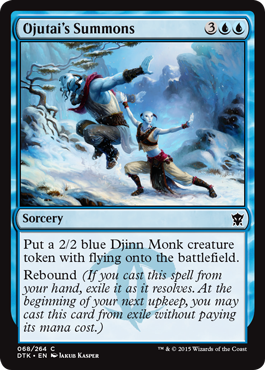
Ojutai's Summons immediately brings to mind Rise of Eagles, which for one mana extra creates both tokens right away and gives you Scry 1 in addition. Since it's a Sorcery and not an Instant, your opponent will in fact get a whole turn before you receive the second 2/2 flying token. That said, being able to cast it a whole turn earlier is a noticeable upgrade, since even in a dedicated Control archetype there can be a big gap between having access to 5 and 6 mana. Right now both Izzet and MonoU Control lists are running Rise of Eagles, and since the latter lacks access to the similar Flurry of Horns, Ojutai's Summons would probably slot into that deck pretty well.
Given the potential for on-board two-for-ones from Rebound, I am not optimistic that we will see more than a couple of these at Common, and possibly only one. Or maybe we'll get lucky and Staggershock will get reprinted at Common. Time will tell.
Here's the text from the Comprehensive Rules on Rebound, for those of you who go for such things:
So far, only one Common with Rebound has been spoiled for Dragons of Tarkir:
Ojutai's Summons immediately brings to mind Rise of Eagles, which for one mana extra creates both tokens right away and gives you Scry 1 in addition. Since it's a Sorcery and not an Instant, your opponent will in fact get a whole turn before you receive the second 2/2 flying token. That said, being able to cast it a whole turn earlier is a noticeable upgrade, since even in a dedicated Control archetype there can be a big gap between having access to 5 and 6 mana. Right now both Izzet and MonoU Control lists are running Rise of Eagles, and since the latter lacks access to the similar Flurry of Horns, Ojutai's Summons would probably slot into that deck pretty well.
Given the potential for on-board two-for-ones from Rebound, I am not optimistic that we will see more than a couple of these at Common, and possibly only one. Or maybe we'll get lucky and Staggershock will get reprinted at Common. Time will tell.
Subscribe to:
Posts (Atom)