When it comes to my favorite hobbies, there is always more to learn. Fortunately for all of us, there have never been more resources available for free online to help anyone do just that. Pretty much whatever you're interested in, there is someone online who is much better than you at it, and has invested time and resources to help others improve.
Right now, I have been mostly focused on writing and playing Hearthstone, although of course Standard Pauper remains high on my list as well. So today, I wanted to share with you three resources that I have been enjoying as of late that relate to these three areas:
1. First off, I've been watching a lot of Limited play on Twitch by a guy named Noah Sandler. He's a highly rated Limited player (hovering around the 2000 mark typically) who provides excellent commentary on both the draft and match portion of his games. He also has excellent taste in music. You can check out his Twitch account here, and follow him on Twitter to find out when he's streaming next.
2. Speaking of Twitch, I've also been playing a lot of Hearthstone as of late. And by far the most well known streamer for Hearthstone is a guy by the name of Jeffry Shih, otherwise known as TrumpSC. He streams almost every day, and has a backlog of content on both YouTube and Twitch covering both Constructed and Arena play for every character class. He also does an excellent job providing commentary on his gameplay. If you want to improve in Hearthstone, TrumpSC may be your number one best resource. Be sure to check out the links above, and follow him on Twitter.
3. Finally, while I confess I have not yet read any of her books (although I am quite intrigued with the mashup of vampires, circuses, and steampunk), author Deliah S. Dawson provides some excellent tips via Twitter when it comes to writing and publication in the fantasy genre. Her advice comes not in the form of long articles, but rather a burst of Tweets with short, concise, and well-written advice on a particular topic. Intrigued? You can follow her on Twitter, check out her webpage for more information, or just scope out her blog and see what catches your fancy.
If you've got resources that you have found helpful in any of these three areas, I'd love to hear about them. Let me know in the comments below. See you next time
Tuesday, June 17, 2014
Saturday, June 14, 2014
Cards for the Journey, Part Two
We've started a new season of Monday Pauper Deck Challenge,
and as always it's interesting to see which cards from the latest set
are making the biggest impact on the format. At the end of my set review for Journey Into Nyx,
I highlighted ten cards that I thought would have the most impact on
the format. So I decided to examine how my
predictions have lined up in the metagame thus far. Last time, I looked at the third and fourth most commonly played Commons from Journey. Today, I will finish with the other two.
As a reminder, my data is based on a quick survey of the 16 decks that have placed in the Top 8 of MPDC since Journey Into Nyx was released. I tabulated the results, and picked out the four cards that have had the most copies played. Here are the other two:
The second most commonly played Common from Journey Into Nyx, coming in at fifteen copies, is Feast of Dreams. While it's no Doom Blade, in a metagame dominated by enchantments and enchantment creatures, Feast of Dreams proves to be quite good. Many of the current contenders use creatures Auras to one extent or another, and Bestow creatures are also quite popular. While there certainly is the possibility that this will be a dead card in your hand from time to time, at least right now, this seems like an excellent inclusion, particularly as a Sideboard card.
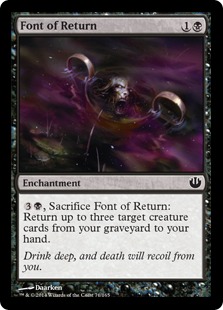
The most commonly played Common from Journey Into Nyx, coming in at sixteen copies, is Font of Return. This is the first time a Common has allowed you to return up to three target creatures from the graveyard (although much older sets did have some X spells that allowed you to return X creatures). As such, this will almost always be a three-for-one. While it doesn't have any immediate effect on the board, and is vulnerable to removal unless you leave up the mana every turn, the potential value of this card is indisputable. It's no Gravedigger, but it's as good of recursion as we are likely to see in the future.
So how did I do on my set review? Sadly, I failed to mention either of these cards in my top ten cards from Journey Into Nyx, although I did at least rate Font of Return as playable. But my assessment of Feast of Dreams was obviously incorrect. In the current metagame, it's playable even in the main.
Let me close with a shout-out to DrChrisBakerDC and RRR726, who both correctly guessed the top two cards. Thanks for reading, and see you next time.
As a reminder, my data is based on a quick survey of the 16 decks that have placed in the Top 8 of MPDC since Journey Into Nyx was released. I tabulated the results, and picked out the four cards that have had the most copies played. Here are the other two:
The second most commonly played Common from Journey Into Nyx, coming in at fifteen copies, is Feast of Dreams. While it's no Doom Blade, in a metagame dominated by enchantments and enchantment creatures, Feast of Dreams proves to be quite good. Many of the current contenders use creatures Auras to one extent or another, and Bestow creatures are also quite popular. While there certainly is the possibility that this will be a dead card in your hand from time to time, at least right now, this seems like an excellent inclusion, particularly as a Sideboard card.
The most commonly played Common from Journey Into Nyx, coming in at sixteen copies, is Font of Return. This is the first time a Common has allowed you to return up to three target creatures from the graveyard (although much older sets did have some X spells that allowed you to return X creatures). As such, this will almost always be a three-for-one. While it doesn't have any immediate effect on the board, and is vulnerable to removal unless you leave up the mana every turn, the potential value of this card is indisputable. It's no Gravedigger, but it's as good of recursion as we are likely to see in the future.
So how did I do on my set review? Sadly, I failed to mention either of these cards in my top ten cards from Journey Into Nyx, although I did at least rate Font of Return as playable. But my assessment of Feast of Dreams was obviously incorrect. In the current metagame, it's playable even in the main.
Let me close with a shout-out to DrChrisBakerDC and RRR726, who both correctly guessed the top two cards. Thanks for reading, and see you next time.
Thursday, June 12, 2014
Cards For the Journey, Part One
We've started a new season of Monday Pauper Deck Challenge, and as always it's interesting to see which cards from the latest set are making the biggest impact on the format. At the end of my set review for Journey Into Nyx, I highlighted ten cards that I thought would have the most impact on the format. So for my next two blog posts I want to examine how my predictions have lined up in the metagame thus far.
To do this, I took a quick survey of the 16 decks that have placed in the Top 8 of MPDC since Journey Into Nyx was released, and picked out the four cards that have had the most copies played. And here's what I found:
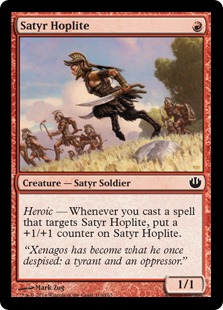
The fourth most commonly played Common from Journey Into Nyx, coming in at eight copies, is Satyr Hoplite. Experience has proven that nearly all of the Heroic creatures that gain +1 / +1 counters are worth playing, and even this unassuming 1/1 for R makes the cut. While it takes a fairly dedicated and aggressive build to want to include this in your decklist, this has the potential to get big in a hurry and get in for a surprising amount of damage before your opponent is able to deal with it. Throw a Madcap Skills or Titan's Strength of this Game 2, and it's quite possible your opponent will never recover.
The third most commonly played Common from Journey Into Nyx, with 11 total copies, is Ajani's Presence. This card is part of a Strive cycle at Common, and is definitely the best of the lot! It's combines the very relevant indestructible ability with a minor combat boost while at the same time allowing for a double Heroic activation! While not quite as versatile as Gods Willing, it has the potential to be much for effective in the right scenario, allowing multiple creatures to survive combat. Like I discussed last time, cards like this are why White tends to be so good in Standard Pauper!
So far so good! Both of these cards were part of my predicted top 10 for Journey Into Nyx. On Saturday, I'll reveal the two most often played Commons thus far from this set. Will my streak continue?
To do this, I took a quick survey of the 16 decks that have placed in the Top 8 of MPDC since Journey Into Nyx was released, and picked out the four cards that have had the most copies played. And here's what I found:
So far so good! Both of these cards were part of my predicted top 10 for Journey Into Nyx. On Saturday, I'll reveal the two most often played Commons thus far from this set. Will my streak continue?
Tuesday, June 10, 2014
If You're Not Playing White, You're Doing It Wrong
Another season, same old story. White continues to be the dominant color in Standard Pauper. In the past I've written at length about why I believe White often positioned so well in the metagame. Essentially, it comes down to versatility. White has great creatures, combat tricks, protection, and removal - what more could you ask for? It may not do all those things as well as other color, but the fact that it has access to all of them makes it almost always the right choice.
Of course, the fact that White is the secondary color of Enchantment removal in an "Enchantments-matter" set, doesn't hurt either.
Which is not to say that White should always be the dominant color in every deck. Merely that, all other things being equal, you probably want access to it. To illustrate my point, here's the winning decklist from yesterday's MPDC 25.02:
Essentially, this deck is a typical Mono Black Control build that splashes White in order to recurse its own Enchantments while dealing with the opponent's. According to RRR726, it is based on this list from DrChrisBakerDC's blog, where he discusses it at some length. This added utility for Enchantments certainly strengthens the Mono Black build, and most of the time will probably prove superior to it.
So are there other popular decks in the format that could use a touch of vanilla to make them that much better? Let me know your thoughts below. See you next time.
Of course, the fact that White is the secondary color of Enchantment removal in an "Enchantments-matter" set, doesn't hurt either.
Which is not to say that White should always be the dominant color in every deck. Merely that, all other things being equal, you probably want access to it. To illustrate my point, here's the winning decklist from yesterday's MPDC 25.02:
Bw Control
1st place by RRR726 in MPDC 25.02
| Creatures 4 Auramancer 4 Basilica Screecher 4 Disciple of Phenax 4 Gray Merchant of Asphodel 2 Keening Apparition 1 Scholar of Athreos 19 cards Other Spells 4 Devour Flesh 4 Quag Sickness 4 Read the Bones 4 Stab Wound 2 Font of Return 18 cards |
Lands 15 Swamp 4 Orzhov Guildgate 4 Plains 23 cards
Sideboard
3 Pharika's Cure 3 Shrivel 2 Revoke Existence 2 Cremate 1 Keening Apparition 1 Crypt Incursion 3 Feast of Dreams 15 cards |
Essentially, this deck is a typical Mono Black Control build that splashes White in order to recurse its own Enchantments while dealing with the opponent's. According to RRR726, it is based on this list from DrChrisBakerDC's blog, where he discusses it at some length. This added utility for Enchantments certainly strengthens the Mono Black build, and most of the time will probably prove superior to it.
So are there other popular decks in the format that could use a touch of vanilla to make them that much better? Let me know your thoughts below. See you next time.
Saturday, June 7, 2014
Asynchronous Drafting in Hearthstone
This will be my last Hearthstone post for a while, I promise!
As someone who has a fair amount of interest in the Limited format from Magic the Gathering, I was intrigued to see just how the Arena worked in Hearthstone. It's pretty similar, at least conceptually. You draft cards from among several choices each pick, then once your deck is complete, you play out matches against opponent's with a similar record.
In practice, there are some pretty big differences between Limited Magic and Hearthstone Arena:
As someone whose biggest obstacle to Limited play is having large blocks of time available, this time flexibility is by far my favorite part. Obviously, with the way that drafting works, this sort of asynchronous play is impossible. But wouldn't it be a great option?
As someone who has a fair amount of interest in the Limited format from Magic the Gathering, I was intrigued to see just how the Arena worked in Hearthstone. It's pretty similar, at least conceptually. You draft cards from among several choices each pick, then once your deck is complete, you play out matches against opponent's with a similar record.
In practice, there are some pretty big differences between Limited Magic and Hearthstone Arena:
- In Hearthstone, there are no packs. Instead, each pick is made from only three possibilities. Further, for each pick you make, the three choices are all of the same rarity.
- In Hearthstone, there is no deckbuilding. You draft exactly 30 cards, and play all of them in your deck. In some ways, this makes drafting a bit more stressful, since it's much harder to make adjustments mid-draft.
- In Hearthstone, you continue to be pairing against an opponent with a similar record until you've accumulated either 12 wins or 3 losses.
- Finally, prizes are determined by the number of wins you accumulate, and you don't get to keep any of the cards you draft.
As someone whose biggest obstacle to Limited play is having large blocks of time available, this time flexibility is by far my favorite part. Obviously, with the way that drafting works, this sort of asynchronous play is impossible. But wouldn't it be a great option?
Thursday, June 5, 2014
Should the Digital Experience of Magic Match the Physical One?
Earlier this week I wrote about my own experiences with Hearthstone and made some suggestions on what Magic Online could learn from Blizzard's approach to that game. I received a surprising amount of response on Twitter, and I am grateful to everyone who favorited and re-tweeted my link. Thanks!
Today I want to discuss my response to one tweet in particular:
Essentially his point was that the experience of playing Magic the Gathering online should, at least ideally, match the experience of playing with physical cards. However, if this concept is applied to the entire experience as a whole, such a rift already exists. Let me offer three quick examples:
However, I will add this caveat, and I believe this is the spirit in which the comment was made. Magic Online can be a great tool for pros and semi-pros to practice, playtest, and perhaps even earn some sweet prizes. Given the level of investment that Wizards has made in professional play, it makes sense that Magic Online should support those who wish to use it towards that end. There should always be the option to play Limited and Constructed in Sanctioned events such that the digital experience is as close as possible to the physical experience. But it also need not be the only option for playing online.
If you've got thoughts on this, I'd love to hear him in the comments below.
Today I want to discuss my response to one tweet in particular:
Essentially his point was that the experience of playing Magic the Gathering online should, at least ideally, match the experience of playing with physical cards. However, if this concept is applied to the entire experience as a whole, such a rift already exists. Let me offer three quick examples:
- At least for the majority of Magic players, playing with physical cards is a social experience. You interact with other people face-to-face, often in ways that are only marginally related to the game itself. The online experience is exactly the opposite. While there may be some limited social interactions, for the most part playing online is purely about the game.
- When playing with physical cards, both players are responsible to have a fundamental understanding of the rules and to enforce them to the best of their ability. This is particularly true with any form of sanctioned play. Playing online, however, the players are freed from having to enforce any of these dynamics, and instead can focus exclusively on their own line of play.
- When dealing with physical cards, the economics of the game are much different. Cards are generally worth more, but it is harder as a seller to get full retail value. Trading cards becomes an effective way at times to get around this problem. Online, cards are generally less expensive, and you have immediate access to buy and sell just about anything in your collection.
However, I will add this caveat, and I believe this is the spirit in which the comment was made. Magic Online can be a great tool for pros and semi-pros to practice, playtest, and perhaps even earn some sweet prizes. Given the level of investment that Wizards has made in professional play, it makes sense that Magic Online should support those who wish to use it towards that end. There should always be the option to play Limited and Constructed in Sanctioned events such that the digital experience is as close as possible to the physical experience. But it also need not be the only option for playing online.
If you've got thoughts on this, I'd love to hear him in the comments below.
Tuesday, June 3, 2014
What Magic Online Can Learn From Hearthstone
As I mentioned last week, I finally decided to download Hearthstone and see what all the fuss was about. While there are still parts of the game that I have not really experienced (in particular, the Arena), at this point I feel like I’ve got a pretty good feel for what it has to offer. Overall, I have been quite impressed, and I certainly plan on continuing to play, at least for the time being.
It is with these experiences in mind that I wanted to offer some things that Hearthstone does well that would be a major improvement for Magic Online.
- Let players sign up for free. Hearthstone offers a ton of free content. Some of it you get access to right away, while the rest must be earned through gameplay. If I had been required to drop even $10 to download the game, I would have been a lot more reluctant to try it out. Considering how much money Wizards is making with Magic Online, establishing an account should be free.
- Create an AI to teach new players the game and/or client. As soon as you log into Hearthstone as a new player, you are dumped into the tutorial against some simple opponents, giving you the chance to learn the client and the cards without putting anything on the line. After you complete the tutorial, at any time you can sleeve up a new deck, or use the pre-created starters, to battle against the AI, which comes in both a normal and expert difficulty. This is, far and away, the best way to teach someone Hearthstone, and the same thing should be present for Magic Online.
- Give new players a progressive set of rewards they can immediately pursue. While Hearthstone allows you to jump right into the action if you want, you have the option of taking the time to unlock every character type, earn all the basic cards by leveling each character up to level 10, and earn more cards by defeating every Expert AI and playing your first real games against a human opponent. You even get your first Arena match without paying anything for it. Magic Online could easily adapt a similar approach: allow players to battle against the iconic Planeswalkers, with each one you beat rewarding you with access to that Vanguard avatar; create a set of challenges that progressively award you all of the Commons from the most recent Core set. These would be so much better than the silly Planeswalker packs they give out that are worthless in any real format.
- Implement a system that automatically matches you against similar opponents. Hearthstone has a Ladder system that always pairs you against opponents of the same rank as you. Magic Online players already have overall ratings based on their performance, so why not create a system whereby you have the ability to only battle players of similar caliber? While this could be a major shift in the way that Constructed and Limited work, it would make a much easier transition for new players into the format of their choice.
Subscribe to:
Posts (Atom)