As I continue the process of working through the entire collection of Dragons of Tarkir Commons, I have been writing all week about what impact these new cards will have on the format. As I mentioned last time, by far my favorite new mechanic in this set is Exploit. While I don't think all five of these Commons will see widespread play in the format, I don't think it's premature to state that this mechanic will probably make the biggest impact as a whole.
Let's take a look at two more of them:
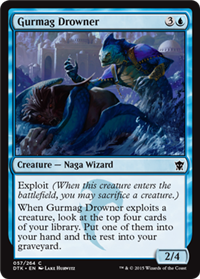
Gurmog Drowner harkens back to one of my favorite cards, Forbidden Alchemy.
While it costs an extra mana, and is Sorcery speed as well, this is
still a powerful effect, especially given the extra synergy you get from
placing the other cards in your Graveyard with Delve. A 2/4 for 3U is
decent, but not that exciting; such cards typically only see play with a relevant
ability. In a dedicated Delve deck, this probably slots right in, giving
you the spell ability most of the time, but also a 2/4 when you need
it. Or, if you have tokens or other abilities that trigger on death,
this is also well worth considering.
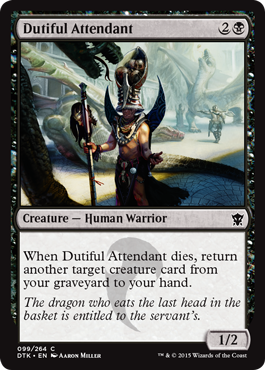
At 4, Silumgar Butcher is both a 3/3 creature and dealing -3/-3 is
overcosted by one mana, so you're definitely paying extra for the
flexibility here. Lash of the Whip has not seen much play in Standard Pauper, since if you're paying that much for removal you want less conditional removal like Flesh to Dust,
even if it is a bit more expensive. However, if Black can find enough
creatures with relevant 'enters the graveyard' abilities, it shouldn't
be too difficult to get both sides of this card. And in that scenario,
this card is quite strong. As such, this should see play in decks with
these type of effects.
Given how strong the Dimir Control deck already was, these Exploit cards may be enough to push that deck to dominate the metagame going forward. We shall see.
In other news, the Standard Pauper Sealed League came to an end this week, with _ShipIt_ taking home the trophy with his Boros build. Congrats to him, and thanks to everyone who participated! I've had several people ask if I plan on running it again, and I would love to do it again in the future.
Saturday, March 21, 2015
Thursday, March 19, 2015
Exploit in Dragons of Tarkir
Of all the mechanics in Dragons of Tarkir, Exploit is probably my favorite. This mechanic essentially ask you to make a choice between getting either
get a vanilla creature or a Sorcery speed spell effect. The flexibility of this choice
is quite valuable. And even better, if you have a creature with an
ability that triggers on dying, or just one that has been rendered
irrelevant, you can sacrifice it instead and get both halves of the
Exploit card.
Allow me to illustrate the design simplicity with one of the new Commons:
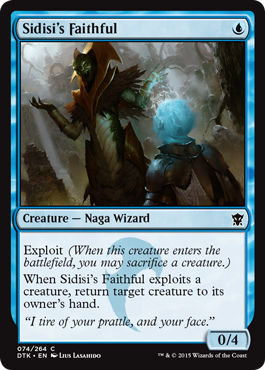
Sidisi's Faithful is the perfect example of the flexibility of Exploit. Against an aggressive archetype, the ability to drop an 0/4 on the first turn provides some great early defense. Or, later in the game, it instead can be used as a Sorcery speed Unsummon, perhaps getting your opponent's best creature out of play. While you can't use it to dodge most forms of removal, it does allow you to get rid of pesky Auras or get a blocker out of the way. While neither the creature nor the ability are amazing, at worst this is a great Sideboard option against aggressive decks. In that spot, it might even be better than Voyage's End against hyper-aggressive decks.
With Sidisi's Faithful, most of the time you're quite happy getting either effect without needing to sacrifice another creature. But sometimes, you really want the ability to get both the creature and the spell. Let's take a look at my favorite of these Exploit creatures:
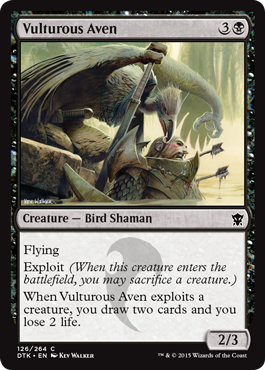
Both halves of Vulturous Aven are quite good, giving you either a 2/3 Flyer in Black or a Sign in Blood effect, although you're paying a considerable premium on the spell-effect. Black rarely sees high Toughness in Flying creatures, so even without the Exploit ability, this card is already borderline playable. As such, you will almost never want to Exploit itself to trigger the Sign in Blood ability. But in combination with cheap creatures like Typhoid Rats or enters the graveyard effects like Black Cat (or the newly released Dutiful Attendant), you have the potential to get some phenomenal value out of this card. If you're playing Black, you should probably be playing this card.
I am definitely excited to get my hands on these cards in the near future. What do you think of Exploit?
Allow me to illustrate the design simplicity with one of the new Commons:
Sidisi's Faithful is the perfect example of the flexibility of Exploit. Against an aggressive archetype, the ability to drop an 0/4 on the first turn provides some great early defense. Or, later in the game, it instead can be used as a Sorcery speed Unsummon, perhaps getting your opponent's best creature out of play. While you can't use it to dodge most forms of removal, it does allow you to get rid of pesky Auras or get a blocker out of the way. While neither the creature nor the ability are amazing, at worst this is a great Sideboard option against aggressive decks. In that spot, it might even be better than Voyage's End against hyper-aggressive decks.
With Sidisi's Faithful, most of the time you're quite happy getting either effect without needing to sacrifice another creature. But sometimes, you really want the ability to get both the creature and the spell. Let's take a look at my favorite of these Exploit creatures:
Both halves of Vulturous Aven are quite good, giving you either a 2/3 Flyer in Black or a Sign in Blood effect, although you're paying a considerable premium on the spell-effect. Black rarely sees high Toughness in Flying creatures, so even without the Exploit ability, this card is already borderline playable. As such, you will almost never want to Exploit itself to trigger the Sign in Blood ability. But in combination with cheap creatures like Typhoid Rats or enters the graveyard effects like Black Cat (or the newly released Dutiful Attendant), you have the potential to get some phenomenal value out of this card. If you're playing Black, you should probably be playing this card.
I am definitely excited to get my hands on these cards in the near future. What do you think of Exploit?
Tuesday, March 17, 2015
Playing White in Dragons of Tarkir, Part Two
Last time, I quickly reviewed why White is so often the best color in Standard Pauper. Quite simply, White is fast, efficient, has access to removal, and has good options against a variety of decks. Then I took a look at two of the stronger White Commons from Dragons of Tarkir. Today I want to take a look at three others that have caught my attention, beginning with the return of a favored staple.
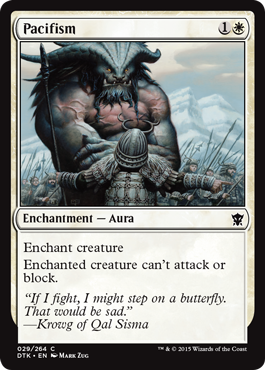
After a long absence, Pacifism has returned to Standard Pauper. This is premium removal, being cheap, effective against any creature, and nearly unconditional (save, of course, that it is vulnerable to Enchantment-hate). Pacifism harkens back to the day when removal at Common was cheap and plentiful. With those days now behind us, Pacifism is all the more valuable. Even better, with Heliod's Pilgrim still in the format, you'll even be able to search it up. I expect that you will see this card in every deck that's playing White once Dragons of Tarkir is released.
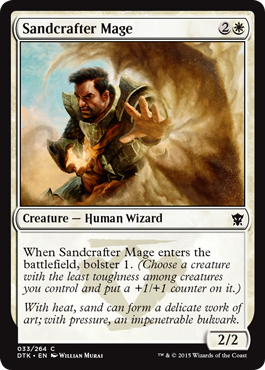
Sandcrafter Mage is easily the best of the Bolster cards at Common. Paying 2W for a 2/2 isn't unreasonable, and most of the time you play this it will be the recipient of the counter, giving you a 3/3 creature for 3 mana, something you typically only see in Green. It's also cheap enough that you can instead bolster one of your early flyers or Heroic creatures, giving you a significant edge going forward. This is certainly worth testing out in most of the White Weenie builds, and might even find a spot in the Boros or Azorius Heroic decks that are so popular right now.
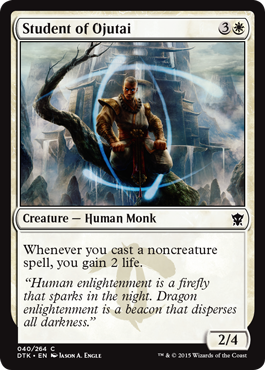
It is rare to find creatures with static abilities at Common anymore; rarer still do you find them attached to a creature with a reasonable body and casting cost. Student of Ojutai embodies both of these as a 2/4 for 3W that has the potential to gain you quite a bit of life in the right build. Several Heroic and Control decks are running a high number of cantrips or cheap spells right now, and this card is perfect for just such a deck, giving you a considerable Life boost while also presenting a relevant blocker. While it won't see play in every White deck, it should still make a big impact.
I hope to have Part One of my set review out soon, with the other two installments to come quickly afterwards. With over a hundred cards to analyze, it's a big task! Don't forget you can keep up with all my work over on Twitter. Just search for the username gwyned42 and click Follow. Thanks for reading.
After a long absence, Pacifism has returned to Standard Pauper. This is premium removal, being cheap, effective against any creature, and nearly unconditional (save, of course, that it is vulnerable to Enchantment-hate). Pacifism harkens back to the day when removal at Common was cheap and plentiful. With those days now behind us, Pacifism is all the more valuable. Even better, with Heliod's Pilgrim still in the format, you'll even be able to search it up. I expect that you will see this card in every deck that's playing White once Dragons of Tarkir is released.
Sandcrafter Mage is easily the best of the Bolster cards at Common. Paying 2W for a 2/2 isn't unreasonable, and most of the time you play this it will be the recipient of the counter, giving you a 3/3 creature for 3 mana, something you typically only see in Green. It's also cheap enough that you can instead bolster one of your early flyers or Heroic creatures, giving you a significant edge going forward. This is certainly worth testing out in most of the White Weenie builds, and might even find a spot in the Boros or Azorius Heroic decks that are so popular right now.
It is rare to find creatures with static abilities at Common anymore; rarer still do you find them attached to a creature with a reasonable body and casting cost. Student of Ojutai embodies both of these as a 2/4 for 3W that has the potential to gain you quite a bit of life in the right build. Several Heroic and Control decks are running a high number of cantrips or cheap spells right now, and this card is perfect for just such a deck, giving you a considerable Life boost while also presenting a relevant blocker. While it won't see play in every White deck, it should still make a big impact.
I hope to have Part One of my set review out soon, with the other two installments to come quickly afterwards. With over a hundred cards to analyze, it's a big task! Don't forget you can keep up with all my work over on Twitter. Just search for the username gwyned42 and click Follow. Thanks for reading.
Saturday, March 14, 2015
Playing White in Dragons of Tarkir, Part One
Have I mentioned that White is generally the best color to play in Standard Pauper? With the full spoiler out now for Dragons of Tarkir, it's easy to see that this set will be no exception. Indeed, within only a few hours of the spoiler being released, at least one player was already complaining about one new White Common.
White has the following advantages when it comes to the format:
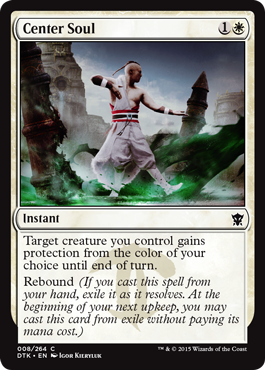
Center Soul is our White protection variant for the set, and with Heroic still in the format, it's particularly powerful. While the Scry on Gods Willing, along with the cheaper cost, might still give it the edge, getting to protect two of your creatures for the cost of 1W at Instant speed is quite strong. Granted, the second casting won't be as good as the first, since it's not like it will be dodging removal or the like. But most of the time it will at least make that creature virtually unblockable, which is still great value. The dream, of course, is getting to enable Heroic with both castings, getting two activations for the price of one.
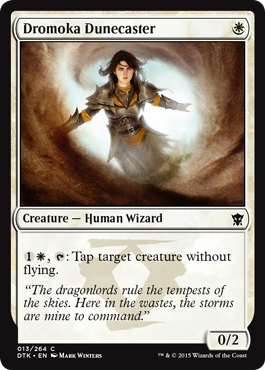
And after a long absence, White once again gets a solid tapper at Common in Dromoka Dunecaster. While not quite as good as the reliable Blinding Mage, the ability to tap down your opponent's best non-flying creature each turn is quite strong. Having to pay 2 mana instead of just one is a significant increase, so using this early will be a sizable hit to your tempo. Worse still, being unable to target flyers does mean that sometimes you won't be able to interact with your opponent's best creature. But even with all of those limitations, tappers are still quite strong, and thus this is a card I suspect will see quite a bit of play.
Next time, I'll take a look at three more White Commons from Dragons of Tarkir that look particularly promising. I'm also hard at work at Part One of my set review, which I hope to have out early next week.
White has the following advantages when it comes to the format:
- White is fast and efficient. White gets access to cheap creatures, typically with good abilities, typically including the key mechanics of the set. Combined with the right spells, it can win very fast, or simply create enough tempo that an opponent can't keep up.
- White has lots of options. There's very little that White can't do. It has good creatures, evasion, removal, enchantment destruction, combat tricks, creature protection, lifegain, and even some graveyard recursion. About the only thing it can't do is counter spells, destroy artifacts, or deal direct damage.
- White has game against almost any archetype. There are very few ways to win in Standard Pauper that White doesn't have some answer to, even if that answer is simply being faster than an opponent.
Center Soul is our White protection variant for the set, and with Heroic still in the format, it's particularly powerful. While the Scry on Gods Willing, along with the cheaper cost, might still give it the edge, getting to protect two of your creatures for the cost of 1W at Instant speed is quite strong. Granted, the second casting won't be as good as the first, since it's not like it will be dodging removal or the like. But most of the time it will at least make that creature virtually unblockable, which is still great value. The dream, of course, is getting to enable Heroic with both castings, getting two activations for the price of one.
And after a long absence, White once again gets a solid tapper at Common in Dromoka Dunecaster. While not quite as good as the reliable Blinding Mage, the ability to tap down your opponent's best non-flying creature each turn is quite strong. Having to pay 2 mana instead of just one is a significant increase, so using this early will be a sizable hit to your tempo. Worse still, being unable to target flyers does mean that sometimes you won't be able to interact with your opponent's best creature. But even with all of those limitations, tappers are still quite strong, and thus this is a card I suspect will see quite a bit of play.
Next time, I'll take a look at three more White Commons from Dragons of Tarkir that look particularly promising. I'm also hard at work at Part One of my set review, which I hope to have out early next week.
Thursday, March 12, 2015
Stress and Madness in Darkest Dungeon
Last time, I shared my thoughts on the Early release build of Darkest Dungeon, described as "a challenging gothic RPG about the stresses of dungeon crawling." As I was researching this game, I came across a fascinating article looking in-depth at how the game portrays mental illness in light of the Lovecraftian horror genre and other games that have come before. You see, in Darkest Dungeon, your heroes face two kinds of danger: physical danger, which results in a loss of health and eventually death, and mental danger, which results in increasing stress, leading to mental illness and possible madness. It is this second danger that the article focus on.
In most video games or RPGs that deal with horror, characters have a generic sanity trait that measures how much mental stress has accumulated based on their experience. Darkest Dungeon instead utilizes stress, which characters suffer from simple exploration, from debilitating monster attacks, falling victim to traps, encountering otherworldly horrors, and even from critical hits inflicted in combat. As this stress builds, eventually the hero reaches the breaking point, and usually immediately suffers some major bout of mental illness. This can lead to the character inflicting damage on herself, refusing healing, skipping their turn, and perhaps worse of all, criticizing or frightening your other heroes, which stresses them out and eventually leads them to the brink of insanity as well.
Thus managing stress becomes your most important task in the game. During quests, making camp and activating certain hero abilities are your primary means of reducing stress. And in between these quests, you gain access to services in town that can reduce a character's stress level, like meditation, binge drinking, prayer, or a night in the brothel. And negative quirks and injuries that remain can be treated in the sanitarium, but only one at a time. Of course, gaining access to any of these services cost money - money that could instead be used to recruit replacement heroes or outfit another venture into the darkness.
It's this mechanic that makes Darkest Dungeon stand out from other similar games, and for this alone it is well worth checking out.
In most video games or RPGs that deal with horror, characters have a generic sanity trait that measures how much mental stress has accumulated based on their experience. Darkest Dungeon instead utilizes stress, which characters suffer from simple exploration, from debilitating monster attacks, falling victim to traps, encountering otherworldly horrors, and even from critical hits inflicted in combat. As this stress builds, eventually the hero reaches the breaking point, and usually immediately suffers some major bout of mental illness. This can lead to the character inflicting damage on herself, refusing healing, skipping their turn, and perhaps worse of all, criticizing or frightening your other heroes, which stresses them out and eventually leads them to the brink of insanity as well.
Thus managing stress becomes your most important task in the game. During quests, making camp and activating certain hero abilities are your primary means of reducing stress. And in between these quests, you gain access to services in town that can reduce a character's stress level, like meditation, binge drinking, prayer, or a night in the brothel. And negative quirks and injuries that remain can be treated in the sanitarium, but only one at a time. Of course, gaining access to any of these services cost money - money that could instead be used to recruit replacement heroes or outfit another venture into the darkness.
It's this mechanic that makes Darkest Dungeon stand out from other similar games, and for this alone it is well worth checking out.
Tuesday, March 10, 2015
Darkest Dungeon (Early Release)
Normally I would not recommend spending money to get early access to a game. I've been burned by doing so more than once. But this time, after some careful research, I made an exception. And I am glad that I did.
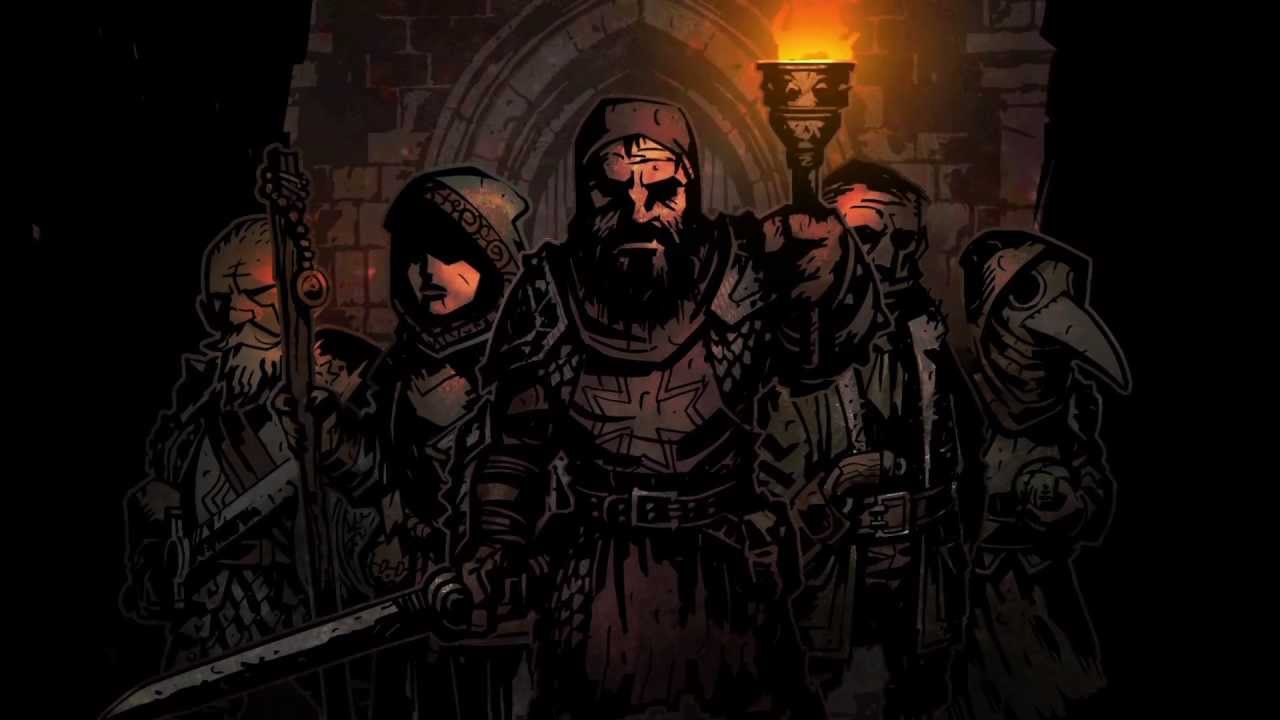
Darkest Dungeon is currently available in Early Release on Steam. In this game, you take on the role of the heir of an ancient estate that has been overrun by unspeakable horror. Your job is to recruit heroes and lead them into the depths to combat the growing evil that has overtaken your ancestral home. As they battle against the darkness, your heroes will face unimaginable horror, psychological stress, plague, famine, and death. Similar to classic games such as Wizardry or XCOM, your heroes, if they survive, will gain in experience and skill, but also may be permanently corrupted by their experiences. Death is also an ever-looming threat, and with the game state saved in real time, death is permanent. To aid you in your task, you can spend your recovered gold and resources to upgrade your manor, giving your heroes access to better equipment and skills as well as providing means to combat the stress and psychological ailments that are an inevitable result of facing the monsters in the dark.
Although the game is still technically in beta, it is very much playable. Currently, the game features 10 hero classes, 3 dungeon environments, dozens of monsters, hundreds of items, and 3 bosses. Upcoming content includes random events for the manor, another dungeon environment, several more bosses, at least four more hero classes, and finally access to the end-game dungeon from which the game gets its title.
At this point I've logged over 20 hours into the game already, and I have yet to complete all of the content that is already available. Depending on who you ask, the game is either crushingly difficult or entirely too easy; for myself, I have found it generally challenging but playable, but prone to occasional disaster when random events don't go your way. The hero classes are varied and unique, with different sets of skills to try out and improve. The dungeons, which somewhat repetitive in nature, offer enough variation in your mission and contents to keep each trip into the darkness interesting. Overall, for a game in beta, I have been very pleased.
Intrigued? Check out the trailer below, and if you're still interested, by all means go ahead and purchase into early release for $19.99. That's a pretty good price for any PC game, and it gets you full access to the final version when it's released. In addition, there's a ton of Let's Play videos featuring this game on YouTube which are worth checking out if you're on the fence. Anyway, enjoy the video below, and thanks for reading.
Darkest Dungeon is currently available in Early Release on Steam. In this game, you take on the role of the heir of an ancient estate that has been overrun by unspeakable horror. Your job is to recruit heroes and lead them into the depths to combat the growing evil that has overtaken your ancestral home. As they battle against the darkness, your heroes will face unimaginable horror, psychological stress, plague, famine, and death. Similar to classic games such as Wizardry or XCOM, your heroes, if they survive, will gain in experience and skill, but also may be permanently corrupted by their experiences. Death is also an ever-looming threat, and with the game state saved in real time, death is permanent. To aid you in your task, you can spend your recovered gold and resources to upgrade your manor, giving your heroes access to better equipment and skills as well as providing means to combat the stress and psychological ailments that are an inevitable result of facing the monsters in the dark.
Although the game is still technically in beta, it is very much playable. Currently, the game features 10 hero classes, 3 dungeon environments, dozens of monsters, hundreds of items, and 3 bosses. Upcoming content includes random events for the manor, another dungeon environment, several more bosses, at least four more hero classes, and finally access to the end-game dungeon from which the game gets its title.
At this point I've logged over 20 hours into the game already, and I have yet to complete all of the content that is already available. Depending on who you ask, the game is either crushingly difficult or entirely too easy; for myself, I have found it generally challenging but playable, but prone to occasional disaster when random events don't go your way. The hero classes are varied and unique, with different sets of skills to try out and improve. The dungeons, which somewhat repetitive in nature, offer enough variation in your mission and contents to keep each trip into the darkness interesting. Overall, for a game in beta, I have been very pleased.
Intrigued? Check out the trailer below, and if you're still interested, by all means go ahead and purchase into early release for $19.99. That's a pretty good price for any PC game, and it gets you full access to the final version when it's released. In addition, there's a ton of Let's Play videos featuring this game on YouTube which are worth checking out if you're on the fence. Anyway, enjoy the video below, and thanks for reading.
Saturday, March 7, 2015
What Are the Best Uncommons in Standard?
As the Standard Pauper Sealed League draws to a close, another league is about to start up. MagicGatherStrat is sponsoring their fourth community league, this time using the Standard Silverblack format, in which all of the Commons and Uncommons in Standard are legal. Registration closes this coming Thursday (March 12), so you've still got some time if you want to participate.
As I pondered entering this event, I found myself wondering what information existed about the format. Once upon a time, there was a consistent weekly Player Run Event in the format, but as far as I can tell, no such event is currently running. As a result, I could not find any information that would help me understand what archetypes or even specific Uncommons would be good in this format.
On the one hand, this is great. Playing in unexplored formats, especially one with nearly 900 individual cards, leaves lots of room for brewing and discovery. On the other hand, with the league starting next week, there is only so much time to devote to it. Worse, unless you have a good network of online friends to test with, getting some matches in with a bunch of different decks is all but impossible. So what's a guy to do?
My solution was to check out MTGOTraders and use their Advanced Search feature to search all of the Uncommons in Standard by price. This also had the advantage of giving me a good idea what kind of cost I would be up against. As it turns out, there are only four Uncommons valued at more than $1 each, and less than 20 that are priced at more than 3 cents each. Leading the pack by a significant margin is Stoke the Flames, which as of this post is going for nearly $5 a copy.
So why are these Uncommons priced the way they are? All things being equal, cards are either expensive because of their rarity or because of their demand. And since all these are Uncommons in sets that can still be drafted on Magic Online, more than likely these cards are seeing a significant amount of play in Standard or Modern right now. Does that mean they will be good in Standard Silverblack? Maybe, and maybe not, but it's certainly a good starting point.
(By the way, don't be fooled by the pricetag for Sengir Vampire. It's not seeing play in Standard. But it is only available through the Intro packs for Magic 2015, which means it's quite rare online (and in high demand for those trying to redeem the set), hence its price).
Got opinions on what Uncommons are going to be good? I'd love to hear them! Let me know in the comments below. Thanks for reading.
As I pondered entering this event, I found myself wondering what information existed about the format. Once upon a time, there was a consistent weekly Player Run Event in the format, but as far as I can tell, no such event is currently running. As a result, I could not find any information that would help me understand what archetypes or even specific Uncommons would be good in this format.
On the one hand, this is great. Playing in unexplored formats, especially one with nearly 900 individual cards, leaves lots of room for brewing and discovery. On the other hand, with the league starting next week, there is only so much time to devote to it. Worse, unless you have a good network of online friends to test with, getting some matches in with a bunch of different decks is all but impossible. So what's a guy to do?
My solution was to check out MTGOTraders and use their Advanced Search feature to search all of the Uncommons in Standard by price. This also had the advantage of giving me a good idea what kind of cost I would be up against. As it turns out, there are only four Uncommons valued at more than $1 each, and less than 20 that are priced at more than 3 cents each. Leading the pack by a significant margin is Stoke the Flames, which as of this post is going for nearly $5 a copy.
So why are these Uncommons priced the way they are? All things being equal, cards are either expensive because of their rarity or because of their demand. And since all these are Uncommons in sets that can still be drafted on Magic Online, more than likely these cards are seeing a significant amount of play in Standard or Modern right now. Does that mean they will be good in Standard Silverblack? Maybe, and maybe not, but it's certainly a good starting point.
(By the way, don't be fooled by the pricetag for Sengir Vampire. It's not seeing play in Standard. But it is only available through the Intro packs for Magic 2015, which means it's quite rare online (and in high demand for those trying to redeem the set), hence its price).
Got opinions on what Uncommons are going to be good? I'd love to hear them! Let me know in the comments below. Thanks for reading.
Subscribe to:
Posts (Atom)