All last week, I explored the concept of tilt. First, I discussed the origin of the term tilt and how it moved from pinball to Poker to Magic the Gathering. Next,
I summarized some of my own struggles with tilt. Finally, I discussed some new ways of thinking about tilt that I found helpful. Today, I want to finish by examining some habits that can help address tilt.
I ended my last post with the statement that knowledge alone is rarely enough to change behavior. As human beings, we can recognize when certain behavior patterns are destructive or irrational, but this recognition alone is rarely sufficient to bring about change. What is needed is to develop new habits.
Imagine trying to change the course of
a small creek. One simply cannot dig a new channel and hope for the
best. You must dam up the water, create a new course for the water to
run, and make sure the water will correctly transition to the newly dug
channel. In the same way, when it comes to changing behavior, one must
not only awkwardly practice new habits, but one must work hard to block
the old patterns of behavior until the transition to the new behavior
becomes habitual.
So here are some actions that I have found helpful in address tilt:
1. Recognize when you are tilting. Tilt is most dangerous when it is unrecognized.
Learn to recognize your own body cues that signal this aggressive shift
in your emotions. Maybe it's a rise in your internal temperature, an
inability to focus your thoughts, or even a simmering rage like I
typically experience. Whatever the symptom, if you have any chance of
avoiding the pitfalls of tilt, you have to clearly identify when your
mental balance is being pushed upon. Heed the warning, stop "nudging"
the table, and take the next step.
2. Refocus your thoughts and emotions. Once your recognize the danger signs, you've got to stop what you're
doing and refocus. Step away for a moment. Take
several deep breaths. In between games, you can even get up, walk
outside for a moment, listen to a song on the Internet, or almost
anything that helps you relax, refocus, and push back against your
rising emotions.
3. Come back to the game. At some point, you've got to come back to the game. In the middle of
an event or a tournament, you may not have the freedom to simply walk away
and take as much time as needed to get your emotions back in check. In
the short term, force yourself to rethink your play without making snap
decisions. Don't rely on your instincts, especially since what probably
comes most naturally is to drift right back into tilt. Slow down, put what's already happened behind you, and focus on the reason why you're playing the game in the first place.
I still have a long way to go before I feel like I have mastered my own struggles with tilt. But with these actions slowly but surely becoming habitual in my life, I have seen progress.
What about you, my readers? Have you struggled with tilt? If so, what have you found helps? Let me know in the comments below. Thanks for reading.
Next time, I'll be back with an annoying Magic Online bug and what you can do to make sure it gets fixed.
Tuesday, July 29, 2014
Saturday, July 26, 2014
On Tilt: A New Perspective
For the next couple posts, I want to explore the concept of tilt. Earlier this week, I discussed the origin of the term tilt and how it moved from pinball to Poker to Magic the Gathering. Then, last time, I summarized some of my own struggles with tilt. Today, I want to talk about a new way of thinking about this level of frustration.
Allow me to share with you two statements that stopped me in my tracks:
1. Everyone will eventually run worse than they ever thought was possible. Let that sink in for a moment. No matter how good you
may be, no matter how successful you may become, at some point the
bottom is going to drop out. You will experience a sequence of bad
outcomes. And this sequence won't play itself out quickly. Instead, it
will continue longer than you would ever have thought possible. And
here's the clincher.
2. The difference between a winner and a loser is that the latter thinks they don't deserve it. Allow me to restate that more clearly. You do not
deserve to win a single game of Magic. Again, no matter how good you may
be, no matter how successful you may become, you do not deserve to ever
win another game of Magic. Nothing is given. The universe owes you
nothing. Great skill and great success do not guarantee future results.
And until you are ready to accept this, you don't belong among the ranks
of winners.
Maybe this sounds like bad news. But in fact, at least for me, it is surprisingly liberating. Part of what I believe fuels the frustration of tilt is this unspoken belief that this particular sequence of bad beats is some sort of cosmic injustice that must be righted if the world is to go on as before. It simply feels so unfair, so wrong, so staggeringly unlikely as to be almost unbelievable. And the natural response of most of us to injustice is a blazing passion to see the wrong made right, especially if we're the one who is perceived to be the victim. But there is no victim here. No matter how great the odds are against the sequence of outcomes that have dropped the bottom out of my game, I don't deserve anything better. I am owed nothing. And I shouldn't be surprised by these experiences. After all, at one point or another everyone is going to have a similar story.
Unfortunately, knowledge alone is rarely enough to change behavior, especially when behavior has become habitual. So if you struggle with tilt, what should you do about it? That's what I want to talk about next time.
Thursday, July 24, 2014
On Tilt: My Story
For the next couple posts, I want to explore the concept of tilt. Last time, I discussed the origin of the term tilt and how it moved from pinball to Poker to Magic the Gathering. Today, I want to explore some of my own experiences with tilt.
This series of tweets from a couple of years ago encapsulates my experience of tilt fairly well:
To say that I was frustrated was putting it mildly. It seemed every time I sat down to play Magic I left feeling angry, frustrated, out-of-control, and hopeless that I could ever get back to playing well, writing articles, and videocasting. In fact, I actually got so tilted after a poor match that I literally quit hosting in the middle of a tournament. Granted, I came to my senses minutes later and logged back in and apologized. But that's how bad things had gotten.
I wish I could say that I learned something from that experience and all was well from that point forward. But sadly that wasn't the case. In fact, just this year, I ended up taking a 40 day hiatus from Magic, realizing that my frustration had built up to the point where time away was the only solution.
But here's the thing: every time that I reach that level of frustration, I realize that I don't want to just give up and walk away. Not only would I be walking away from what has become my favorite hobby, but I would also be losing a wonderful creative outlet and letting down the community that has developed around the Standard Pauper format.
So what should I do? What's the solution? As with most things, the key is changing my pattern of thinking. What I need is to readjust my thoughts to a different perspective. Next time, I want to talk about what that perspective is.
This series of tweets from a couple of years ago encapsulates my experience of tilt fairly well:
To say that I was frustrated was putting it mildly. It seemed every time I sat down to play Magic I left feeling angry, frustrated, out-of-control, and hopeless that I could ever get back to playing well, writing articles, and videocasting. In fact, I actually got so tilted after a poor match that I literally quit hosting in the middle of a tournament. Granted, I came to my senses minutes later and logged back in and apologized. But that's how bad things had gotten.
I wish I could say that I learned something from that experience and all was well from that point forward. But sadly that wasn't the case. In fact, just this year, I ended up taking a 40 day hiatus from Magic, realizing that my frustration had built up to the point where time away was the only solution.
But here's the thing: every time that I reach that level of frustration, I realize that I don't want to just give up and walk away. Not only would I be walking away from what has become my favorite hobby, but I would also be losing a wonderful creative outlet and letting down the community that has developed around the Standard Pauper format.
So what should I do? What's the solution? As with most things, the key is changing my pattern of thinking. What I need is to readjust my thoughts to a different perspective. Next time, I want to talk about what that perspective is.
Tuesday, July 22, 2014
On Tilt: Origins
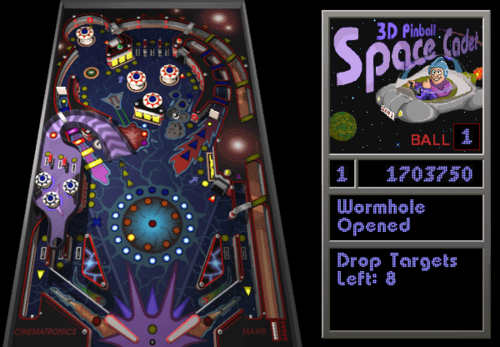
For the next couple posts, I want to explore the concept of tilt. And it all starts with the simple game of pinball, which I spent way too many hours playing. Not on a physical machine,
unfortunately. But, I spent countless hours playing 3D Space Cadet Pinball on Windows XP. Granted, I was not the most skilled player, but
it was still fun.
Of course, virtual physics don't quite match up to the real-world counterpart. Nowhere was this more apparent than in its "nudge" control, which would allow you to virtually "bump" the table in a particular direction, much as you can in a real arcade pinball machine. Rarely did this feature accomplish anything other than activating the game's tilt sensor. For those unfamiliar with pinball (virtual or otherwise), this tilt sensor immediately locks out all the controls and often cancels any bonuses or other earned advantages in the game. I distinctly remember watching that little silver ball bounce erratically around the course, powerless to do anything to affect its eventual trajectory down the drain. While occasionally I would heed the warnings from my frequent use of the "nudge" control and tone back my button mashing, usually I just ignored them.
Today, the term tilt has survived the near-extinction of the pinball machine and come into the world of Magic via poker. When confronted by a series of events in which the player experiences frustration, animosity, or bad luck, an emotional response is triggered. The player becomes more aggressive, more likely to make bad decisions, and often feels as if he or she is owed an optimal outcome due to the sequence of misfortune that has played itself out. Just like a poor bounce of the pinball would lead a player to pushing aggressively on the table to try and change the ball's trajectory, these events cause a player to aggressively push back against the game, giving up control and finesse and attempting to force good results through sheer effort. And in either case, this aggression ends with the player powerless to do anything except watch the silver ball, and his or her game, slide down the drain to yet another loss.
In poker, tilt results in players throwing away significant dollars by playing out too many hands, making unreasonable calls and raises, and stubbornly refusing to walk away until they win their money back. In Magic, while the stakes are certainly much lower, the same sequence can play itself out, leading to increasing frustration, a feeling of powerlessness, and the sense that one has lost the ability to compete. And in either case, tilt has no doubt been a major factor in the decision for that player to walk away from the game, never to return.
I should know. Too many times, I've allowed tilt to detract from the fun of Magic. And worse, I've seriously considered walking away. Next time, I'll share more about my own experiences with tilt.
Of course, virtual physics don't quite match up to the real-world counterpart. Nowhere was this more apparent than in its "nudge" control, which would allow you to virtually "bump" the table in a particular direction, much as you can in a real arcade pinball machine. Rarely did this feature accomplish anything other than activating the game's tilt sensor. For those unfamiliar with pinball (virtual or otherwise), this tilt sensor immediately locks out all the controls and often cancels any bonuses or other earned advantages in the game. I distinctly remember watching that little silver ball bounce erratically around the course, powerless to do anything to affect its eventual trajectory down the drain. While occasionally I would heed the warnings from my frequent use of the "nudge" control and tone back my button mashing, usually I just ignored them.
Today, the term tilt has survived the near-extinction of the pinball machine and come into the world of Magic via poker. When confronted by a series of events in which the player experiences frustration, animosity, or bad luck, an emotional response is triggered. The player becomes more aggressive, more likely to make bad decisions, and often feels as if he or she is owed an optimal outcome due to the sequence of misfortune that has played itself out. Just like a poor bounce of the pinball would lead a player to pushing aggressively on the table to try and change the ball's trajectory, these events cause a player to aggressively push back against the game, giving up control and finesse and attempting to force good results through sheer effort. And in either case, this aggression ends with the player powerless to do anything except watch the silver ball, and his or her game, slide down the drain to yet another loss.
In poker, tilt results in players throwing away significant dollars by playing out too many hands, making unreasonable calls and raises, and stubbornly refusing to walk away until they win their money back. In Magic, while the stakes are certainly much lower, the same sequence can play itself out, leading to increasing frustration, a feeling of powerlessness, and the sense that one has lost the ability to compete. And in either case, tilt has no doubt been a major factor in the decision for that player to walk away from the game, never to return.
I should know. Too many times, I've allowed tilt to detract from the fun of Magic. And worse, I've seriously considered walking away. Next time, I'll share more about my own experiences with tilt.
Saturday, July 19, 2014
Pondering the Clan
In case you didn't know, there is a Magic Online clan dedicated to Standard Pauper called, appropriately enough, Standard Pauper Players. I am a member and enthusiast, although I have not been very active as of late. That probably needs to change, as I have been asked to take over the position of clan captain, at least for the interim while the previous captain is away.
Late last year, I wrote a special post for the Standard Pauper Players clan exploring a piece written by Patrick Chapin about what makes for a strong Magic the Gathering playgroup and explored how his concepts applied to this clan. I still believe that these tenets are the key to having a successful and influential clan, so if you haven't read that post, it would be helpful in regards to the rest of this post.
So here's the deal. I have been asked by the current captain to make my interim position permanent. In other words, I would become the clan captain for the Standard Pauper Players clan on Magic Online. So the question is, should I? Specifically, there are several issues that I feel like I want to address before making that decision:
Late last year, I wrote a special post for the Standard Pauper Players clan exploring a piece written by Patrick Chapin about what makes for a strong Magic the Gathering playgroup and explored how his concepts applied to this clan. I still believe that these tenets are the key to having a successful and influential clan, so if you haven't read that post, it would be helpful in regards to the rest of this post.
So here's the deal. I have been asked by the current captain to make my interim position permanent. In other words, I would become the clan captain for the Standard Pauper Players clan on Magic Online. So the question is, should I? Specifically, there are several issues that I feel like I want to address before making that decision:
- Is it a conflict of interest for a host of a PRE to run a clan? This is probably the most important issue that I would love to get some feedback on.
- Is it even possible to fulfill the tenets of a good playgroup given the limitations of Magic Online? Again, if you haven't read my summary, please do so. I'd love to hear what you think.
- What kind of things would be valuable or useful to members of this clan? In other words, what do you hope to get from joining the clan? I have my opinions, but this is another area where feedback would be great.
- What responsibilities do you expect from a clan captain? Again, this is important to me. I don't want to commit to anything without at least some understanding of what I'm signing up for.
Thursday, July 17, 2014
Multicolor Mayhem Followup
Back at the end of May, I announced on this blog the start of a league-style Player Run Event called Multicolor Mayhem. In case you missed it, this was a special event featuring a mashup of the Shards of Alara Block and the Return to Ravnica Block.
Perhaps due to the short time span between the announcement and the start of the event, we ended up with only 17 participants, including myself. Nonetheless, the event was a lot of fun, and the winner walked away with one of the bigger prizes I've ever given out: 14 tickets!
This past week, the two remaining participants battled it out in the Finals, and Adner's Esper Mayhem was crowned the winner!
Esper was probably the most dominant archetype in Standard Pauper back when the Shards of Alara block was part of the format, and it's easy to see why. Using Sanctum Gargoyle, one can recur the excellent "spell-artifacts" Courier's Capsule and Executioner's Capsule, as well as looping multiples of the gargoyles themselves. That set also featured one of the best removal spells at Common: Oblivion Ring. To this solid core Adner added the excellent Gatekeepers from Dragon's Maze as well as additional recursion via Deputy of Acquittals. The result is a powerful Control deck capable of handling most any threat and equipped to generate tons of card advantage over the course of a game.
This event was a lot of fun, and there is already discussion about what format to do next. In the future, I would make two small changes:
Perhaps due to the short time span between the announcement and the start of the event, we ended up with only 17 participants, including myself. Nonetheless, the event was a lot of fun, and the winner walked away with one of the bigger prizes I've ever given out: 14 tickets!
This past week, the two remaining participants battled it out in the Finals, and Adner's Esper Mayhem was crowned the winner!
Esper Mayhem
1st place in Multicolor Mayhem by Adner
| Creatures 4 Sanctum Gargoyle 4 Ubul Sar Gatekeepers 3 Deft Duelist 3 Deputy of Acquittals 3 Sunspire Gatekeepers 2 Basilica Guards 1 Keymaster Rogue 1 Opal Lake Gatekeepers 21 cards Other Spells 3 Courier's Capsule 3 Executioner's Capsule 3 Oblivion Ring 3 Soul Manipulation 2 Stab Wound 1 Crypt Incursion 1 Midnight Recovery 16 cards |
Lands 4 Azorius Guildgate 4 Dimir Guildgate 4 Orzhov Guildgate 4 Plains 3 Island 3 Swamp 1 Esper Panorama 23 cards
Sideboard
3 Relic of Progenitus 3 Dispeller's Capsule 2 Stab Wound 2 Executioner's Swing 2 Agony Warp 1 Crypt Incursion 1 Opal Lake Gatekeepers 1 Keymaster Rogue 15 cards |
Esper was probably the most dominant archetype in Standard Pauper back when the Shards of Alara block was part of the format, and it's easy to see why. Using Sanctum Gargoyle, one can recur the excellent "spell-artifacts" Courier's Capsule and Executioner's Capsule, as well as looping multiples of the gargoyles themselves. That set also featured one of the best removal spells at Common: Oblivion Ring. To this solid core Adner added the excellent Gatekeepers from Dragon's Maze as well as additional recursion via Deputy of Acquittals. The result is a powerful Control deck capable of handling most any threat and equipped to generate tons of card advantage over the course of a game.
This event was a lot of fun, and there is already discussion about what format to do next. In the future, I would make two small changes:
- Advertise the event a few weeks in advance so as to generate maximum exposure.
- Allow players to change their decklist each week rather than requiring them to keep it the same throughout the event.
Tuesday, July 15, 2014
Farewell to Magic Online
No, I'm not selling out and uninstalling Magic Online, although some may be tempted to do just that in the days and weeks ahead. But today marks the last day of the version 3 client of Magic Online. Tomorrow, it will go down for the weekly downtime, and when the downtime is over, the former "beta" client will be the only client for Magic Online.
So how do I feel about this personally?
What do you think of the transition? How are you planning on dealing with the changes? Let me know in the comments below. Thanks for reading.
So how do I feel about this personally?
- It's going to change how I host. While the new client mostly has the same functionality, it works quite differently in some regards. Some of the methods I use to host will have to change accordingly. As a result I will be trying different things until I figure out the best system moving forward.
- It's disappointing. When Wizards announced they were starting work on the new client, I was happy to hear it. Version 3 is far from perfect, especially in its visuals. Once Wizards had something usable, I equally supported their decision to run both the old and the new side-by-side. But now, with the new version far from perfect, Wizards is pulling the plug. I understand their decision, but ultimately it's disappointing that more progress wasn't made prior to this point.
- It's frustrating. I will be the first to admit that the new client is better in many ways to the old. But some things changed without any real improvement; it's not better, just different. Many players, including myself, have to adapt to new ways of doing things. This is inevitable, understandable, but at the end of the day, it's also frustrating.
- It's necessary. For months now, the word from development has been that any new features for Magic Online would have to wait until the old client was turned off. The only way that Magic Online will continue to improve is if Wizards only has to focus on one version of the client. No matter how bumpy the process, turning off the old is necessary if the new is ever going to live up to expectations.
What do you think of the transition? How are you planning on dealing with the changes? Let me know in the comments below. Thanks for reading.
Subscribe to:
Posts (Atom)