Thursday, January 15, 2015

Dash in Fate Reforged

Fate Reforged is bringing three new mechanics into Standard Pauper. I've already spent some time talking about Manifest and how it functions on Ethereal Ambush. As I continue to work on my set review for Standard Pauper, I thought I would take the rest of this week to look at the other two new mechanics and what impact I expect them to make in the format. Today we'll be looking at the Dash mechanic.

At Common, we only get three cards with Dash - Alesha's Vanguard, Goblin Heelcutter, and Mardu Scout. None of these cards have any special ability that is triggered when they are cast using Dash; you merely get a reduction in mana cost (1 less for the Vanguard and Heelcutter, 1R instead of RR for the Scout) when the corresponding effect of returning it to your hand at the beginning of your end step, assuming of course it's still on the battlefield. This effectively allows the creature to attack 2 rounds earlier than normal. So the real question is this - when is it better to cast these creatures for their Dash cost?
  1. As a surprise attacker. When your opponent has just enough blockers to hold your creatures back, swinging in with a Haste creature can be just what you need to push through additional damage. Or if it forces your opponent to deal with it on that turn, you've effectively gained some tempo through the discounted casting cost.
  2. To dodge Sorcery speed removal. If you strongly suspect that the only way your opponent can deal with your creature is with Sorcery speed removal, and you've got the mana to spare, using Dash prevents your opponent from ever having an opportunity to interact with it.
  3. When the game is about to end. If you can end the game either this turn or the next, and you don't need any blockers, then using Dash makes sense, because you otherwise would not get to deal any damage with that creature.
But in general, even if Dash allows you to attack with a creature one round earlier than you would otherwise be able, you're better off just casting it normally. Assuming that you have other spells to cast, it will be more efficient in the long run to cast the creature normally and get value out of it turn after turn.

That being said, these three creatures are not very impressive as vanilla creatures, so unless you're playing an aggressive deck that will be able to setup board states where one or more of those conditions apply, you're probably better of not playing these creatures. They're not terrible, but should only see play in decks built around them specifically.

What do you think of the Dash mechanic in general and these three creatures in particular? Let me know in the comments below. Thanks for reading.

Tuesday, January 13, 2015

Choice and Complexity

As I continue to work on my set review for Fate Reforged, I have made an interesting note about this set. In the past, I have written extensively about Common Design and the tenets of New World Order limit the kinds of cards we can expect at Common going forward. The whole point of this design constraint is to limit complexity and thereby keep the bar of entry for new players as low as possible while still retaining the essentially elements of the game.

But, at least in my opinion, both Khans of Tarkir and Fate Reforged have been pushing up against the constraints of New World Order more than we have seen in some time. Indeed, I would argue that simply by allowing the Morph mechanic (and now Manifest as well) at Common, signals a shift in what kinds of complexity are allowable.

Now, in Fate Reforged, we have the return of modal abilities in a cycle of creatures at Common. The presence of such cards used to be fairly routine in Magic's history; now, they are quite unusual. So while these abilities never disappeared entirely, giving players the choice of two distinct abilities when a card is cast is an unusually high level of complexity, and one that probably would have been red-flagged and then moved up in rarity save that it ties into a particular theme of the set. Additionally, these creatures also would have been red-flagged simply for the amount of text on the card, which easily exceeds the four line limit.

Choice creates complexity. Board states with hidden or hard-to-discern information also create complexity. And yet, both these elements are present at Common. Is this a shift in New World Order philosophy, or simply an oddity due to the specific needs of this block? Time will tell, but at least for now, I am cautiously optimistic about what this means for future Commons.

Saturday, January 10, 2015

Fate Reforged Multicolor Instant Cycle, Part Two

Last time, I took a look at two more of the cards in the cycle of Instant Multicolor Commons from Fate Reforged. Today I want to finish with the last two cards in the cycle and offer my evaluation of them. And again, in the interest of full disclosure, I am offering my review of these cards after listening to Episode 266 of Limited Resources, where this cycle was reviewed as the show's official preview cards.

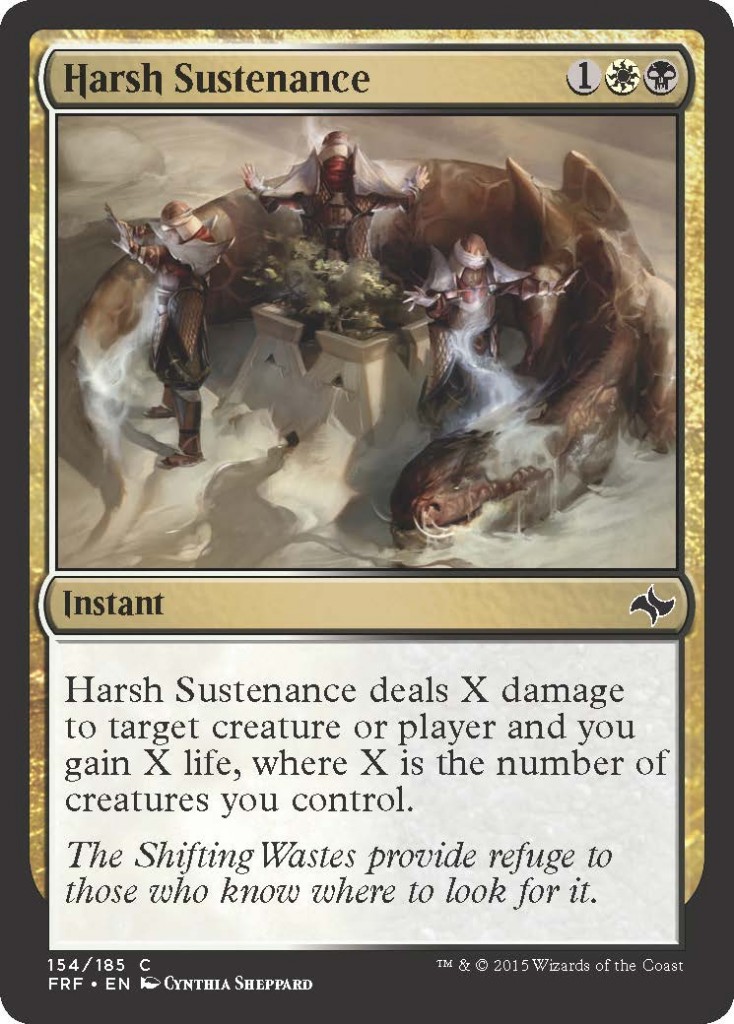
This card immediately brings to mind one of the more powerful Commons to see print: Corrupt. Harsh Sustenance is cheaper, and Instant speed instead of Sorcery, but relies on the number of creatures you have in play rather than the number of Swamps. Even with only three creatures in play, this is the equivalent of Lightning Helix, another extremely powerful card. It's quite strong in a board stall situation, or when swinging in for an alpha strike, and particular strong in any sort of tokens strategy. Granted, it does nothing if you have no creatures in play; your opponent can also destroy your creatures in response. But this card is very strong, and will definitely see widespread play.

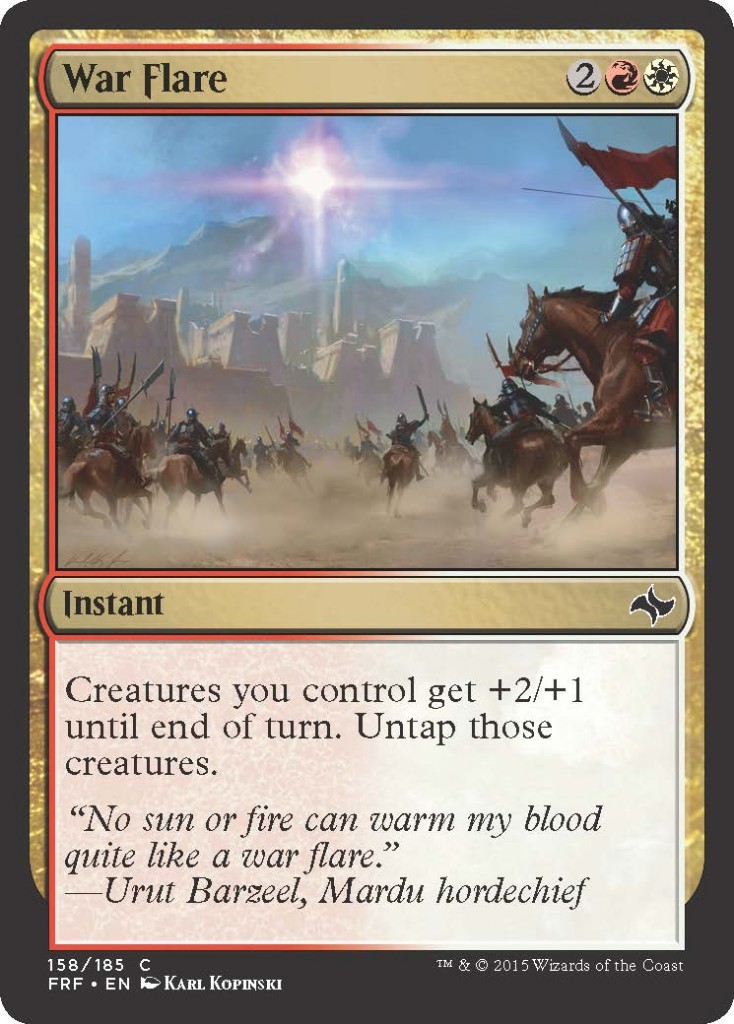
War Flare is also strikingly similar to another card - in this case, Inspired Charge, which was recently printed again in Magic 2015. However, ignoring mana costs, this is strictly better, since it also untaps all of your creatures, making this useful on both offense and defense. There has been a dramatic increase in the number of tokens at Common in both Red and White, and obviously this card would be quite powerful in that sort of strategy. In a board stall, it allows you to swing in freely, knowing that even if you don't finish off your opponent, your creatures will still be able to block on your opponent's turn. It's a bit expensive as a combat trick though, so it will probably only see play in decks specifically designed for it.

Taken as a whole, this is a very powerful cycle of cards at Common. Given the design constraints of New World Order, you can clearly see that these cards were "pushed" to retain this level of power and/or complexity at Common. While requiring two colors does constrain them somewhat, the availability of easy fixing at Common should allow them to see widespread play. I anticipate this cycle will have a strong impact on the Standard Pauper metagame after the release of Fate Reforged.

What do you think of this cycle? Let me know in the comments below.

Thursday, January 8, 2015

Fate Reforged Multicolor Instant Cycle, Part One

Last week, I offered my evaluation of Ethereal Ambush, one of the more powerful of the Manifest cards at Common for Fate Reforged. As it turns out, this card is one of a five card cycle of multicolor Instants at Common, so I thought I would take my next two posts to evaluate the rest of the cycle.

This cycle was also the official preview cards for Limited Resources, who evaluated the cards during Episode 266, which is incidentally also the first show featuring new co-host Luis Scott-Vargas. If you're not already listening to this show, I highly recommend it. In any case, for full disclosure, I am offering my review of these cards after listening to this episode.

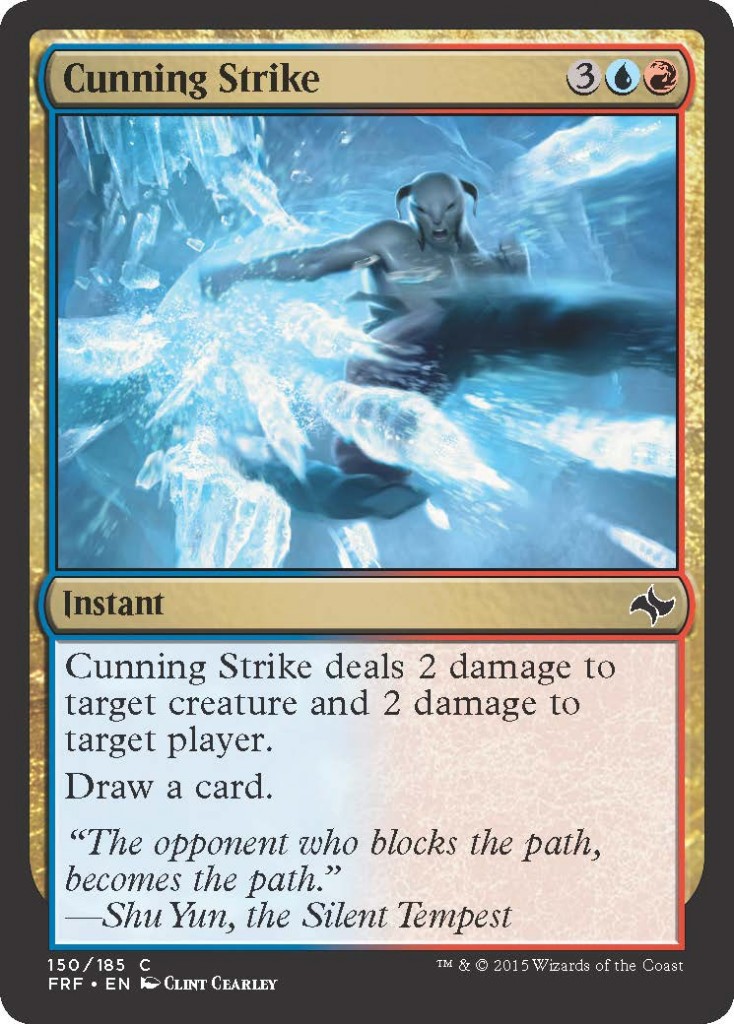
Searing Blaze returns, but now it replaces itself as well? Not quite. Cunning Strike does a lot of small things well. It deals 2 damage to a creature, draws an additional card, and hits your opponent for 2 as well. Problem is, you pay 5 mana to accomplish this. Granted, you do get 4 points of damage for the price, most of the time you'd rather not split it between the creature and the player. Further, while it does have some synergy with Prowess, this mechanic has not made much of an impact in Standard Pauper. Overall, to get full value out of this card, you'll probably need to play it in a Control archetype like Izzet Control, but even there I'm not sure it's worth running over the existing cards in that list.

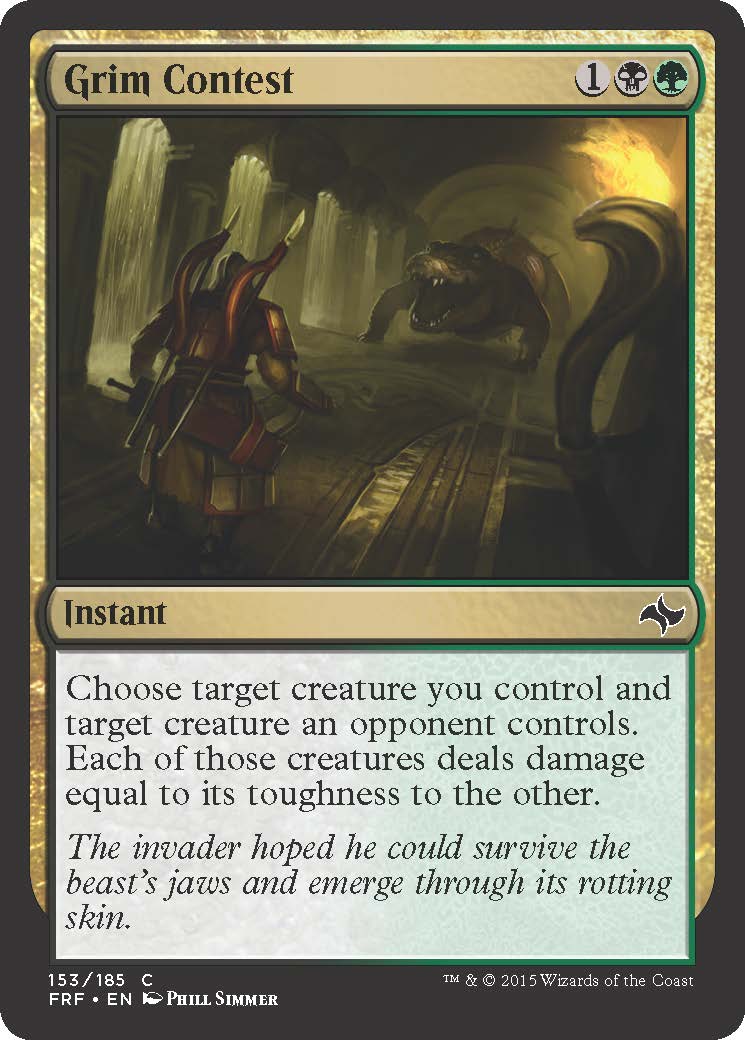
The Fight mechanic continues to see print in several interesting variations at Common, and Grim Contest seems right in line with these cards. But in this case, the damage is based upon both creatures' Toughness rather than Power. This is an odd change, but probably not particularly relevant for the card's overall value. I would evaluate this as being pretty much on par with other Instant-speed Fight effects like Pit Fight or Fall of the Hammer, but with the significant downside of requiring two colors of mana. Additionally, the Black/Green combination hasn't seen much play in Standard Pauper in this metagame, so this card also lacks an obvious deck to slot it into. Thus, while the value is there, I don't anticipate this card making a big impact.

Let me close with a couple other reminders:
  1. My article covering the State of Standard Pauper was published over at PureMTGO earlier this week, and I would appreciate my readers checking it out.
  2. Earlier this week I announced the details for the long anticipated Standard Pauper Sealed League. Don't miss out on this fun and unique event!
See you next time.

Tuesday, January 6, 2015

Standard Pauper Sealed League

Here's the announcement you've all been waiting for!

I am happy to officially announce the Standard Pauper Sealed League. Last month, I previewed this great format with an article on PureMTGO, a couple videos, and a previous post discussing how the event would work. But if you've somehow missed all that, here's the quick concept: a 90 card Sealed pool consisting of all Commons, generated from 9 packs in any combination of sets that are currently legal in Standard. You receive your pool, sort out of the non-Commons, create a decklist, and battle it out over a several week period. And like the old Sealed Leagues, you can even add additional packs as the event goes on!

So here are the official rules for this event:

1. Registration: Registration begins immediately and will be open until 11:59pm EST on Friday, January 30th. To register, send an email to gwyned at gmail dot com with "Standard Pauper Sealed" in the subject line and include your MTGO username, your time zone, and your choice of boosters for your Sealed pool (more on that below) in the body of the E-mail. There is no entry fee to participate - in other words, it's absolutely free!

2. Important Dates: You must register by Friday, January 30th at 11:59pm EST to participate in this event. You will receive your Sealed Pool by 11:59pm EST on Sunday, February 1st. Round 1 then begins on Monday, February 2nd. Each round will run one week, beginning on Monday and ending at 11:59pm EST every Sunday.

3. Sealed Pool: Each player can choose which booster packs will be used for his or her Sealed Pool. You pick 9 boosters from the five sets currently in Standard (Theros, Born of the Gods, Journey Into Nyx, Magic 2015, or Khans of Tarkir). However, you may not choose more than 4 boosters from any one set. This means, at minimum, your pool will contain cards from at least three different sets. As the host, I will be generating pools for each player to ensure integrity. You will receive your pool as an E-mail attachment, and you will need to sort out all of the non-Commons prior to building your decklist. Check out this video for a walkthrough on how to do this (start at the 4:12 mark on the video).

Additionally, after you have finished your match for the week, you can request an additional booster pack worth of cards to be added to your pool. These pools will also be sent via E-mail attachment and will need to be manually added to your existing pool.

4. Decks: Decks are 40 card minimum, with any card in your pool available during Sideboarding.

5. Structure: This event will be Swiss style, with the total number of rounds determined by the number of players:
  • With less than 17 players, we will play 3 rounds. 
  • With 17 players or more, we will play 4 rounds.
  • With 33 players or more, we will play 5 rounds.
  • With 65 players or more, we will play 6 rounds.    
  • With 129 players or more, we will play 7 rounds.
After the Swiss rounds are complete, there will be a cut to Top 8 (resulting in three more Single Elimination rounds).

I will be using Gatherling on pdcmagic.com to facilitate matches. This means that each participant needs to have a functional account at pdcmagic.com/Gatherling. I will be adding players to the event manually once I have received your registration E-mail, so don't try to register on that site directly.

Each week, login to the Player CP on Gatherling and look for the entry under Standard Pauper Sealed #1. There you will see your Pairing for the round. Once your match is over, both players will need to record the results in their Player CP as well. Failure to complete your match may be grounds for disqualification for the event. Be sure and contact your opponent early each week to make sure you can complete your match in a timely fashion.

6. Tables: Please set up each match as follows; before you join a match, make sure the match is setup correctly.
  • Type: Freeform
  • Match Structure: Best 2 out of 3
  • Event Timer: 25 minutes
  • Allow Watchers
  • Comment: Standard Pauper Sealed Round #
7. Conduct: It is the responsibility of each player to be aware of all the rules for this event. Ignorance will NOT be an excuse.

This event, like any Player Run Event, relies on the honor system. Please be a good sport.

If you’ve contacted your opponent and have not received a response in 48 hours, please contact me. If only one person contacts me and no results are reported, I will award that player a match win and drop his or her opponent.

If you are having any other problem (such as your opponent not showing up, your opponent dropped connection in the middle of the match, harassment, or anything else), don’t hesitate to contact me. And if you suspect another player is cheating, let me know. But I trust that every player will be a good sport and act in good faith such that I never have to become involved.

8. Prizes: The exact prize structure will be determined by the total number of players, but I will be donating a minimum of $28 in prizes. If you are interesting in donating to this prize pool, please contact me at gwyned at gmail dot com with the subject line "Standard Pauper Sealed Prizes".

9. Questions: Leave any questions in the comments below, or feel free to contact me at gwyned at gmail dot com.

Saturday, January 3, 2015

The State of the Standard Pauper Metagame

Early next week, I will have an article published over at PureMTGO concerning the current state of Standard Pauper. Today I want to bring you a sneak peek of the content from that article by discussing the current Standard Pauper metagame.

The current metagame is in an interesting place. Typically, aggro strategies dominate a new format, then are slowly pushed out by control builds as the metagame matures. More recently, White Weenie has stayed at the top of the heap, generally having good matchups against just about anything in the format. Right now, the metagame is divided almost straight down the middle between aggro and control, with three major archetypes dominating the Top 4 of these events. However, even though these three decks represent the bulk of the metagame, that's not to say that there are no other viable choices. In fact, over the past couple months, fifteen different archetypes have made at least one Top 4 finish in either MPDC or SPDC. Here's a snapshot of how these different decks have been represented in the Top 4:


Considering that the Standard Pauper set is at its smallest possible size right now (with only four expansion sets and one core set), this is an impressive amount of variety! Additionally, even the top performing decks are seeing quite a bit of variation in their actual lists, so there is still plenty of room for innovation and experimentation in the metagame right now.

So what's your favorite deck in the metagame right now? Let me know in the comments below.

Thursday, January 1, 2015

Making Sense of Manifest

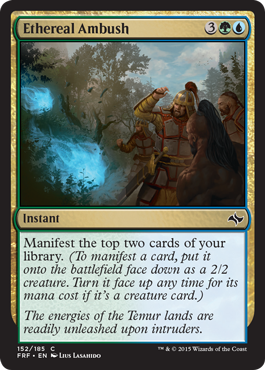
Everyone's favorite season is here again. No, not the holiday season - spoiler season! In this case, the first spoilers for Fate Reforged have been revealed, including seven Commons. While there are several new mechanics that caught my interest, today I wanted to take a quick look at the Manifest mechanic, particularly as it plays out in Ethereal Ambush.

Manifest is an ability that has you take a card from another zone (typically your library), and play is face down on the battlefield as a 2/2 creature. If the card that you play is a creature, you can flip it face up for its mana cost at Instant speed. Interestingly enough, if it's a Morph card, you can also flip it face up for its Morph cost. But if it's not a creature card, the card will continue to be a 2/2 creature until it leaves the battlefield or the game ends.

Now some might intrinsically dislike this ability. After all, the card that gets played face down might have been the one card in your deck that could let you win the game. It might be a powerful Instant or Sorcery, or a creature with a sweet enters-the-battlefield ability, or something or that nature. So rather than getting to play it, now it's relegated to a mediocre 2/2 creature.

But in fact, Manifest plays out almost like a mill-type effect. At its worst, it is equivalent to: place the top card of your library into your graveyard, then put a 2/2 creature token onto the battlefield. In fact, it's actually better than that, because one of the best ways to get rid of tokens is to bounce them, and that won't permanently deal with a Manifest card.

So with that out of the way, how good is Ethereal Ambush in Standard Pauper?

For the sake of argument, imagine instead it was a 4/4 vanilla creature with Flash for 3GU. While you might prefer a 3/3 with evasion (aka Spire Monitor), this would be certainly be playable in the right deck. Now, instead make it an Instant that splits that 4/4 up into two 2/2 creature tokens, and you have a card that is arguably even better. The near equivalent to this, of course, is the powerful Flurry of Horns and Rise of Eagles, trading the french vanilla abilities for the upgrade from Sorcery to Instant speed.

Of course, this does cost you two cards from your deck. But unless Manifest leads you to empty your library, those extra two cards don't really matter anyway. At best, you've gained some interesting options for two creature cards; at worst, you've discarded two cards into your graveyard. 

Obviously the final value of this card will depend a lot on the metagame that surrounds it. But the ability to summon multiple creatures at Instant speed in Standard Pauper is nothing to be overlooked. I evaluate Ethereal Ambush as being playable at worst, and potentially very good in the right deck or circumstances.