Saturday, June 28, 2014

Common Design Part 3: What to Expect in Standard Pauper

This week, I am writing a series on Commons. Specifically, I am focusing on the design aspects that Wizards of the Coast considers when it comes to creating Commons. To do this, I will primarily be relying on Mark Rosewater's Making Magic column, as well as his recent Drive to Work podcasts.

Earlier in the week, I discussed New World Order, which is a specific design philosophy that governs what is acceptable at Common. Then, last time, I discussed the role that Commons play in the design of a set. Today, for my final entry in this series, I want to talk about what we should expect from Standard Pauper based on what we learned from the previous two entries.

Standard Pauper is a great format. It's cheap to play, uses the most popular format, is well-supported by Player Run Events, and enjoys a deep metagame. In fact, I wrote a whole article a couple years back about exactly why it's good for both players and for Wizards of the Coast. However, the specific constraints that go into Common design have a significant impact on the kind of cards we can expect going forward.

So here's the good news:
  • Standard Pauper will always include the themes and mechanics of a new set. Since a central tenet of design is that these needs to be present at Common, the format will always include the key elements of a set. This is good, as it keeps the format from going stale.
  • Standard Pauper will always have access to certain types of effects. To make a balanced Limited environment, a new set will always include removal, pump-effects, mana-ramp, counterspells, card draw, and the like. Because of the inclusion of these elements, playing Standard Pauper will continue to be an experience that is representative of the game as a whole.
  • In Standard Pauper, the power-level will be relatively flat. No one card should warp the format so strongly as to negatively affect the overall metagame, all other things being equal. Additionally, this keeps the format accessible to new players and the prices of individual cards low.
But here's the bad news:
  • Standard Pauper will include a lot of cards that aren't playable. According to the tenets of New World Order, 80% of the Commons will be simple, 1-for-1 effects, that have only a minor effect, if any, on any other cards in play. Thus, only around 20% of the Commons will be considerable playable in the format, and only a handful of those will see widespread play.
  • Even the best of the cards in Standard Pauper will be relatively simple  The 20% that get pushed from any set will only get pushed so far. Compared to even the Uncommons in the set, the complexity of the strongest cards will be low.
  • Standard Pauper will include a lot of the same cards, with only minor variation, from set to set. Since every Limited environment needs certain types of effects, those effects will be present in every set.
Now, that said, I still reject the assertion is uninteresting or mostly luck-based. I wrote a whole blogpost on this, and would encourage you to read it if you'd like to know more.

I hope you enjoyed this look at Common Design. See you next week.

Thursday, June 26, 2014

Common Design Part 2: The Role of Commons in a Set

This week, I am writing a series on Commons. Specifically, I am focusing on the design aspects that Wizards of the Coast considers when it comes to creating Commons. To do this, I will primarily be relying on Mark Rosewater's Making Magic column, as well as his recent Drive to Work podcasts.

Last time, I discussed New World Order, which is a specific design philosophy that governs what is acceptable at Common. Today, I want to discuss the role of Commons in a given set.

Believe it or not, Commons have a very important role in the success of a set. In fact, Rosewater has stated that Commons are actually the hardest card type to design; so hard, in fact, that most of the cards that designers turn in at Common end up seeing print as Uncommons and Rares!

So what do Commons need to accomplish for a set to be successful?
  1. Commons need to be simple. Commons make up the bulk of a set. In order to provide space and appreciation for what the set is trying to accomplish, the Commons need to be simple. To use a metaphor, Commons are the cake, while the other rarities are the frosting.
  2. Commons need to communicate the theme. Rosewater states that, "if the theme of your set isn't in Common, it isn't your theme." Again, since Commons make up the bulk of a set, it falls to them to communicate the theme of the set. Ideally, one should be able to flip through a booster or two of a given set, and by looking at the Commons, easily identify the big idea the set is trying to communicate.
  3. Commons are where you fit in the most important aspects of the set. Whatever the most important mechanics, cycles, or card types are for a set, they need to exist at Common. Otherwise, you run the risk of not being able to fit them in as the set grows larger and larger. Whenever you are trying to fit a large number of things into a tight space, the most efficient method is to start with the largest thing. And for a Magic set, that is the Commons.
  4. Commons provide the known to highlight the unknown. In any given set, you will tend to find certain kinds of cards - pump effects, iconic creatures for a color, removal, etc. Commons provide most of this material. By doing so, they keep the focus squarely on what is new and different in the set.
As you can see, Commons actually have a major role to play. They may seem simple, but that simplicity masks a very complicated balance.

Next time, I'll conclude my look at Common design by analyzing how these design constraints impact the Standard Pauper format.

Also, I wanted to highlight a special event this weekend. There will be a Standard Pauper tournament going on at a local shop in South Carolina, and they will be providing video coverage of the event on Twitch. You can get all the details here, and can also click here to view their coverage from the last Standard Pauper tournament they held.

Tuesday, June 24, 2014

Common Design Part 1: New World Order


This week, I want to do a series on Commons. Specifically, I want to focus on the design aspects that Wizards of the Coast considers when it comes to creating Commons. To do this, I will primarily be relying on Mark Rosewater's Making Magic column, as well as his recent Drive to Work podcasts.

Today, I want to start by discussing New World Order, which is a specific design philosophy that governs what is acceptable at Common.

At its heart, New World Order is about limiting the complexity that new players are faced with. Since Commons make up the bulk of the cards that new players will interact with, if you limit the amount of complexity at Common (and shift it to higher rarities), you effectively lower the learning curve for new players without reducing the overall complexity of the game.

Rosewater identifies three kinds of complexity:
  1. Comprehension Complexity - How difficult it is to understand what a single card does.
  2. Board Complexity - How difficult it is to understand how a card or group of cards affects all of the other cards in play.
  3. Strategic Complexity - How difficult it is to identify the most advantageous line of play given a particular game state.
The goal of New World Order is to minimize the first two without adversely affecting the third.

So how is that done? Rosewater uses the term "red-flag" to identify a Common that violates the simplicity requirements of New World Order. While he did not provide a full set of parameters, here are some of the ways a Common can find itself "red-flagged."
  • Is the card too wordy or complex? A typical cut-off is whether or not the card has more than 4 lines of rules text.
  • Does the card affect other cards in play? For example, a creatures that taps to prevent one damage potentially affects every combat phase, and thus increases board complexity.
  • Does the card create a 2-for-1 on the board? In other words, does the card give a new permanent while also taking away an opponent's permanent.
  • Does the card force you to track information that normally is irrelevant? For example, having to know exactly how many cards are in your opponent's graveyard is not typically information that a player needs to know. 
Now, an important caveat. Just because a Common is "red-flagged" doesn't necessarily mean that it won't be printed. But it does mean that the card has to justify its existence in some way. Maybe it features the new mechanic for the set. Maybe it actually simplifies the choices that a player has to make. In fact, Rosewater states that in any given set, approximately 20% of the Commons violate New World Order in some way or another. But the point is that they do so intentionally in order to accomplish something that the set otherwise could not accomplish.

If you're interested in reading more about New World Order, check out Rosewater's article on it here, and his more recent podcast on the topic here. Thanks for reading.

Next time, I will discuss the role that Commons need to serve in a Magic set.

Saturday, June 21, 2014

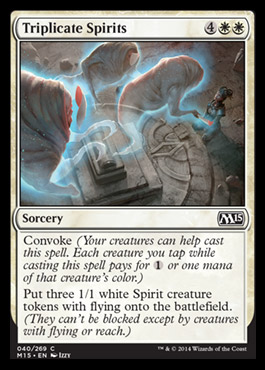
Triplicate Spirits

Last time, I talked about how the Convoke keyword ability was returning to Standard with the release of Magic 2015 and evaluated one of the best Commons to feature that ability - Scatter the Seeds. Today, I want to share with you one of the first new Commons to be spoiled from this set that features this mechanic. Let's take a look.

Triplicate Spirits is a Sorcery speed White Common that summons three 1/1 flying Spirit tokens onto the battlefield for 4WW. It also has the Convoke keyword ability. Back in Magic 2013, we had Captain's Call, that also summoned three 1/1s at Sorcery speed, but for 3W. Even at 2 mana cheaper, it was not considered playable in Standard Pauper. So is Triplicate Spirits better?

I would argue that it is. First of all, getting Flying on those tokens is a very big deal. Second, with Convoke, White can reasonably expect to get a one or two mana discount. Most of the time, you will get a much improved version of Captain's Call but at almost the same cost. Finally, at least until Return to Ravnica block rotates out, there are several decent cards that play well with tokens.

In fact, this card is surprisingly similar to Spectral Procession, which was an Uncommon back in Shadowmoor. To me, that bodes pretty well for this card.

Speaking of Convoke, let me pass on a useful tip I received from JMason on the PDCMagic forums this week:


That's a good thing to keep in mind when Magic 2015 releases online.

So what do you think of Triplicate Spirits? Let me know in the comments below. Thanks for reading.

Thursday, June 19, 2014

Magic 2015's Returning Mechanic

Hard to believe it, but spoiler season is already upon us for the next card set - Magic 2015. For the past few years, each Core set has included a single returning mechanic. And thanks to some early spoilers, we already know what that mechanic will be - Convoke.

In case you didn't play the original Ravnica block, here's a refresher for what this keyword mechanic means:

"For each colored mana in this spell’s total cost, you may tap an untapped creature of that color you control rather than pay that mana. For each generic mana in this spell’s total cost, you may tap an untapped creature you control rather than pay that mana."

Essentially then, Convoke allows you to significantly reduce the cost of a spell if you have several untapped creatures in play. This doesn't change the casting cost of the spell, but merely reduces the amount of mana you actually have to pay. This can even reduce the cost down to zero.

One of the more popular Convoke cards in Pauper was the spell Scatter the Seeds:

Especially in Pauper, the ability to get three creatures out of a single card is pretty good, even if there are only 1/1s. Additionally, this could be cast as an Instant, which allowed it to be used as a combat trick to block one or more creatures your opponent expected to remain unblocked. Given that White typically pays 2W for two 1/1 tokens at Sorcery speed, getting three 1/1 tokens at Instant speed for 2 additional mana is already a good deal. But when you factor Convoke into the equation, this becomes quite mana efficient, particularly in color that already rewards playing lots of creatures.

Since the original Ravnica was released, the token-generating effect has become more predominantly White rather than Green. And as I will discuss next time, that explains why Magic 2015 brings us a very similar card but now in White.

What do you think of Convoke as a returning ability? Let me know in the comments below.

Tuesday, June 17, 2014

Three Hobbies, Three Resources

When it comes to my favorite hobbies, there is always more to learn. Fortunately for all of us, there have never been more resources available for free online to help anyone do just that. Pretty much whatever you're interested in, there is someone online who is much better than you at it, and has invested time and resources to help others improve.

Right now, I have been mostly focused on writing and playing Hearthstone, although of course Standard Pauper remains high on my list as well. So today, I wanted to share with you three resources that I have been enjoying as of late that relate to these three areas:

 1. First off, I've been watching a lot of Limited play on Twitch by a guy named Noah Sandler. He's a highly rated Limited player (hovering around the 2000 mark typically) who provides excellent commentary on both the draft and match portion of his games. He also has excellent taste in music. You can check out his Twitch account here, and follow him on Twitter to find out when he's streaming next.

2. Speaking of Twitch, I've also been playing a lot of Hearthstone as of late. And by far the most well known streamer for Hearthstone is a guy by the name of Jeffry Shih, otherwise known as TrumpSC. He streams almost every day, and has a backlog of content on both YouTube and Twitch covering both Constructed and Arena play for every character class. He also does an excellent job providing commentary on his gameplay. If you want to improve in Hearthstone, TrumpSC may be your number one best resource. Be sure to check out the links above, and follow him on Twitter.

3. Finally, while I confess I have not yet read any of her books (although I am quite intrigued with the mashup of vampires, circuses, and steampunk), author Deliah S. Dawson provides some excellent tips via Twitter when it comes to writing and publication in the fantasy genre. Her advice comes not in the form of long articles, but rather a burst of Tweets with short, concise, and well-written advice on a particular topic. Intrigued? You can follow her on Twitter, check out her webpage for more information, or just scope out her blog and see what catches your fancy.

If you've got resources that you have found helpful in any of these three areas, I'd love to hear about them. Let me know in the comments below. See you next time

Saturday, June 14, 2014

Cards for the Journey, Part Two

We've started a new season of Monday Pauper Deck Challenge, and as always it's interesting to see which cards from the latest set are making the biggest impact on the format. At the end of my set review for Journey Into Nyx, I highlighted ten cards that I thought would have the most impact on the format. So I decided to examine how my predictions have lined up in the metagame thus far. Last time, I looked at the third and fourth most commonly played Commons from Journey. Today, I will finish with the other two.

As a reminder, my data is based on a quick survey of the 16 decks that have placed in the Top 8 of MPDC since Journey Into Nyx was released. I tabulated the results, and picked out the four cards that have had the most copies played. Here are the other two:

The second most commonly played Common from Journey Into Nyx, coming in at fifteen copies, is Feast of Dreams. While it's no Doom Blade, in a metagame dominated by enchantments and enchantment creatures, Feast of Dreams proves to be quite good. Many of the current contenders use creatures Auras to one extent or another, and Bestow creatures are also quite popular. While there certainly is the possibility that this will be a dead card in your hand from time to time, at least right now, this seems like an excellent inclusion, particularly as a Sideboard card.
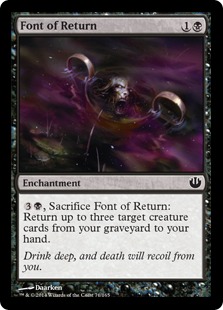
The most commonly played Common from Journey Into Nyx, coming in at sixteen copies, is Font of Return. This is the first time a Common has allowed you to return up to three target creatures from the graveyard (although much older sets did have some X spells that allowed you to return X creatures). As such, this will almost always be a three-for-one. While it doesn't have any immediate effect on the board, and is vulnerable to removal unless you leave up the mana every turn, the potential value of this card is indisputable. It's no Gravedigger, but it's as good of recursion as we are likely to see in the future.

So how did I do on my set review? Sadly, I failed to mention either of these cards in my top ten cards from Journey Into Nyx, although I did at least rate Font of Return as playable. But my assessment of Feast of Dreams was obviously incorrect. In the current metagame, it's playable even in the main.

Let me close with a shout-out to DrChrisBakerDC and RRR726, who both correctly guessed the top two cards. Thanks for reading, and see you next time.