Showing posts with label Design. Show all posts

Sunday, September 3, 2017

Mistborn House War - Two Player Variant?

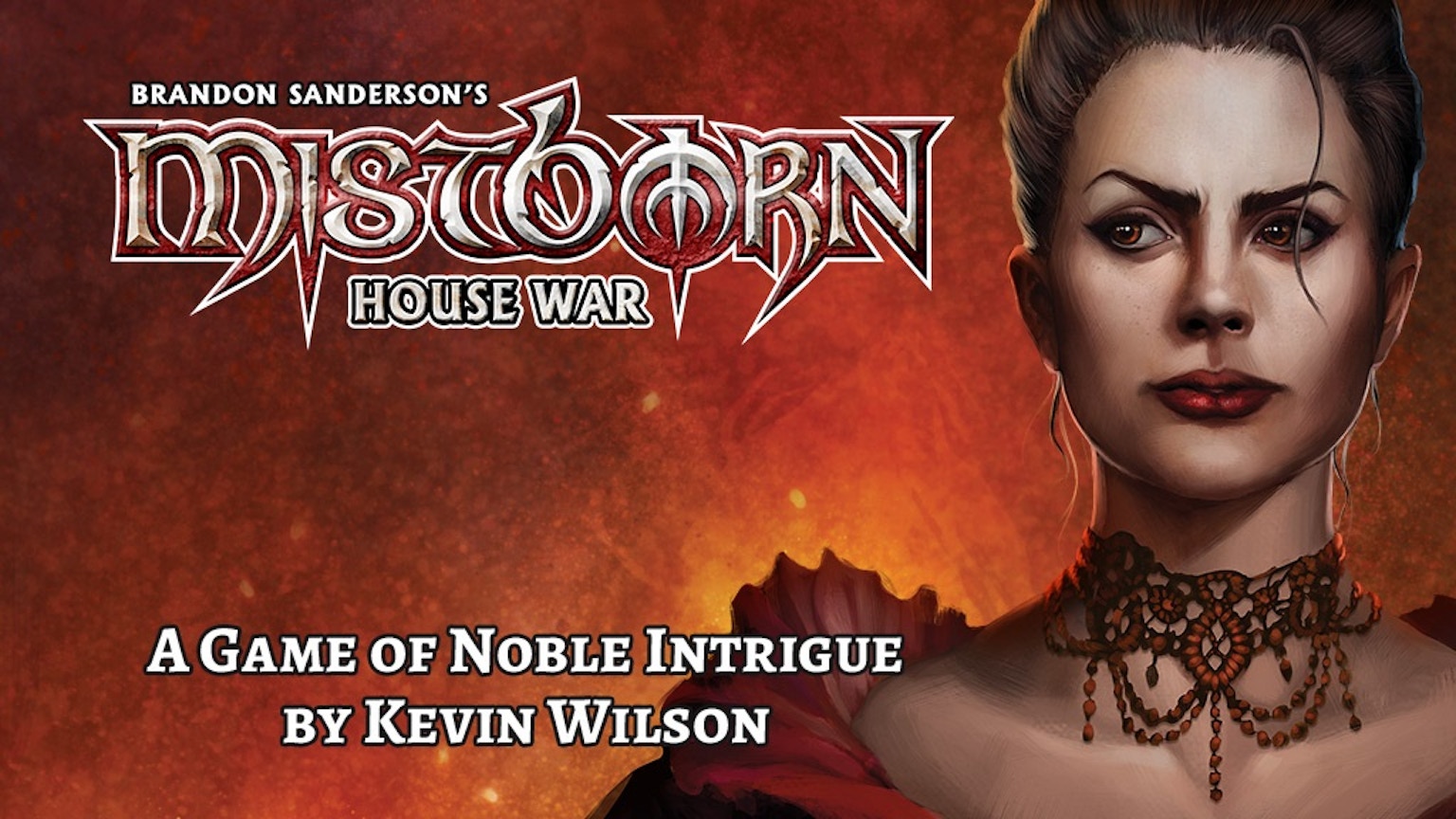
Within just a few days after GenCon, my Kickstarter copy of Mistborn: House War arrived on my porch. While I didn't get a chance to play it this year, I did demo it at last year's GenCon, and its promise hasn't lessened in my mind since then. The game's only problem, however, is that it requires at least three people to play. Which means I'm still waiting for the opportunity in the midst of a very busy schedule to get together with my game group and try it out.

In the mean time though, I've been thinking about how the game might be adapted for only 2 players (or possibly even just one). Having played a lot of Scythe recently, I was intrigued by the Automata feature of that game, which essentially uses a deck of cards to substitute for the actions of a human player. While I wasn't ready to develop something quite that complex, I was curious if I could come up with a simple set of rules to govern a "dummy" player who the two human players would be competing against.

You see, at its heart Mistborn: House War is a social, semi-cooperative resource management game. Everyone's working for the same end, and you work together to solve Problems before they "erupt" and make the overall situation worse. You do this by contributing your own resources and agreeing with everyone else how much Favor you'll receive for your aid out of the total available. But at the same time, you're all individually competing to earn the most Favor, which is awarded for each Problem solved before it "erupts." You can read my review here for more details.

My design strategy looked something like this:
  • Make the "dummy" player always act out a simple script. In this case, it always plays a card during a deal, always gets any Favor that won't divide evenly from any deal it participates in, and only solves Problems during its turn if it can do so without any help. 
  • The human players have to agree on any actions that the dummy takes; if they can't agree, determine the result randomly. Furthermore, they can never decide to target the dummy player with negative consequences unless those consequences are equally applied among all three players.
  • Finally, to incentivize the players to deal with the dummy more often, any time a Problem "erupts," it increases the Unrest track by one. And should that track reach 8, the players lose. This is in addition to whatever the normal consequences printed on the card when it "erupts," even if that includes additional Unrest.
I'll be testing this with my wife over the next few weeks. It's been a fun diversion and let me enjoy playing the game without having to wait for a full group of friends to come together to play.

Saturday, July 8, 2017

Five Room Dungeon

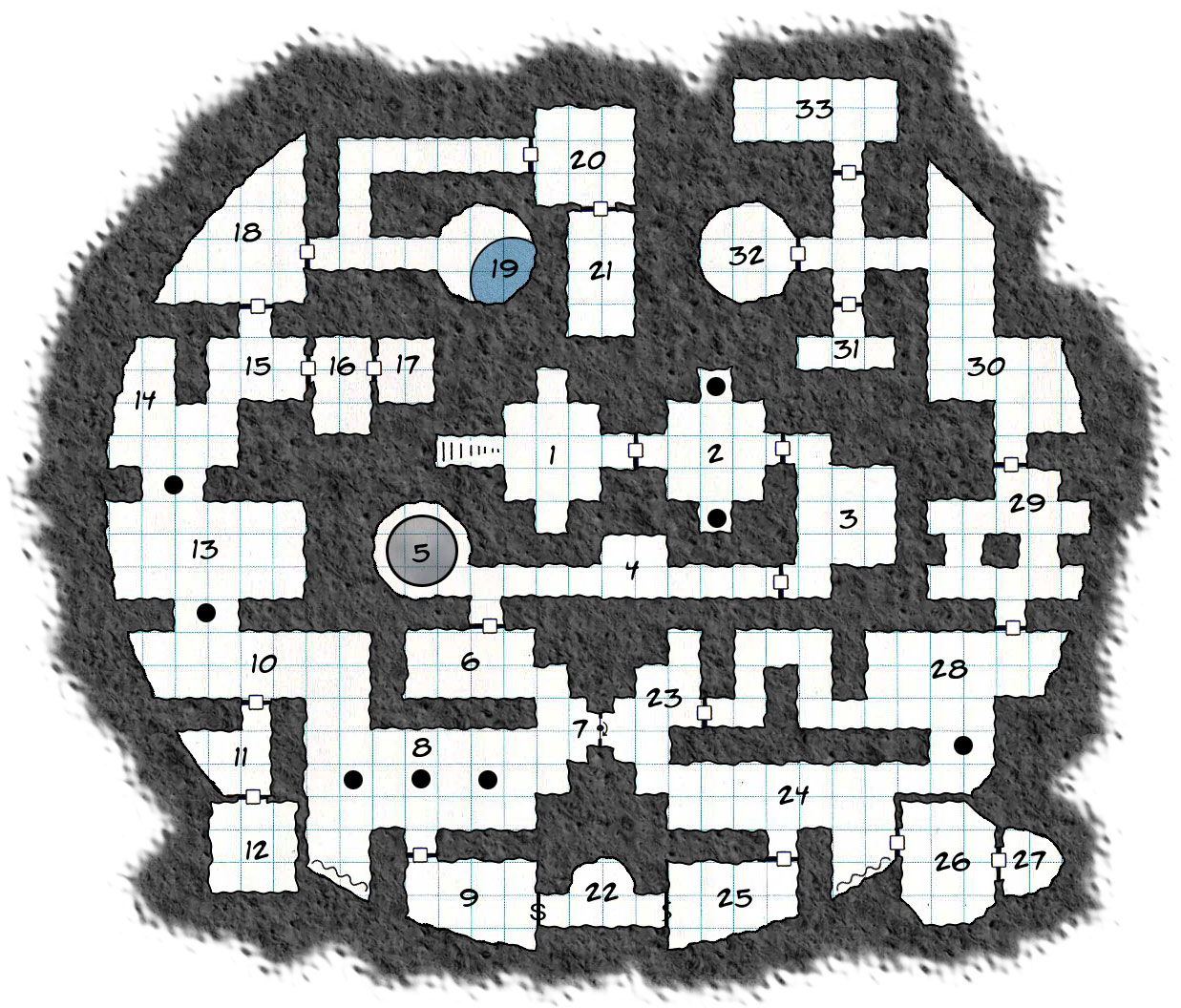
One of the best tools I've ever found for designing a side-quest or short adventure is the Five Room Dungeon Model, which I believe originated with John Four's Roleplaying Tips website. In case you're unfamiliar with it, here's the short version:

Room 1: Entrance And Guardian
Room 2: Puzzle Or Roleplaying Challenge
Room 3: Red Herring
Room 4: Climax, Big Battle Or Conflict
Room 5: Plot Twist

The idea is that a good adventure includes an opening conflict, an obstacle that you can't just kill or destroy, a distraction or diversion, a face-off against significant odds, and some sort of twist or link to the next adventure. Its brevity, variety, and focus is actually what makes it so good. Your players don't waste time wandering around fighting off random monsters; instead, each encounter is significant, interesting, and engages different types of players. If you're interested, you can actually download an e-book with 88 unique dungeons built using this model.

While this specifically was written for a short dungeon, it actually easily can be used as an outline for a larger dungeon complex, a major adventure arc, or even a campaign. I certainly have made use of it both for individual adventure locations in my current D&D campaign and the overall flow for the adventure. So if this is something you haven't used before, definitely read the whole article and start using it for your own adventures.

Wednesday, December 14, 2016

Warcry in Eternal

If you’ve been reading my blog for any length of time, by now you probably know about my enthusiasm for Eternal, a relatively new digital CCG by Direwolf Digital. Although I was a major Hearthstone fan for a while, I find that Eternal has all of the same elements that attracted me to that game, but does them better. And by better, I suppose I mean more like Magic.

So what makes Eternal special? Zachary Barash, of Hipsters of the Coast (whom I have quoted in this blog before), wrote an article this week highlighting on the key mechanics of Eternal called Warcry. Warcry is a relatively simple mechanic. Whenever a unit with Warcry attacks, the next unit or weapon in your deck gets +X / +X, where X is equal to the unit’s Warcry number. Unlike Magic, these changes persist even when the card is no longer in play, effectively permanently changing that card until the end of the game. Additionally, the top unit or weapon can get multiple Warcry triggers over the course of play, accumulating until you draw it.

Barash identifies four reasons why this is such a good mechanic:
  1. It’s simple. Warcry is easily understood. You attack, your next unit gets bigger. Since most units only have Warcry 1, each attack with that unit makes the next one have one additional power and health.
  2. It encourages attacking. All other things being equal, you want to be attacking. This mechanic gives new players the incentive to do just that. It rewards them for doing what they should be doing anyway, effectively teaching good playing habits.
  3. It provides advantage over the course of a game. Warcry is a great equalizer for aggressive strategies. Your units keep getting larger over the course of a game, making them relevant longer. And at times, this advantage is significant enough to even make it worth throwing away a unit on an ill-advised attack, simply because it will give a corresponding advantage later.
  4. It creates great moments. Often the fun in card games is the big, flashy moments. Warcry helps create those. There is something quite compelling about swinging in with a massive unit for a very cheap cost created by multiple Warcry triggers. It allows you to suddenly win out of nowhere, or win a game you were almost certainly going to lose.

Eternal is free on Steam right now. And while it’s still in closed beta, it’s quite polished, and well worth checking out.

Tuesday, November 8, 2016

"Pushed" Cards and Player Skill

As some of you probably know, I have been playing quite a bit of Eternal, a great digital card game by Direwolf Digital that is currently in closed beta. Today, I read an excellent article discussing the concept of pushed cards and why they are good for the game. Given all of the recent discussion around whether or not to ban Self-Assembler, I thought the concepts presented in this article were very timely. I certainly encourage you to read the whole article, but today I want to highlight certain key points and briefly discuss how they might be relevant to our discussion.

What is a pushed card? NeonBlonde, the author of the article, defines it this way:

A good definition of the term might be “a card that is obviously and deliberately powerful”, or maybe “a card that is significantly above average on purpose”.

Even in an all-Commons format like Standard Pauper, we certainly have had our share of pushed cards: Kor Skyfisher, Ghostly Flicker, and Treasure Cruise, just to name a few. Interestingly enough, I believe at one time or another players called for each of these three cards to be banned.

Now the argument could be made that such cards are bad for the format. That the very fact that they are so much better than the rest of the cardpool warps the metagame in unhealthy ways. Doesn't it make the game less skill intensive, since it all comes down to either who draws these cards first or who plays the best answers to them?

NeonBlonde suggests just the opposite:

An environment where there is a variable power level becomes much more skill intensive. Firstly, deck building becomes more challenging. Of course you want to jam as many pushed cards into your deck, and leave out the weaker cards, but there is a limit in the number of excellent cards that are hanging around. You need to identify what is best, which becomes harder and harder as you move down the list. In addition, you need answers to the best cards from your opponent’s deck. It isn’t enough to just have a random sample of cards that are good, since your opponent’s best cards may be much better than your answers if you are not careful. Game play becomes more interesting too. The value of cards will tend to move up and down much more depending on what is happening in the game. In flat power level world the most important cards will generally just be the highest cost card in play. In variable power world, this is often not the case, as context becomes more important. The skill of the game goes up as a result, since you must keep track of what matters and why, rather than just following what costs the most. You are also forced to come up with creative lines of play when you draw your less powerful cards and you opponents draw their more powerful cards. Sure they have the advantage, but is their a way to combine these low power cards to actually counter my opponent’s strongest threats? That leads to some of the most interesting games.

So in my opinion, this is the best question to ask about Self-Assembler. Does the fact that this card is so good contribute to increasing the skill level required for success in Standard Pauper? Or does it in fact lower the skill level, since games are truly only about either drawing Self-Assembler or finding the perfect answers for it?

I would love to hear your thoughts on this. Feel free to comment below.

Wednesday, July 13, 2016

Eldritch Moon First Thoughts

As I mentioned in an earlier tweet, I am currently on the road on vacation, which is certainly an inconvenient time for the full set of Eldritch Moon to be revealed. Finding time to blog, much less work on my set review, is going to be a challenge, but I will do my best to get the content out as fast as I can. But for today, I wanted to offer my first thoughts on Eldritch Moon after going over all of the Commons a few times.
  1. The power level of the Commons is significantly above average. By my count, there are at least two dozen cards that I expect to see regular play in Standard Pauper, and several of those seem good enough to be make a major impact on the format.
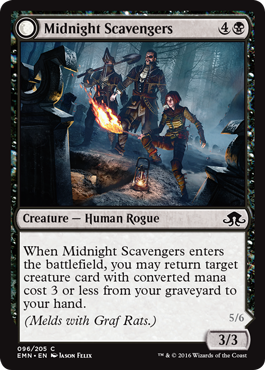
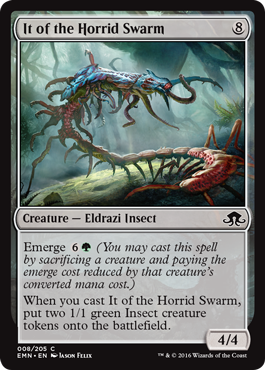
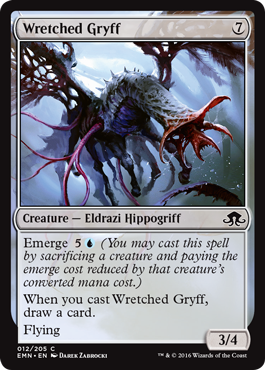
  2. Although they are only present at Common in a handful of cards, all three of the new mechanics should see play in the format. Escalate is the most represented of the three, but Meld's representative Midnight Scavengers is quite strong, as are It of the Horrid Swarm and Wretched Gryff, our two Common Emerge cards.
  3. Of the returning mechanics, Madness got a nice boost from the handful of new cards, while even Delirium and Skulk have some potential new playables.
  4. The "Graveyard matters" theme seems stronger in Eldritch Moon than in Shadows Over Innistrad, at least at Common.
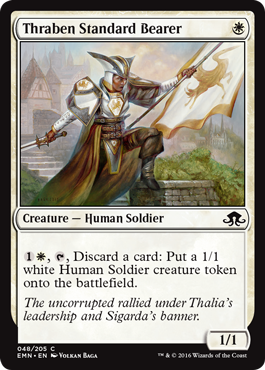
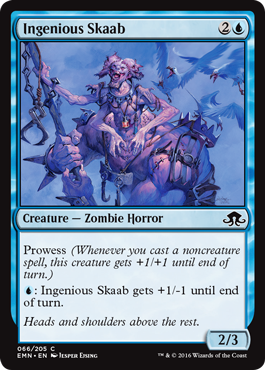
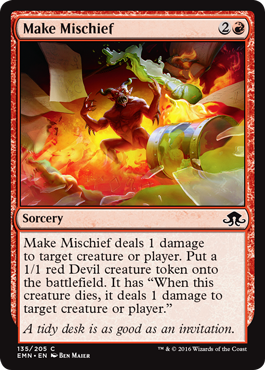
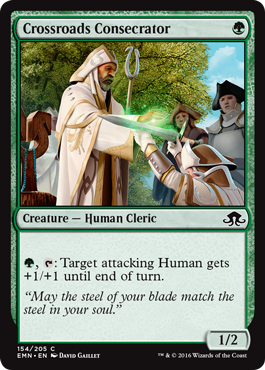
  5.  Not only are the Commons more powerful, but they seem to be unusually complex as well. Thraben Standard Bearer, Ingenious Skaab, Make Mischief, and Crossroads Consecrator are all examples of Commons that would be red-flagged for one reason or another, yet still saw print despite also not being tied to the new set mechanics. While these cards are not necessarily amazing, the level of complexity is remarkable in this post New World Order era.
Anyway, that's enough from me for now to at least whet your appetite for my full set review. No promises on when that will be published, but I will do what I can while I am traveling. At the very least, it will be available prior to the release of Eldritch Moon on Magic Online. I'm definitely looking forward to it!

Tuesday, July 5, 2016

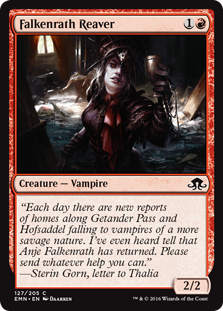
Why Would Wizards Spoil Falkenrath Reaver?

We're deep into the spoiler season for Eldritch Moon, with new cards being revealed every day, leading up to the paper Prerelease Weekend on July 16-17 and its eventual online release on August 1. The idea behind such spoilers is to build increasing excitement for the set, revealing some of the  marquee cards and mechanics and saving the more mundane cards for the full spoiler, which should come out sometime next week.

So imagine my surprise today when one of the newly revealed cards was Falkenrath Reaver. It's hard to imagine a less exciting card. It's a vanilla 2/2 for 2, with a creature type consistent with what we've already seen, that certainly doesn't seem to play any special role in the format. Why would Wizards want to use this card as a way to create excitement for the upcoming set.

As it turns out, this card was spoiled on the Magic Development Tumblr page in response to the question, "Will we ever see a vanilla 1R 2/2?". In fact, this is the first 2/2 for 2 converted mana (outside of Rares; even then I believe those cost RR) that has ever been printed without a drawback. Two good examples of this card type at Common are Mage-Ring Bully and Valley Dasher, which both come with the drawback of having to attack each round. Granted, it's arguable that Mage-Ring Bully is superior to Falkenrath Reaver, but that's neither here nor there. The point is, this is a statement from development about what we can expect from Red Commons in the future. In fact, it wouldn't surprise me if we saw such cards even with one of the set's mechanics without a drawback in the future.

As Mark Rosewater has said many times, the hardest part of design is Commons. But now, the design mentality has shifted. And in my opinion, better creatures at Common can only be good for the format.

Amazing what you can glean from a vanilla 2/2 for 2! Guess that's why Wizards thought it was worth spoiling.

Saturday, August 29, 2015

Creating Magic Items in D&D 5th Edition

As I've mentioned in some recent posts, I have been playing Dungeons and Dragons 5th edition with my gaming group, and we have absolutely loved it. Our group actually started together playing Pathfinder, and on the whole we've found D&D 5th edition to be superior in almost every way. But one thing I enjoyed in Pathfinder was some pretty detailed rules concerning crafting magic items. Granted, the way that system works, it's almost trivially easy for players to do this, but at least there are detailed rules to guide them. In comparison, in D&D 5th edition the rules for crafting magic items are paper-thin, and seem more tacked on than actually integrated with the system. Considering the sheer number and variety of magic items described in the Dungeon Master's Guide, this seems like a pretty major oversight.

Now that said, I actually like the removal of what one author termed the magic item economy, where it was trivially easy for characters to buy and sell magic items to their heart's content. Nevermind that even the average merchant would never be able to afford the tens of thousands of gold selling price, or would be hard pressed to ever find a buyer for said item. Making magic items rare and the ability to craft them a lost art certainly makes for a better default gaming experience.

Nonetheless, I still wanted crafting rules that would work within that framework. And since the current rules set doesn't include them, and since I couldn't find anything online that I liked, I had to create my own. Here's a sneak peek:

Given the default environment for 5th edition, most magic items are considered relics of a previous age that are generally beyond the knowledge of the typical magic practitioner to create. In fact, recipes for how to create even the most common of magic items (such as a potion of healing or a first level spell scroll) are still considered uncommon treasures valued at hundreds of gold pieces (DMG 141). As such, the creation of any magic item is a major accomplishment, and one that should not come about without a considerable investment of time and resources.
 

Step-By-Step Creation Overview
1. Acquire the formula for the magic item.
2. Acquire the components needed to create the magic item.
3. Meet all of the prerequisites for the magic item, including achieving minimum character level, preparing each spell that will be produced by the item, and acquiring all of the material components for not only the magic item but also for each of the spells.
4. Calculate the total creation cost, the time required, and the difficulty of the skill check at the end of the creation process.
5. Complete the creation process by spending the required costs and time, make an Arcana check against the appropriate difficulty, and determine your results.


If you are interested, I would love to have a few more people who are familiar with D&D 5th edition take a look at the whole document and give me some feedback. If that's you, feel free to drop me a line and let me know.

Thursday, August 27, 2015

Transparency in Video Game Design

As any longtime reader of my blog knows, I am a devoted gamer of both the digital and physical media. And one of the fascinating effects of the ubiquity of the tablet is how the distinction between a video game and a board game is beginning to shrink. Indeed, many of my favorite board games are available as video games!

So when a link came across my Twitter feed to a presentation by Soren Johnson (former lead designer for Civilization IV and current lead for Offworld Trading Company), about what video games can learn from board games, I was immediately intrigued. I've linked the entire presentation below:


Okay, I'm guessing most of you didn't actually watch the whole video. It's pretty long and geeky, so I can't blame you if you didn't. You really should watch it. But if not, here's the gist of it:

What defines a board game is not the fact that you play with physical components. Instead, what makes a board game unique is the level of transparency in the game. All of the mechanics, by necessity, must be fully explainable to the end user; otherwise they don't work. And it is this transparency that creates such great games, fostering deep engagement, player comfort, and meaningful choice.

Now I'm a major fan of Johnson's Offworld Trading Company, and I can definitely see how he has applied these concepts to that game. So if you want to see these concepts in action, I would definitely encourage you to check it out.

Thursday, July 23, 2015

Common Design: Why Commons Become Uncommons

I've spent quite a bit of time on my blog writing about the design of Commons, particularly in reference to the New World Order design philosophy and how it affects what we will see at Common in future sets. As is typical with the release of a new set, there is a certain subset of the Pauper community that laments these design constraints, since it typically means that few if any new cards will actually see play in Classic Pauper.

For Magic Origins, at least one player picked up on the fact that several former Commons (Knightly Valor, Sigiled Starfish, and Totem-Guide Hartebeest, among others) saw print as Uncommons in the set, and took this as further proof that New World Order is taking away all the complexity out of print at Common. In response to one such post, a player by the name of casual_melvin posted this response (which I have edited slightly just for clarity):

A) Cards often shift rarities from set to set, sometimes up sometimes down. Sometimes this reflects a change in how WotC handles rarity. More often it reflects the differing needs of the new set. Scion of the Wild was reprinted as a common in Modern Masters 2015 despite two previous printings at rare. This was acceptable because Modern Masters has less restriction on complexity than Standard legal sets.

B) Origins is a core set, and core sets have always had less complexity available than expansion sets. Shimmering Grotto was printed as a common in 2 expansion sets before being printed as an uncommon in M14. Then a functionally equivalent card, Unknown Shores, was printed at common in Theros.

C) Specifically, printing Sigiled Starfish at uncommon in Origins allows them to make a new common card of similar complexity. WotC gives itself a "complexity budget" for use on commons. A certain number of commons each set are allowed to do things that commons can't do too much without unbalancing limited. They use this budget to craft limited play around the set/block's themes so that always powerful things like removal and evasion aren't always taking center stage.

C2) Whether a card like Sigiled Starfish is printed at common or uncommon has less to do with the card itself than how it plays with the cards in the environment.  Apparently, while Origins does have scry, it is less of a focus than it was in Theros, so as a repeatable scry-er, Sigiled Starfish fits better at uncommon. 


As you're evaluating new sets, these are very great points to keep in mind. Thanks for reading.

Saturday, June 20, 2015

Do Bad Cards Need to Exist?

As a proponent of Standard Pauper, one of the downsides of the format is that for any given new set, so many of the Commons simply aren't good enough to see play. Worse, a smaller subset of them aren't just unplayable, but are complete garbage. So why do these cards exist?

Interestingly enough, the same question has been asked in Hearthstone. A well known streamer by the handle of Kripparian recently posted a video discussing an idea that Blizzard should periodically go back and change unplayable cards to mix up the metagame and improve the overall health of the game. Surprisingly enough, Ben Brode, Senior Game Designer for Hearthstone, responded with a video of his own essentially debunking this idea. While I encourage you to check out this video for all the details, here are his essential points:
  • It's impossible not to have bad cards. Cards aren't judged in a vacuum, but in relation to other cards. Make one card better, and all you do is shift which cards are considered "bad."
  • Changing cards is bad for the game. Not only does it take a significant amount of time to rebalance a card for a new environment, it also penalizes older players who have to relearn how things work.
  • Different kinds of cards are good for different types of players. So-called bad cards may have marginal effects that are good in the right situation, may appeal to certain types of players, or help teach and illustrate concepts to new players.
Obviously in Magic, Wizards doesn't have the luxury of going back and changing cards once they've seen print. But otherwise, Brode's arguments are as true for Magic as they are for Hearthstone. Indeed, his comments are right in line with comments Mark Rosewater has made in the past.

Sorry, Kripparian. As it turns out, bad cards not only do need to exist, but are actually good for the game. Who knew?

Saturday, November 1, 2014

Redflagging

Earlier this year, I took an entire series of blogposts to write about the design process for Commons as detailed by Mark Rosewater. In my initial article, I discussed a process called redflagging, in which Wizards Design and Development marks cards that violate the principles of New World Order, which is a design document adopted to govern all Commons going forward.

In episode #144 of Rosewater's popular Drive to Work podcast, he went into further detail about the factors that cause a Common to be redflagged. For today's post, I wanted to highlight these factors:
  1. Does it continuously affect other permanents? Rosewater uses Samite Healer as the poster-child for this kind of complexity. Since it can prevent 1 damage from any source at any time, it greater increased the mental math one has to do before attacking or blocking. However, not all cards that affect other permanents will be redflagged. A card like Akroan Mastiff, which taps another target creature, actually decreases complexity, as it reduces the decisions your opponent has to make. But in general, these type of cards will be flagged.
  2. Does it have four or more lines of rules text? Rosewater says that this is a sign that the card is either too wordy or too complex. If it's the former, that's fine. But if it's the latter, the card is judged to be too confusion to be at Common, and thus will be flagged.
  3. Does it create on-board card advantage by itself? Rosewater uses examples like killing two creatures, or killing another creature when it enters the battlefield, or creates the potential for repeatable damage. Cards like Flametongue Kavu or Prodigal Pyromancer are perfect examples of these type of effects.
  4. Does it create a loop? Rosewater stresses that having the same thing happen over and over again is not a desirable state, and thus wants to minimize the chances that this occurs. This is the factor that led Gravedigger to be moved to Uncommon, since you could often chain Gravediggers into one another, such that every time one died, you used another to bring it back into your hand.
  5. Does this card get more powerful in multiples? In Odyssey block, there was a cycle of cards at Common that gave you an additional effect if you already had a copy of that card in your graveyard. Accumulated Knowledge is another popular example of this type of effect. Such effects will always get a card redflagged now.
  6. Does this card cause confusing interactions? This is perhaps the most nebulous of the factors. But essentially, Rosewater explains it as any card that new players almost always misunderstand, especially in the context of a complicated rule or interaction. The example Rosewater uses is the combination of Deathtouch and Trample on the same creature. It is counter-intuitive that a creature with both abilities only has to deal a single point of damage to whatever creature blocks it, and the rest is applied to the player. Since the average player probably gets this interaction wrong, it shouldn't come up at Common, and thus is redflagged.
Now, it's important to remember that just because a Common is redflagged doesn't mean it can't see print at Common. But it does mean that the card has to have a strong reason to remain at Common in the set, and will require approval from both Design and Development. And in general, only about 20% of the Commons in a set can violate these principles.

Obviously, this has enormous impact  on the type of cards we will see in Standard Pauper. So what do you think of this list? Which one do you feel is too restrictive? How have these factors changed the landscape of cards at Common? Let me know in the comments below. Thanks for reading.

Tuesday, September 16, 2014

Khans of Tarkir: Morph

In case you somehow missed it, the returning mechanic for Khans of Tarkir is Morph. Morph was first introduced way back in Onslaught, and is certainly one of the stranger mechanics in Magic's history. The ability to essentially play a 2/2 token for 3 mana by putting the card face-down introduces a whole new element of hidden knowledge from your opponent, and the complexity is even higher given that you can flip a Morph card over at any time, assuming you have enough mana to pay the Morph cost. It is also worth pointing out here that the act of turning the card face-up doesn't use the stack, and thus cannot be responded to. In other words, if your opponent pays the Morph cost and goes to flip over her creature, you can't cast Shock to remove it as a 2/2 creature.

As I have been working on the set review for Standard Pauper for Khans of Tarkir, I have had some difficulty in evaluating just how good the Morph cards are in this set. Today, rather than looking at specific cards, I want to evaluate the mechanic as a whole.

Typically, Morph cards have three major advantages over other creatures:
  1. Your opponent doesn't know what creature you played. Since all Morph cards cost the same to play face-down, your opponent has no real information to go on. Unless he is playing Lens of Clarity, the only way your opponent learns what card you played either when you flip it over or when it leaves the battlefield or the game ends.
  2. You can always play the card as soon as you have three mana available. Playing them facedown doesn't require any specific colored mana. Additionally, most of the time this is cheaper than the actual casting cost of the creature, allowing you to get value out of the card much earlier than you otherwise could.
  3. You control when the creature is flipped over. This means that you can effectively surprise your opponent in combat, allowing you to block a creature you might not have been able to block or setup a favorable block that your opponent couldn't foresee.
These are pretty significant advantages. Honestly, given the complexity that this introduces, I am surprised Morph is being reprinted at Common. This also means that we should expect that the Morphs at Common will probably only be vanilla or french-vanilla creatures, since additional complexity would easily push the card into Uncommon or Rare.

For those of you who have played with Morph cards before, what do you think of them in general? Are you excited to get your hands on them in Khans of Tarkir? Let me know in the comments below.

Saturday, September 13, 2014

Khans of Tarkir: Full Spoiler and Contest Results

That didn't take long.

Probably timed to coincide with the start of the Community Cup, the full spoiler for Khans of Tarkir has been released. The timing is also convenient for me, since it allows me to immediately announce the results of the contest I held right here at Write Adept in my previous blog post.

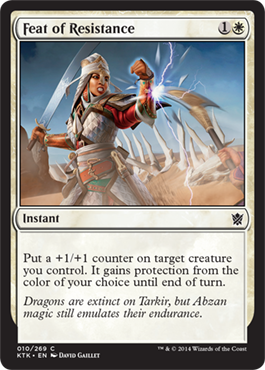
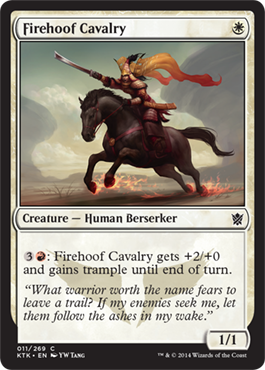
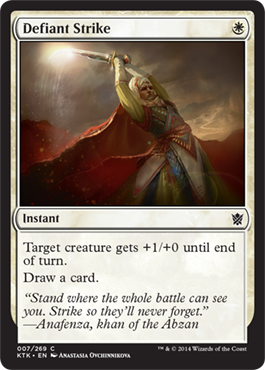
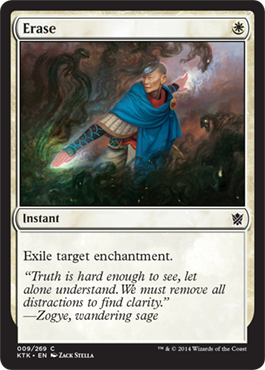
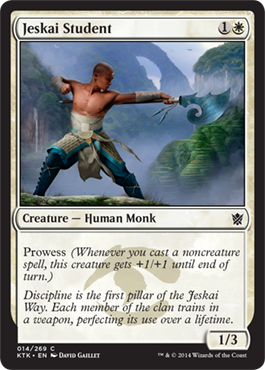
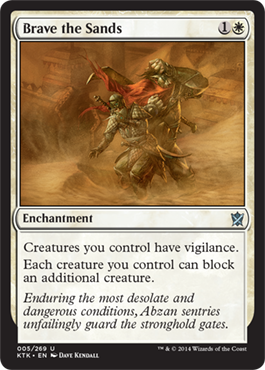
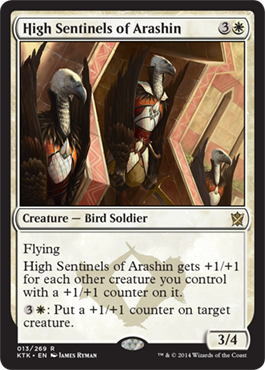
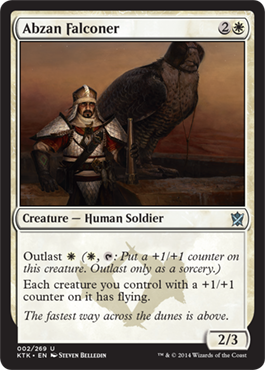
For those who missed it, MTGSalvation had a slew of unofficial spoilers, including a bunch of White cards that included the full rules text but not the rarity of the cards. I posted them and asked my loyal readers to try to figure out which ones could be Common based on power-level. For reference, here are the cards in question (click on the image for a larger version):


For reference, I should have numbered them, particularly since they ended up out of any logical order due to my unusual copy/paste from the site. For today's post, I will simply refer to them from left to right, finishing the whole row before moving down to the next row. The correct rarity for the cards is as follows: Uncommon, Common, Uncommon, Common, Common, Rare, Uncommon, Common, Common, Common, Common, Common.

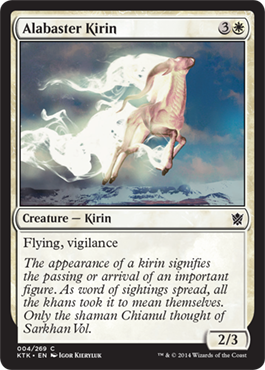
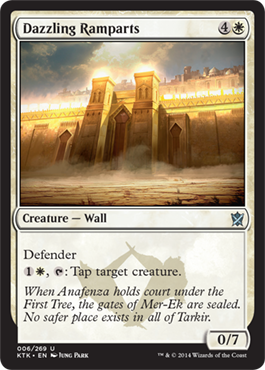
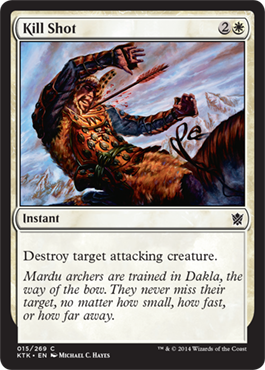
Out of these eleven cards, I thought six of them were obviously Common: Alabaster Kirin, Feat of Resistance, Firehoof Calvary, Defiant Strike, Erase, and Jeskai Student. These six cards represent elements almost always found at White at Common: simple combat tricks, "fair" costed creatures with a single ability, a single-target protection spell, and a reprinted Enchantment hate. Additionally, both Brave the Sands and High Sentinels of Arashin were clearly not Commons, since both add significant complexity to combat with the latter also requiring you to keep an accurate understanding of the board to determine the Sentinel's Power and Toughness. That left Abzan Falconer, Dazzling Ramparts, and Kill Shot as the more tricky to evaluate.

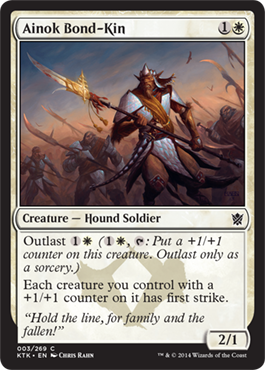
Under the right circumstances, I would vouch that all three could be potential Commons, at least with minor tweaks. Abzan Falconer is probably too efficiently costed to be a Common, both for its Outlast cost and its casting cost, and granting Flying is arguably too strong at Common. However, it isn't that different than Ainok Bond-Kin, and so is borderline between Common and Uncommon. Dazzling Ramparts is even closer, as White often gets a tapper at Common, and an 0/7 Defender for 1W is not particularly efficient. Finally, Kill Shot, while clearly better than the classic Divine Verdict, is a functional reprint of Rebuke from Innistrad. 

As far as my evaluation, I actually missed only one, placing Dazzling Ramparts as a Common instead of an Uncommon. Chris Baker, one of only two entries, got them all correct, and so Writer Adept will be awarding him a single ticket for his victory!

I hope you enjoyed this exercise. Thanks for reading.

Thursday, September 11, 2014

Khans of Tarkir: Could It Be Common?

Another spoiler season for a new set, another set of unofficial spoilers, this time courtesy of MTGSalvation. In this case user nal2 posted the text of a bunch of cards from Khans of Tarkir, without artwork or even the rarity. As I was perusing the spoiled cards, I found myself trying to figure out which ones could be Common. It was such an interesting exercise, I thought I would post it up here on the blog for my readers. But rather than focusing on all of them, I decided to limit it to White.

Since the information could change quickly (especially with Sealed Clans of Tarkir as a Community Cup event this weekend), here are the White cards that were spoiled in this batch (click on the image for full size resolution):


Based on what we know about Common Design, can you pick out which of these cards are Common? Actually, I would divide them into three categories, based on the fact that sometimes rarity is determined by factors other than power level or complexity.
  1. Probably Common
  2. Definitely Common
  3. Not Common
I've recorded my picks, and I will discuss them on Saturday. Let me know your picks in the comments below. Once these eleven cards  are spoiled, I'll even throw in a small prize for whoever gets them all correct (or randomly select one among multiple winners).

Saturday, June 28, 2014

Common Design Part 3: What to Expect in Standard Pauper

This week, I am writing a series on Commons. Specifically, I am focusing on the design aspects that Wizards of the Coast considers when it comes to creating Commons. To do this, I will primarily be relying on Mark Rosewater's Making Magic column, as well as his recent Drive to Work podcasts.

Earlier in the week, I discussed New World Order, which is a specific design philosophy that governs what is acceptable at Common. Then, last time, I discussed the role that Commons play in the design of a set. Today, for my final entry in this series, I want to talk about what we should expect from Standard Pauper based on what we learned from the previous two entries.

Standard Pauper is a great format. It's cheap to play, uses the most popular format, is well-supported by Player Run Events, and enjoys a deep metagame. In fact, I wrote a whole article a couple years back about exactly why it's good for both players and for Wizards of the Coast. However, the specific constraints that go into Common design have a significant impact on the kind of cards we can expect going forward.

So here's the good news:
  • Standard Pauper will always include the themes and mechanics of a new set. Since a central tenet of design is that these needs to be present at Common, the format will always include the key elements of a set. This is good, as it keeps the format from going stale.
  • Standard Pauper will always have access to certain types of effects. To make a balanced Limited environment, a new set will always include removal, pump-effects, mana-ramp, counterspells, card draw, and the like. Because of the inclusion of these elements, playing Standard Pauper will continue to be an experience that is representative of the game as a whole.
  • In Standard Pauper, the power-level will be relatively flat. No one card should warp the format so strongly as to negatively affect the overall metagame, all other things being equal. Additionally, this keeps the format accessible to new players and the prices of individual cards low.
But here's the bad news:
  • Standard Pauper will include a lot of cards that aren't playable. According to the tenets of New World Order, 80% of the Commons will be simple, 1-for-1 effects, that have only a minor effect, if any, on any other cards in play. Thus, only around 20% of the Commons will be considerable playable in the format, and only a handful of those will see widespread play.
  • Even the best of the cards in Standard Pauper will be relatively simple  The 20% that get pushed from any set will only get pushed so far. Compared to even the Uncommons in the set, the complexity of the strongest cards will be low.
  • Standard Pauper will include a lot of the same cards, with only minor variation, from set to set. Since every Limited environment needs certain types of effects, those effects will be present in every set.
Now, that said, I still reject the assertion is uninteresting or mostly luck-based. I wrote a whole blogpost on this, and would encourage you to read it if you'd like to know more.

I hope you enjoyed this look at Common Design. See you next week.

Thursday, June 26, 2014

Common Design Part 2: The Role of Commons in a Set

This week, I am writing a series on Commons. Specifically, I am focusing on the design aspects that Wizards of the Coast considers when it comes to creating Commons. To do this, I will primarily be relying on Mark Rosewater's Making Magic column, as well as his recent Drive to Work podcasts.

Last time, I discussed New World Order, which is a specific design philosophy that governs what is acceptable at Common. Today, I want to discuss the role of Commons in a given set.

Believe it or not, Commons have a very important role in the success of a set. In fact, Rosewater has stated that Commons are actually the hardest card type to design; so hard, in fact, that most of the cards that designers turn in at Common end up seeing print as Uncommons and Rares!

So what do Commons need to accomplish for a set to be successful?
  1. Commons need to be simple. Commons make up the bulk of a set. In order to provide space and appreciation for what the set is trying to accomplish, the Commons need to be simple. To use a metaphor, Commons are the cake, while the other rarities are the frosting.
  2. Commons need to communicate the theme. Rosewater states that, "if the theme of your set isn't in Common, it isn't your theme." Again, since Commons make up the bulk of a set, it falls to them to communicate the theme of the set. Ideally, one should be able to flip through a booster or two of a given set, and by looking at the Commons, easily identify the big idea the set is trying to communicate.
  3. Commons are where you fit in the most important aspects of the set. Whatever the most important mechanics, cycles, or card types are for a set, they need to exist at Common. Otherwise, you run the risk of not being able to fit them in as the set grows larger and larger. Whenever you are trying to fit a large number of things into a tight space, the most efficient method is to start with the largest thing. And for a Magic set, that is the Commons.
  4. Commons provide the known to highlight the unknown. In any given set, you will tend to find certain kinds of cards - pump effects, iconic creatures for a color, removal, etc. Commons provide most of this material. By doing so, they keep the focus squarely on what is new and different in the set.
As you can see, Commons actually have a major role to play. They may seem simple, but that simplicity masks a very complicated balance.

Next time, I'll conclude my look at Common design by analyzing how these design constraints impact the Standard Pauper format.

Also, I wanted to highlight a special event this weekend. There will be a Standard Pauper tournament going on at a local shop in South Carolina, and they will be providing video coverage of the event on Twitch. You can get all the details here, and can also click here to view their coverage from the last Standard Pauper tournament they held.

Tuesday, June 24, 2014

Common Design Part 1: New World Order


This week, I want to do a series on Commons. Specifically, I want to focus on the design aspects that Wizards of the Coast considers when it comes to creating Commons. To do this, I will primarily be relying on Mark Rosewater's Making Magic column, as well as his recent Drive to Work podcasts.

Today, I want to start by discussing New World Order, which is a specific design philosophy that governs what is acceptable at Common.

At its heart, New World Order is about limiting the complexity that new players are faced with. Since Commons make up the bulk of the cards that new players will interact with, if you limit the amount of complexity at Common (and shift it to higher rarities), you effectively lower the learning curve for new players without reducing the overall complexity of the game.

Rosewater identifies three kinds of complexity:
  1. Comprehension Complexity - How difficult it is to understand what a single card does.
  2. Board Complexity - How difficult it is to understand how a card or group of cards affects all of the other cards in play.
  3. Strategic Complexity - How difficult it is to identify the most advantageous line of play given a particular game state.
The goal of New World Order is to minimize the first two without adversely affecting the third.

So how is that done? Rosewater uses the term "red-flag" to identify a Common that violates the simplicity requirements of New World Order. While he did not provide a full set of parameters, here are some of the ways a Common can find itself "red-flagged."
  • Is the card too wordy or complex? A typical cut-off is whether or not the card has more than 4 lines of rules text.
  • Does the card affect other cards in play? For example, a creatures that taps to prevent one damage potentially affects every combat phase, and thus increases board complexity.
  • Does the card create a 2-for-1 on the board? In other words, does the card give a new permanent while also taking away an opponent's permanent.
  • Does the card force you to track information that normally is irrelevant? For example, having to know exactly how many cards are in your opponent's graveyard is not typically information that a player needs to know. 
Now, an important caveat. Just because a Common is "red-flagged" doesn't necessarily mean that it won't be printed. But it does mean that the card has to justify its existence in some way. Maybe it features the new mechanic for the set. Maybe it actually simplifies the choices that a player has to make. In fact, Rosewater states that in any given set, approximately 20% of the Commons violate New World Order in some way or another. But the point is that they do so intentionally in order to accomplish something that the set otherwise could not accomplish.

If you're interested in reading more about New World Order, check out Rosewater's article on it here, and his more recent podcast on the topic here. Thanks for reading.

Next time, I will discuss the role that Commons need to serve in a Magic set.