Saturday, March 15, 2014

Daily Espresso: Some Math

Last weekend we had a large gathering of family in our home. Most of them are coffee lovers; or, more precisely, lovers of espresso-based drinks like those that Starbucks has made famous. As the proud owner of my own home espresso machine, I got to play barista several times over the weekend. Without exception, each person commented how much better they enjoyed my home crafted brew than the similar product they usually got at Starbucks. Maybe they were just being nice to me - being family and all. Maybe it was just because it was free.

But inevitably this led me to ask them how often they purchase coffee at their favorite coffee shop. You see,  I figured out a long time ago, if you really love the daily espresso habit, the only sane thing to do is to purchase your own machine, grinder, syrups, and coffee, and make them yourself. Let me explain.

If you spend approximately $6.00 a day at your local coffee shop, that quickly adds up to around $180 a month, or over $2100 per year. I don't know what your budget looks like, but at least in my household, that's a pretty significant chunk of change. And God forbid you've got two or three people in on the habit.

While I didn't do the math myself, once you own your own equipment, you could support that same daily espresso habit for under $500 a year, even if you purchase your beans and syrups straight from your local coffee shop (which is hugely expensive when cheaper alternatives exist). Already, you've cut the cost of your habit by 75%.

Now here's the part that most people don't believe. Take out that $500 you will spend either way out of the $2100 you're spending now. With the money that's left, you could purchase a nice home espresso machine and grinder, and still have money left over for all of the other assorted items that make home espresso machine ownership easier. In a year, you've broken-even on your purchase of a very nice home espresso machine. You could even be more budget conscience, and cut those costs in half, spending as little as $500 to get yourself started.

Let that sink in. Even if you're only spending $20 or more per week on espresso right now, for the same price you could purchase your own machine and make an equivalent drink every day for the exact same price. And after the first year, you're saving almost $10 a week.

So why don't people make the switch, and what do you need to know to be successful in brewing your own daily espresso? That will be my topic for next week. See you then!

Thursday, March 13, 2014

More Terraria


Over a year ago, I reviewed what has become my most played video game of all time - a indie game known as Terraria. Terraria at its heart is a 2D hybrid of Minecraft and the Legend of Zelda, with a dash of sci-fi elements reminiscent of Metroid. While Terraria was released almost three years ago, development for the game is still ongoing, with a number of large content releases over that time, particularly in the last six months or so. 

Back in October, I reviewed the release of 1.2, which still stands as the biggest update since the game's release. But a ton of new content has been released since then, so I wanted to take the time today to document just how much has changed since then.

Essentially, there have been three major releases since then, with some smaller bugfix release in-between. The first was 1.2.1, which was a Halloween themed release. This included a whole host of costumes, pets, and items centered around Halloween, capped off with a massive end-game "invasion" event where the player battles wave after wave of some of the most difficult enemies in the game for the opportunity to walk away with some very powerful items. The update also added some cosmetic changes such that every year during the Halloween season (or anytime you change your computer's date to October), enemies dress in costumes, hearts change into candy apples, and pumpkins grow in abundance.

The second major release was 1.2.2, which was a Christmas themed release. This release actually augmented earlier content available only during the Christmas season, which included enemies dropping presents when killed, a Santa Claus NPC, holiday lights, and other festive decorations. The biggest change with this update was the addition of a second end-game "invasion" event, this time pitting the player against waves of Christmas enemies (like evil gingerbread men, angry Christmas trees, Santa-Claus mechs, and the Frost Queen). This event is even harder than the previous one, but once again gives the player access to some fantastic end-game content.

The most recent release was 1.2.3, which featured a change log over 5 pages long of new and updated content! It included two new NPCs, tons of new vanity items, increased stack-size for most blocks, tons of new home furnishings, more character customization options, a host of balance changes designed to make the early and mid game easier while increasing the difficulty of the end game, and even some optimizations to the game code that decreases it demand on lower-end computers. 

Development work is already underway for 1.2.4, and beyond that the long-awaited "Lunar" themed 1.3 release, which will probably be the last major content release for the game.

I'm not sure what I could say about this game that hasn't been said before. It's a fantastic game, and one that you owe it to yourself to play. You won't be disappointed.

See you next time.

Tuesday, March 11, 2014

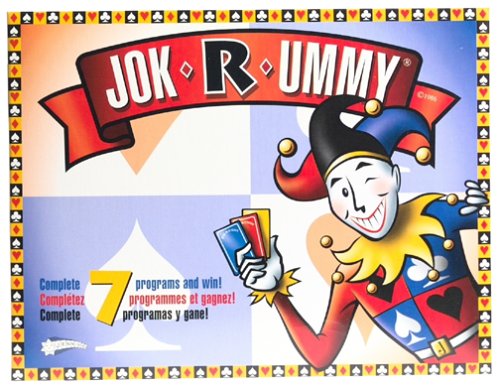
Jok-R-ummy

If you’ve been reading my blog for a while, it should come as no surprise that I love games. I have a particular soft-spot for complex board games, but I also enjoy a lot of different card games. Some family favorites include Euchre, Nertz (a variant of Dutch Blitz), and Rummy in all its various forms and iterations. But this past weekend I got introduced to a Rummy variant that I really enjoyed, so I thought I would pass it along to  my readers.

It’s called Joker Rummy (well okay, technically Jok-R-ummy, but I do not want to write that out every time!). Like most forms of Rummy, you divide out all the cards, draw and discard a card each turn, and attempt to lay down sets (cards of the same number) or runs (cards of the same suit in order) to score points. In this case, both Jokers and 2s are considered wild, meaning that they can be used to represent any other card. But unlike traditionally Rummy, every player isn’t going for the same goal. Instead, each round, you draw a card that describes your particular goal for that round.

Let me give you a few examples:
  • A set of 5 of a particular card (like 5 Jacks or 5 10s, for example)
  • Two three card sets and one four card run
  • A run of seven cards
  • A run of four cards in a particular suit
Once you achieve your goal for that round, you try to “go out” like in traditionally Rummy, by adding to either your own played cards or those of your opponent, until you discard your last card at the end of your turn. However, you don’t score any points this way. Instead, your only points are the number of goal cards you complete at the end of the game, which is typically played to seven. As soon as someone goes out, the round is over. Any player who completed their goal draws a new card, and the next round begins.

Luck is obviously a major factor in any card game, and the fact that there is so much variation among the goal cards just increases that variability. Worse still, if you don’t complete a particular hard goal, you’re stuck with it for every round until you finally do so. This can be quite punishing when you have a particularly difficult goal.

As a result, we tried two different variants to help mitigate this:
  1. If you get stuck on the same goal for two rounds in a row, you have the option to discard that card and take a new one before starting the next round.
  2. Rather than drawing one goal, you start with three goals in hand. You may attempt any of these three goals during a round, but you can only accomplish one per round. Additionally, in-between rounds, you always draw back up to three goal cards.
Overall, I found Joker Rummy to be an enjoyable game. It’s not particularly difficult or complex, but there’s just enough strategy to make it interesting. Seems like it would be a great game when you just want something to play while enjoying good conversation with friends. If you’re looking for something a bit different to play at your next game night – give it a try!

See you next time.

Saturday, March 8, 2014

40 Days Away From Magic, Part Three

As I announced on Twitter earlier this week, I will be taking  40 days away from Magic the Gathering. This means I will not play, write, or blog about Magic. This even includes staying away from my Twitter feed and the various websites that provide high quality articles and videos related to this great game. I will, however, continue to host Monday Pauper Deck Challenge.

This week, I will be exploring three reasons why I believe this is the right decision and the right time for me to take this time away from the hobby that I enjoy so much. I posted the first reason on Tuesday, as well as the second reason on Thursday. Today I want to talk about the third and final reason.

About a year ago, I was diagnosed with depression. While my case was relatively minor, it appears likely I had been struggling with it for years without any recognition or treatment. I started taking anti-depressants, and the results have been dramatic. Yet I still struggle from time to time. So, in addition to my medication, I have also been exploring what triggers my episodes and how to mitigate those situations.

Unfortunately, playing Magic the Gathering can be a trigger. While I get great enjoyment out of providing a great tournament and resources for Standard Pauper, when my personal gaming is in a rut, it is easy for it to begin to affect me emotionally. And this, in turn, takes its toll on my life, my friends, and my family. I have tried pushing through these episodes while continuing to play, but as of yet this has not been a successful strategy.

I am hopeful that the next few weeks without Magic will help in this area. Already, I can recognize patterns in my gaming that have been unhealthy. At the same time, I already miss a lot of the things I enjoy about the game, and it hasn't even been a full week yet. I sincerely believe that this 40 day period away from Magic will lead to breakthrough. But even if it doesn't, I do know that it will allow me to enjoy Magic the Gathering for a long time to come.

Next week, I will be back to my less personal posts here on my blog. I've got books and games to review, some more writing resources to discuss, and a few other surprises in the queue. And it won't be long before the 40 days will be at an end. I promise I will have lots of great Standard Pauper content forthcoming.

Thanks for reading.

Thursday, March 6, 2014

40 Days Away From Magic, Part Two

As I announced on Twitter earlier this week, I will be taking  40 days away from Magic the Gathering. This means I will not play, write, or blog about Magic. This even includes staying away from my Twitter feed and the various websites that provide high quality articles and videos related to this great game. I will, however, continue to host Monday Pauper Deck Challenge.

This week, I will be exploring three reasons why I believe this is the right decision and the right time for me to take this time away from the hobby that I enjoy so much. I posted the first reason on Tuesday. Here's the second one.

The broken locks were a warning,
you got inside my head
I tried my best to be guarded,
I'm an open book instead
I still see your reflection
inside of my eyes
That are looking for a purpose,
they're still looking for life
                                                                                                - “Broken”

Several years ago, I was part of a conversation about how you know when something you enjoy has become unhealthy or destructive. My friend’s answer was: when it owns your heart.
 
That’s why I feel like I need some time away from Magic. I fear it’s gotten to the point that it owns my heart. So much of my leisure time has been devoted to it: reading articles, watching videos, testing out different decks, writing about it, blogging about it – the list goes on. Even worse, when my play experience goes badly - as it will for anyone from time to time – my reaction is way out of proportion. In fact, after a particularly frustrating match during MPDC this week, there was a moment when I just wanted to log off Magic Online and never open it again.
 
So if my diagnosis is right, the best cure is time away. Time to discover just enmeshed this game has become in my heart. Time to reflect on where this has become dehumanizing and unhealthy. And time away to miss what is good and fun about it and look forward to returning to it next month.
 
In the end, I believe this time away will restore my enjoyment of the game – and in the process, make me a better Magic player. See you next time.

Tuesday, March 4, 2014

40 Days Away from Magic, Part One

As I announced on Twitter yesterday, I will be taking the next 40 days away from Magic the Gathering. This means I will not play, write, or blog about Magic. This even includes staying away from my Twitter feed and the various websites that provide high quality articles and videos related to this great game. I will, however, continue to host Monday Pauper Deck Challenge.

This week, I want to explore three reasons why I believe this is the right decision and the right time for me to take this time away from the hobby that I enjoy so much. Here's the first one.

Tomorrow marks the start of the observation of Lent, a Christian religious observance that marks a period of repentance and devotion to God in preparation for the celebration of Easter. In the past, I have misunderstood Lent to be a typical "anti-world" Christian activity, rejecting so called "worldly-things" in favor of "heavenly things." Or, even worse, as a shallow religious activity designed to convince an arbitrary God to overlook past mistakes and/or earn His blessings.

However, as I read more about this ancient tradition, I discovered that it is, in fact, about something very different. All of us have a limited ability to experience things in life. We only have so much brain-power, so much attention, and so many waking hours. Lent, then, is a time to set aside lesser things to make margin in one's life for something better. A time to recognize those things that are dehumanizing and hurtful, turn from them, and embrace something better.

So for the next 40 days, I will be setting aside the time I normally focus on Magic to instead pursue more important goals: spending time with friends and family, developing my writing skills, enjoying some good literature, and cultivating love, joy, and peace. I believe that by intentionally pursuing these things over the next 40 days, I will not only experience a better, richer life; in the end, it will also free me to have a greater enjoyment of Magic in the future. More on that next time.

Saturday, March 1, 2014

When a Host Plays, He Cheats

I was chatting with one of my fellow Standard Pauper players earlier today, and during a discussion about what happened to a previous Player Run Event, he mentioned that one of the issues involved was the accusation that the host was cheating. Apparently, some involved believed that it is always inappropriate for a host to play in any event he or she is running.

I thought this was an interesting perspective. For as long as I have been involved on Magic Online in various Player Run Events, the host has always been a participant. I also almost always play in the events that I run. And I have never even considered that this might be seen as cheating. Here's why:

There is actually surprisingly little a host can do to cheat. Sure, he or she can try to manipulate the pairings to get what might seem like a less-experienced opponent. The host could even make sure that he or she always received the bye whenever eligible to receive it. I suppose the host could even deliberately alter the pairings to try to improve his or her tiebreakers.

Here's the thing though. Those actions, dishonest as they are, are a very minor advantage. And they come with a huge cost. Player Run Events have always been about trust. The players trust that the host will provide the prizes advertised; all of the players assume that the other players won't change their deck or Sideboard in between rounds; the host trusts that none of the players are intentionally losing to another player to then split the prizes. Trust is fundamental to the success of a PRE. Without it, the event will lose players and eventually die out.

So for a host, it makes no sense to try to gain an edge by unfairly manipulating the pairings. The potential loss of trust is massive, and the potential gain from those actions is pretty minor. After all, the host still has to actually win most or all of his matches, and on Magic Online, there is very little you can do to cheat your way to a win.

But I'd love to hear what the community thinks. Is it improper for a host to play in an event he or she is running? Why or why not? Let me know in the comments.