Tuesday, September 16, 2014

Khans of Tarkir: Morph

In case you somehow missed it, the returning mechanic for Khans of Tarkir is Morph. Morph was first introduced way back in Onslaught, and is certainly one of the stranger mechanics in Magic's history. The ability to essentially play a 2/2 token for 3 mana by putting the card face-down introduces a whole new element of hidden knowledge from your opponent, and the complexity is even higher given that you can flip a Morph card over at any time, assuming you have enough mana to pay the Morph cost. It is also worth pointing out here that the act of turning the card face-up doesn't use the stack, and thus cannot be responded to. In other words, if your opponent pays the Morph cost and goes to flip over her creature, you can't cast Shock to remove it as a 2/2 creature.

As I have been working on the set review for Standard Pauper for Khans of Tarkir, I have had some difficulty in evaluating just how good the Morph cards are in this set. Today, rather than looking at specific cards, I want to evaluate the mechanic as a whole.

Typically, Morph cards have three major advantages over other creatures:
  1. Your opponent doesn't know what creature you played. Since all Morph cards cost the same to play face-down, your opponent has no real information to go on. Unless he is playing Lens of Clarity, the only way your opponent learns what card you played either when you flip it over or when it leaves the battlefield or the game ends.
  2. You can always play the card as soon as you have three mana available. Playing them facedown doesn't require any specific colored mana. Additionally, most of the time this is cheaper than the actual casting cost of the creature, allowing you to get value out of the card much earlier than you otherwise could.
  3. You control when the creature is flipped over. This means that you can effectively surprise your opponent in combat, allowing you to block a creature you might not have been able to block or setup a favorable block that your opponent couldn't foresee.
These are pretty significant advantages. Honestly, given the complexity that this introduces, I am surprised Morph is being reprinted at Common. This also means that we should expect that the Morphs at Common will probably only be vanilla or french-vanilla creatures, since additional complexity would easily push the card into Uncommon or Rare.

For those of you who have played with Morph cards before, what do you think of them in general? Are you excited to get your hands on them in Khans of Tarkir? Let me know in the comments below.

Saturday, September 13, 2014

Khans of Tarkir: Full Spoiler and Contest Results

That didn't take long.

Probably timed to coincide with the start of the Community Cup, the full spoiler for Khans of Tarkir has been released. The timing is also convenient for me, since it allows me to immediately announce the results of the contest I held right here at Write Adept in my previous blog post.

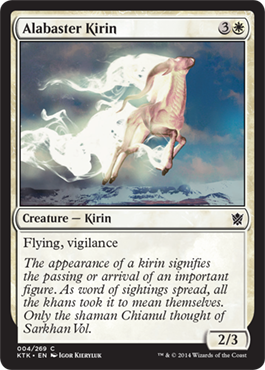
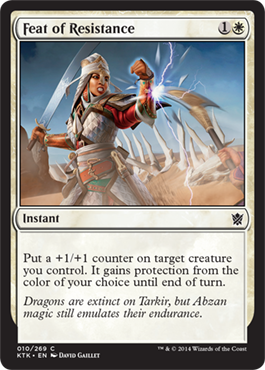
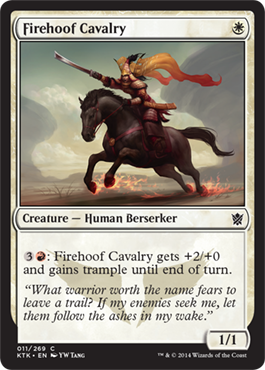
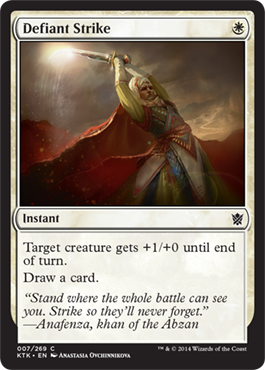
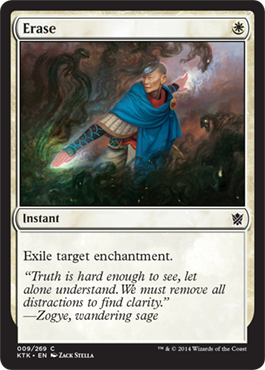
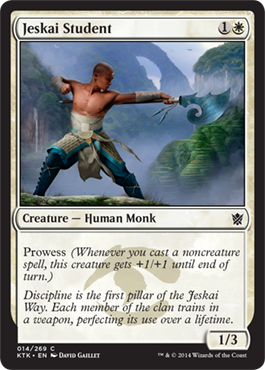
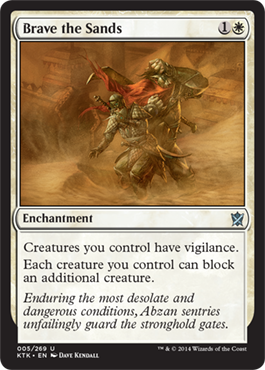
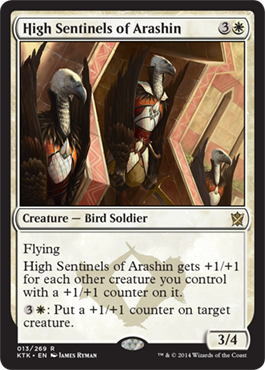
For those who missed it, MTGSalvation had a slew of unofficial spoilers, including a bunch of White cards that included the full rules text but not the rarity of the cards. I posted them and asked my loyal readers to try to figure out which ones could be Common based on power-level. For reference, here are the cards in question (click on the image for a larger version):


For reference, I should have numbered them, particularly since they ended up out of any logical order due to my unusual copy/paste from the site. For today's post, I will simply refer to them from left to right, finishing the whole row before moving down to the next row. The correct rarity for the cards is as follows: Uncommon, Common, Uncommon, Common, Common, Rare, Uncommon, Common, Common, Common, Common, Common.

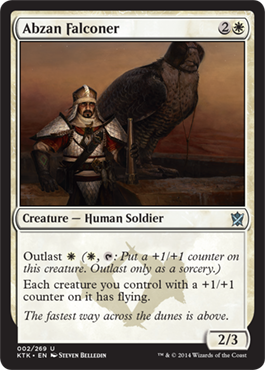
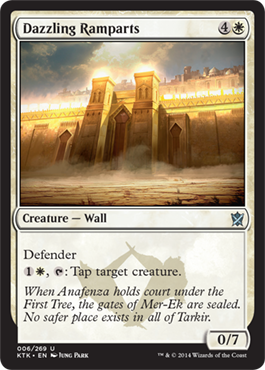
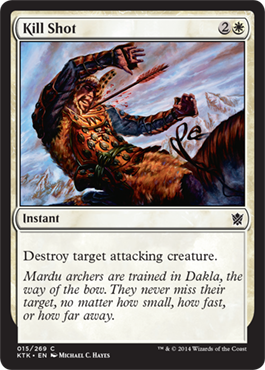
Out of these eleven cards, I thought six of them were obviously Common: Alabaster Kirin, Feat of Resistance, Firehoof Calvary, Defiant Strike, Erase, and Jeskai Student. These six cards represent elements almost always found at White at Common: simple combat tricks, "fair" costed creatures with a single ability, a single-target protection spell, and a reprinted Enchantment hate. Additionally, both Brave the Sands and High Sentinels of Arashin were clearly not Commons, since both add significant complexity to combat with the latter also requiring you to keep an accurate understanding of the board to determine the Sentinel's Power and Toughness. That left Abzan Falconer, Dazzling Ramparts, and Kill Shot as the more tricky to evaluate.

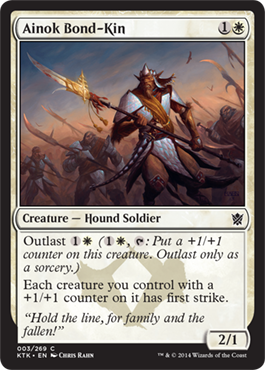
Under the right circumstances, I would vouch that all three could be potential Commons, at least with minor tweaks. Abzan Falconer is probably too efficiently costed to be a Common, both for its Outlast cost and its casting cost, and granting Flying is arguably too strong at Common. However, it isn't that different than Ainok Bond-Kin, and so is borderline between Common and Uncommon. Dazzling Ramparts is even closer, as White often gets a tapper at Common, and an 0/7 Defender for 1W is not particularly efficient. Finally, Kill Shot, while clearly better than the classic Divine Verdict, is a functional reprint of Rebuke from Innistrad. 

As far as my evaluation, I actually missed only one, placing Dazzling Ramparts as a Common instead of an Uncommon. Chris Baker, one of only two entries, got them all correct, and so Writer Adept will be awarding him a single ticket for his victory!

I hope you enjoyed this exercise. Thanks for reading.

Thursday, September 11, 2014

Khans of Tarkir: Could It Be Common?

Another spoiler season for a new set, another set of unofficial spoilers, this time courtesy of MTGSalvation. In this case user nal2 posted the text of a bunch of cards from Khans of Tarkir, without artwork or even the rarity. As I was perusing the spoiled cards, I found myself trying to figure out which ones could be Common. It was such an interesting exercise, I thought I would post it up here on the blog for my readers. But rather than focusing on all of them, I decided to limit it to White.

Since the information could change quickly (especially with Sealed Clans of Tarkir as a Community Cup event this weekend), here are the White cards that were spoiled in this batch (click on the image for full size resolution):


Based on what we know about Common Design, can you pick out which of these cards are Common? Actually, I would divide them into three categories, based on the fact that sometimes rarity is determined by factors other than power level or complexity.
  1. Probably Common
  2. Definitely Common
  3. Not Common
I've recorded my picks, and I will discuss them on Saturday. Let me know your picks in the comments below. Once these eleven cards  are spoiled, I'll even throw in a small prize for whoever gets them all correct (or randomly select one among multiple winners).

Tuesday, September 9, 2014

Khans of Tarkir: Refuge Lands

It's spoiler season once again, which means we are finally getting our first glance at the Commons for the upcoming fall release of Khans of Tarkir. While the entire Common pool won't be known until the full set is finally spoiled, this week a new Common cycle was disclosed that will have a major impact on the upcoming metagame.

With this set emphasizing multicolor by means of three-color wedges, a major emphasis in the design is mana-fixing. According to Erik Lauer's article this week, at one point R&D was strongly considering actually released three color lands at Common. This would have been a major milestone, but sadly it was not to be, as tri-color lands at Common pushed too many developers to play four or five color decks rather than sticking to one of the wedges. Which meant that these tri-color lands ended up at Uncommon, and instead at Common we got these:


Called 'Refuge Lands' (from an identical cycle of Uncommon Lands from Zendikar), these ten duals will replace the Return to Ravnica Gates when they rotate out of Standard this fall. While not technically strictly better than the Gates (since Gate is a sub-type that affected other permanents), for all intents and purposes these will functional almost exactly the same, other than the small but not insignificant incidental lifegain when they enter the battlefield. 

The inclusion of this cycle is significant for Standard Pauper in at least three ways:
  1. It solidifies that dual-colored, enters-the-battlefield tapped, Lands can be printed at Common, even with a minor beneficial effect.
  2. It weakens Aggro strategies, in that it not only incentivizes players to play multiple colors, it also rewards them with extra life for doing so, helping them to survive early aggression. The latter is particularly potent in a format that already will include Radiant Fountain.
  3. It should allow players to utilize the best of the wedge and/or multicolor cards from the block effectively. Since such cards tend to be stronger (and thus more expensive), this will also push the format away from Aggro.
So what do you think of this cycle of Lands? Let me know in the comments below. See you next time.

Saturday, September 6, 2014

Guest Blog: Chris Baker on Tilt

Earlier this week, I wrote about one of my recent episodes of tilt. I admit I was still pretty steamed when I wrote that post, and I think it came out in what I wrote. Chris Baker, Standard Pauper enthusiast, host of SPDC, and author of The Draft Brewery, took the time to send me a lengthy response via E-mail. It was so good I wanted to share it here. So here's Chris, in his own words, on how to deal with tilt.

There are things in life you have control over and things that you do not.  What other people think about you, how other people react to situations / react to your writing etc - you cannot control.  The cards in your opening 7, the cards on top, etc - you cannot control. 

Is is pointless to care about things that are not in your control.  It's like buying a lottery ticket, not winning, and being sad about it.  It's like having a favorite sports team and becoming depressed when they lose.  I see that all the time and I think it's a joke.

Sometimes other people like us.  Sometimes the deck likes us and we draw perfects, right on time.  When it doesn't, my advice is to simply not care.  The reason is because the consequences are nonexistent.  The more you care the more hurt you feel.  You lost one match in a league that has 4 rounds.  It's just not a big deal.  You still can go 3-1 and make Top8.  You could lose out every other round but you play the game for the chance to get good draws and crush people, too.  The results are unknown.  The fact that your game 1 would have been so drastically different with just one land is a tough pill to swallow because it is a "so close but so far" scenario. 

Round 8, fighting to stay alive for Day 2 for my team at GPPortland.  I kept a solid 2 land hand on the draw and I drew 13 land in my first 19 cards in library in game 3 where my match would be the decider.  The first 3 lands on top were perfect, but the rest were garbage.   I barely lost and I got the opponent down to 3 life with multiple Lightning Strikes in the deck.  I was pissed.  Any spell would have done it at basically any point.  I forgot about it by the next day and was beating Rietzl, Sperling, and DWilliams in a team draft the next day.

Had the closest game imaginable G2 against DW where his Ancient Silverback abyssed me for 14 turns.  I finally drew a second white source by turn 10 so that I could play white creature + Spirit Bonds activation to stay alive (I was down to 6 life) on a stable board except for the Gorilla) and then had Rogue's Gloves to draw more gas to chump his beats more.  I bricked a few too many turns in a row with dead land draws and that was it.  I rolled him with a nut-draw game 3.  I had control of the cards I drafted for my deck the and for the decision to barely stay alive all game 2 instead of conceding when it looked super grim.  I was not in control of my draws but game 3 I got rewarded.  Either way, I was happy to win and get a sick draw but I don't care much about that because I wasn't in control of that game 3.  Game 2 was the tightest, most fun game I've played in this format and I would love to be in that situation again. 

Big picture - losing you Mono-Red mirror match does not influence your success in life nor should it affect your happiness.  It can if you let it, but I don't think it should. 

When you focus on creating a positive disposition in your mind that isn't dependent on perfect results to be happy, I find that it's easier to let go.  The only thing you can control is how you react, perceive, and deal with the cards that show up in the game and in life.  No one gets dealt perfect cards 100% of the time.  I admire people who do the best to turn the crappy hands into the best possible.  In magic, in means never conceding until you are actually killed.  It means mulling to 5 and thinking about the decision of mulling to 4 or not because you did not lose yet.  The decision matters.  You think, you fight, you try your best to win with what is given to you.  That is respectable and is what I learned from competitive sports as a junior in tennis.  I was down 0-5 in my Conference Finals senior year and I won that set 7-5 and then the match.  When your back is against the wall you will either crumble or focus.  I think it depends on how you train.  If you train your mind to be tough and never give up, then you will thrive, or at least give yourself the best chance to do so. 

Big-time mentally tough people with short-term memory loss for things that don't go our way - that's the ideal athlete/magic player attitude that I want to teach my students/patients/friends/kids to be like. 

Sometimes when we lack discipline, we need consequences/accountability somewhere to keep us in check.  So take it easy on yourself and you better stay in that event and do work!  Get better draws and you'll be fine, but even if you don't - who cares?  You can always play another game another day. 

Thursday, September 4, 2014

A Confession of Tilt

It happened again last night.

No this isn't another bad beats story. It's more like a confession; a diagnosis of the malady I'm still suffering from.

I've blogged fairly recently about tilt and how I've struggled with it for the last few years in relation to playing Magic. Last night, it hit me again - hard.

I was playing out my match for the "M" Core League. Both my opponent and I were played a Mono-Red build. Game 1 I got shorted on two mana, drew all my three drops, and basically did nothing the entire game. Game 2, I kept an opener with three lands, and drew two more lands in my next draws. I immediately conceded and then dropped from the event.

This happens to everyone who plays Magic. It happens a lot to me. It feels like it happens way more often to me than anybody else, but intellectually I know that's nonsense. Lately, I've done better at just shrugging off the variance, fighting for every narrow edge, and pushing through. But apparently I still have a long way to go.

If anyone has any ideas on how I can grow in this area, I'd love to hear about it. God knows, I need all the help I can get.

Tuesday, September 2, 2014

Escape: The Curse of the Temple Review

One of the new board games that my wife and I picked up at GenCon is Escape: The Curse of the Temple. Given that the game is not normally distributed in the United States, this was a great find, particularly since we also got two of the expansions almost for free.

One of the great things about GenCon is that you get to playtest almost any game before you buy it. My wife had played before, and recommended it highly. After watching the group ahead of us play, and then playing through it myself, I was hooked.

Escape: The Curse of the Temple is a cooperative board game themed around the concept of exploring a jungle temple, dodging deadly traps, and retrieving gems before the temple closes, trapping you inside forever. The most unique feature of the game is that its played in real-time. You have ten minutes to play the game, and when time's up, you immediately either win or lose. Time is kept by an included soundtrack, which not only provides some music appropriate for the theme, but also signals certain events that you have to react to or face the consequences. The music adds a great ambiance to the game, and really contributes to the pressure to get in, get the treasure, and get out.

The temple is laid out by randomly arranging a series of square interior pieces, which are revealed one at a time as you explore. The exit to the temple is always one of the last interior pieces in the pile, which means that you have to reveal most of the temple before you're able to escape. These same interior pieces also include the pedestals for the gems. The number of gems left in the temple contributes to the difficulty in escaping. So to get out, you not only have to find the exit, but you also have to get as many gems as possible.

All this is accomplished through a simple dice-rolling mechanic. Rather than standard dice, each person has a set of five dice with six different symbols on them. Exploring, moving between rooms, and picking up gems are all accomplished by different combinations of these symbols. Furthermore, the dice also include a curse symbol, which locks that die out of the game until you (or another player in the same room) rolls the blessing symbol. Finally, once you've gotten enough gems, it takes yet another combination of dice for each player to exit.

If you've played the classic game Yahtzee, the dice rolling plays out a lot like that. Except rather than taking turns, every player is playing at the same time for the entire length of the game. Each player is constantly rolling twice, trying for specific combos, then moving on to the next step. Since you can choose to save a particular roll and reroll the others, there is a certain amount of strategy in your rolling, but for the most part you're just trying to roll as fast as you can.

The base game includes a few other variants to try once you've mastered the base game, and the two expansions add even more options. I haven't yet had the time to try these out, but once I do so I will definitely report back.

Escape: The Curse of the Temple is a great game and one that I highly recommend. Even if you're not a big "geek-gamer," this is a fast, fun game that anyone can enjoy. The game is easy to play, easy to teach, and one enjoyable by all ages. If you get a chance to pick it up, you won't be disappointed.