Earlier this week, I wrote about one of my recent episodes of tilt. I admit I was still pretty steamed when I wrote that post, and I think it came out in what I wrote. Chris Baker, Standard Pauper enthusiast, host of SPDC, and author of The Draft Brewery, took the time to send me a lengthy response via E-mail. It was so good I wanted to share it here. So here's Chris, in his own words, on how to deal with tilt.
There are things in life you have control over and things that you do
not. What other people think about you, how other people react to
situations / react to your writing etc - you cannot control. The cards
in your opening 7, the cards on top, etc - you cannot control.
Is is pointless to care about things that are not in your control.
It's like buying a lottery ticket, not winning, and being sad about it.
It's like having a favorite sports team and becoming depressed when
they lose. I see that all the time and I think it's a joke.
Sometimes other people like us. Sometimes the deck likes us and we
draw perfects, right on time. When it doesn't, my advice is to simply
not care. The reason is because the consequences are nonexistent. The
more you care the more hurt you feel. You lost one match in a league
that has 4 rounds. It's just not a big deal. You still can go 3-1 and
make Top8. You could lose out every other round but you play the game
for the chance to get good draws and crush people, too. The results are
unknown. The fact that your game 1 would have been so drastically
different with just one land is a tough pill to swallow because it is a
"so close but so far" scenario.
Round 8, fighting to stay alive for Day 2 for my team at
GPPortland. I kept a solid 2 land hand on the draw and I drew 13 land
in my first 19 cards in library in game 3 where my match would be the
decider. The first 3 lands on top were perfect, but the rest were
garbage. I barely lost and I got the opponent down to 3 life with
multiple Lightning Strikes in the deck. I was pissed. Any spell would
have done it at basically any point. I forgot about it by the next day
and was beating Rietzl, Sperling, and DWilliams in a team draft the next
day.
Had the closest game imaginable G2 against DW where his Ancient
Silverback abyssed me for 14 turns. I finally drew a second white
source by turn 10 so that I could play white creature + Spirit Bonds
activation to stay alive (I was down to 6 life) on a stable board except
for the Gorilla) and then had Rogue's Gloves to draw more gas to chump
his beats more. I bricked a few too many turns in a row with dead land
draws and that was it. I rolled him with a nut-draw game 3. I had
control of the cards I drafted for my deck the and for the decision to
barely stay alive all game 2 instead of conceding when it looked super
grim. I was not in control of my draws but game 3 I got rewarded.
Either way, I was happy to win and get a sick draw but I don't care much
about that because I wasn't in control of that game 3. Game 2 was the
tightest, most fun game I've played in this format and I would love to
be in that situation again.
Big picture - losing you Mono-Red mirror match does not influence
your success in life nor should it affect your happiness. It can if you
let it, but I don't think it should.
When you focus on
creating a positive disposition in your mind that isn't dependent on
perfect results to be happy, I find that it's easier to let go. The
only thing you can control is how you react, perceive, and deal with the
cards that show up in the game and in life. No one gets dealt perfect
cards 100% of the time. I admire people who do the best to turn the
crappy hands into the best possible. In magic, in means never conceding
until you are actually killed. It means mulling to 5 and thinking
about the decision of mulling to 4 or not because you did not lose yet.
The decision matters. You think, you fight, you try your best to win
with what is given to you. That is respectable and is what I learned
from competitive sports as a junior in tennis. I was down 0-5 in my
Conference Finals senior year and I won that set 7-5 and then the
match. When your back is against the wall you will either crumble or
focus. I think it depends on how you train. If you train your mind to
be tough and never give up, then you will thrive, or at least give
yourself the best chance to do so.
Big-time mentally tough people with short-term memory loss for
things that don't go our way - that's the ideal athlete/magic player
attitude that I want to teach my students/patients/friends/kids to be
like.
Sometimes when we lack discipline, we need
consequences/accountability somewhere to keep us in check. So take it
easy on yourself and you better stay in that event and do work! Get
better draws and you'll be fine, but even if you don't - who cares? You
can always play another game another day.
Showing posts with label Tilt. Show all posts
Saturday, September 6, 2014
Thursday, September 4, 2014
A Confession of Tilt
It happened again last night.
No this isn't another bad beats story. It's more like a confession; a diagnosis of the malady I'm still suffering from.
I've blogged fairly recently about tilt and how I've struggled with it for the last few years in relation to playing Magic. Last night, it hit me again - hard.
I was playing out my match for the "M" Core League. Both my opponent and I were played a Mono-Red build. Game 1 I got shorted on two mana, drew all my three drops, and basically did nothing the entire game. Game 2, I kept an opener with three lands, and drew two more lands in my next draws. I immediately conceded and then dropped from the event.
This happens to everyone who plays Magic. It happens a lot to me. It feels like it happens way more often to me than anybody else, but intellectually I know that's nonsense. Lately, I've done better at just shrugging off the variance, fighting for every narrow edge, and pushing through. But apparently I still have a long way to go.
If anyone has any ideas on how I can grow in this area, I'd love to hear about it. God knows, I need all the help I can get.
Tuesday, July 29, 2014
On Tilt: Find New Habits
All last week, I explored the concept of tilt. First, I discussed the origin of the term tilt and how it moved from pinball to Poker to Magic the Gathering. Next,
I summarized some of my own struggles with tilt. Finally, I discussed some new ways of thinking about tilt that I found helpful. Today, I want to finish by examining some habits that can help address tilt.
I ended my last post with the statement that knowledge alone is rarely enough to change behavior. As human beings, we can recognize when certain behavior patterns are destructive or irrational, but this recognition alone is rarely sufficient to bring about change. What is needed is to develop new habits.
Imagine trying to change the course of a small creek. One simply cannot dig a new channel and hope for the best. You must dam up the water, create a new course for the water to run, and make sure the water will correctly transition to the newly dug channel. In the same way, when it comes to changing behavior, one must not only awkwardly practice new habits, but one must work hard to block the old patterns of behavior until the transition to the new behavior becomes habitual.
So here are some actions that I have found helpful in address tilt:
1. Recognize when you are tilting. Tilt is most dangerous when it is unrecognized. Learn to recognize your own body cues that signal this aggressive shift in your emotions. Maybe it's a rise in your internal temperature, an inability to focus your thoughts, or even a simmering rage like I typically experience. Whatever the symptom, if you have any chance of avoiding the pitfalls of tilt, you have to clearly identify when your mental balance is being pushed upon. Heed the warning, stop "nudging" the table, and take the next step.
2. Refocus your thoughts and emotions. Once your recognize the danger signs, you've got to stop what you're doing and refocus. Step away for a moment. Take several deep breaths. In between games, you can even get up, walk outside for a moment, listen to a song on the Internet, or almost anything that helps you relax, refocus, and push back against your rising emotions.
3. Come back to the game. At some point, you've got to come back to the game. In the middle of an event or a tournament, you may not have the freedom to simply walk away and take as much time as needed to get your emotions back in check. In the short term, force yourself to rethink your play without making snap decisions. Don't rely on your instincts, especially since what probably comes most naturally is to drift right back into tilt. Slow down, put what's already happened behind you, and focus on the reason why you're playing the game in the first place.
I still have a long way to go before I feel like I have mastered my own struggles with tilt. But with these actions slowly but surely becoming habitual in my life, I have seen progress.
What about you, my readers? Have you struggled with tilt? If so, what have you found helps? Let me know in the comments below. Thanks for reading.
Next time, I'll be back with an annoying Magic Online bug and what you can do to make sure it gets fixed.
Saturday, July 26, 2014
On Tilt: A New Perspective
For the next couple posts, I want to explore the concept of tilt. Earlier this week, I discussed the origin of the term tilt and how it moved from pinball to Poker to Magic the Gathering. Then, last time, I summarized some of my own struggles with tilt. Today, I want to talk about a new way of thinking about this level of frustration.
Allow me to share with you two statements that stopped me in my tracks:
1. Everyone will eventually run worse than they ever thought was possible. Let that sink in for a moment. No matter how good you
may be, no matter how successful you may become, at some point the
bottom is going to drop out. You will experience a sequence of bad
outcomes. And this sequence won't play itself out quickly. Instead, it
will continue longer than you would ever have thought possible. And
here's the clincher.
2. The difference between a winner and a loser is that the latter thinks they don't deserve it. Allow me to restate that more clearly. You do not
deserve to win a single game of Magic. Again, no matter how good you may
be, no matter how successful you may become, you do not deserve to ever
win another game of Magic. Nothing is given. The universe owes you
nothing. Great skill and great success do not guarantee future results.
And until you are ready to accept this, you don't belong among the ranks
of winners.
Maybe this sounds like bad news. But in fact, at least for me, it is surprisingly liberating. Part of what I believe fuels the frustration of tilt is this unspoken belief that this particular sequence of bad beats is some sort of cosmic injustice that must be righted if the world is to go on as before. It simply feels so unfair, so wrong, so staggeringly unlikely as to be almost unbelievable. And the natural response of most of us to injustice is a blazing passion to see the wrong made right, especially if we're the one who is perceived to be the victim. But there is no victim here. No matter how great the odds are against the sequence of outcomes that have dropped the bottom out of my game, I don't deserve anything better. I am owed nothing. And I shouldn't be surprised by these experiences. After all, at one point or another everyone is going to have a similar story.
Unfortunately, knowledge alone is rarely enough to change behavior, especially when behavior has become habitual. So if you struggle with tilt, what should you do about it? That's what I want to talk about next time.
Thursday, July 24, 2014
On Tilt: My Story
For the next couple posts, I want to explore the concept of tilt. Last time, I discussed the origin of the term tilt and how it moved from pinball to Poker to Magic the Gathering. Today, I want to explore some of my own experiences with tilt.
This series of tweets from a couple of years ago encapsulates my experience of tilt fairly well:
To say that I was frustrated was putting it mildly. It seemed every time I sat down to play Magic I left feeling angry, frustrated, out-of-control, and hopeless that I could ever get back to playing well, writing articles, and videocasting. In fact, I actually got so tilted after a poor match that I literally quit hosting in the middle of a tournament. Granted, I came to my senses minutes later and logged back in and apologized. But that's how bad things had gotten.
I wish I could say that I learned something from that experience and all was well from that point forward. But sadly that wasn't the case. In fact, just this year, I ended up taking a 40 day hiatus from Magic, realizing that my frustration had built up to the point where time away was the only solution.
But here's the thing: every time that I reach that level of frustration, I realize that I don't want to just give up and walk away. Not only would I be walking away from what has become my favorite hobby, but I would also be losing a wonderful creative outlet and letting down the community that has developed around the Standard Pauper format.
So what should I do? What's the solution? As with most things, the key is changing my pattern of thinking. What I need is to readjust my thoughts to a different perspective. Next time, I want to talk about what that perspective is.
Tuesday, July 22, 2014
On Tilt: Origins
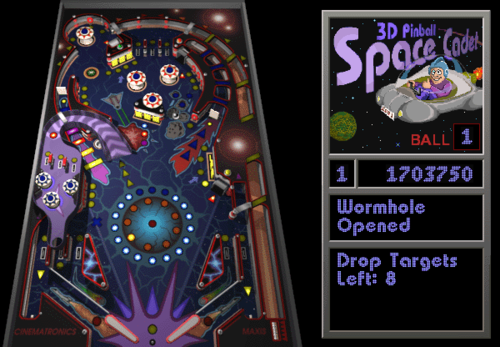
For the next couple posts, I want to explore the concept of tilt. And it all starts with the simple game of pinball, which I spent way too many hours playing. Not on a physical machine,
unfortunately. But, I spent countless hours playing 3D Space Cadet Pinball on Windows XP. Granted, I was not the most skilled player, but
it was still fun.
Of course, virtual physics don't quite match up to the real-world counterpart. Nowhere was this more apparent than in its "nudge" control, which would allow you to virtually "bump" the table in a particular direction, much as you can in a real arcade pinball machine. Rarely did this feature accomplish anything other than activating the game's tilt sensor. For those unfamiliar with pinball (virtual or otherwise), this tilt sensor immediately locks out all the controls and often cancels any bonuses or other earned advantages in the game. I distinctly remember watching that little silver ball bounce erratically around the course, powerless to do anything to affect its eventual trajectory down the drain. While occasionally I would heed the warnings from my frequent use of the "nudge" control and tone back my button mashing, usually I just ignored them.
Today, the term tilt has survived the near-extinction of the pinball machine and come into the world of Magic via poker. When confronted by a series of events in which the player experiences frustration, animosity, or bad luck, an emotional response is triggered. The player becomes more aggressive, more likely to make bad decisions, and often feels as if he or she is owed an optimal outcome due to the sequence of misfortune that has played itself out. Just like a poor bounce of the pinball would lead a player to pushing aggressively on the table to try and change the ball's trajectory, these events cause a player to aggressively push back against the game, giving up control and finesse and attempting to force good results through sheer effort. And in either case, this aggression ends with the player powerless to do anything except watch the silver ball, and his or her game, slide down the drain to yet another loss.
In poker, tilt results in players throwing away significant dollars by playing out too many hands, making unreasonable calls and raises, and stubbornly refusing to walk away until they win their money back. In Magic, while the stakes are certainly much lower, the same sequence can play itself out, leading to increasing frustration, a feeling of powerlessness, and the sense that one has lost the ability to compete. And in either case, tilt has no doubt been a major factor in the decision for that player to walk away from the game, never to return.
I should know. Too many times, I've allowed tilt to detract from the fun of Magic. And worse, I've seriously considered walking away. Next time, I'll share more about my own experiences with tilt.
Subscribe to:
Posts (Atom)