Showing posts with label Fate Reforged. Show all posts

Friday, April 1, 2016

Farewell to the Clans, Part Two

Last time, I talked about how with the upcoming release of Shadows Over Innistrad that Standard will be rotating soon, with some very significant Commons from Khans of Tarkir and Fate Reforged leaving the format forever. This shift will drastically change the Standard Pauper format, and so I wanted to dedicate my blog posts this week to looking at what I believe are the six cards whose loss will have the biggest impact in the format. I already discussed Disdainful Stroke, Gurmag Angler, and Hooting Mandrills. Today, I'll look at the other three.

4. Jeskai Sage is another card that looked fairly innocuous when it was released, but proved to be a major cornerstone of an archetype in the format. In the right deck, it typically will attack as a 2/2 thanks to Prowess, and is a particularly strong target for combat tricks. But best of all, you can trade it off with your opponent's creatures without regret, since upon death it immediately cycles for a brand new card. That's built-in card advantage for an already decent card, and in a format where every little edge counts, it's little wonder that this little card proved to be such a gem.

5. While White has somewhat fallen out of favor, Sandsteppe Outcast is the perfect card for any White Weenie or similar archetype. For your three mana you get three points worth of Power, which most of the time you will want to split up into two creatures, one of which gets Flying. The fact that the card also had the Warrior subtype was another important boon to this card's versatility and power. Given the Spirit synergy in Shadows Over Innistrad it's a shame to see this go, as it would have been right at home in the new metagame. As is, this card will continue to live on in its color-shifted cousins Eldrazi Skyspawner and Ghirapur Gearcrafter.

6. In this case I definitely saved the best for last. Treasure Cruise turned out to be one of the more broken Commons to see print in recent times, thanks primarily to how routine it was to fill up your graveyard and cast this for half its cost or less. In fact, it's so good that it ended up being banned in Modern, Legacy, and Pauper. This card alone made it almost always worth your while to play Blue, and if so you always wanted the full four copies in your deck. While I still don't think it should have been banned in Standard Pauper, I know many players will be happy to see it go.

And so those are my top picks from Khans of Tarkir and Fate Reforged that will be leaving the format with the release of Shadows Over Innistrad. Other honorable mentions include Feat of Resistance, Mardu Hordechief, Elusive Spellfist, Sultai Emissary, Whirlwind Adept, and Whisk Away. One thing is for sure - Standard Pauper will look quite different in just a few short weeks!

Tuesday, March 29, 2016

Farewell to the Clans, Part One

With the full spoiler now available for Shadows Over Innistrad, we are mere weeks away from saying farewell to both Khans of Tarkir and Fate Reforged. Khans of Tarkir in particular proved to be quite strong for Standard Pauper, and so seeing these two sets rotate out of Standard is going to be a big shift for the metagame. Given that, I thought I would take some time this week to look at what I believe are the six cards whose loss will have the biggest impact in the format.

I will be looking at these cards in alphabetical order; no overall ranking is implied by the order.

 1. Counterspells that cost only two mana have been proven very strong in most formats, and today it is rare to see them printed at any rarity, much less Common. So while Disdainful Stroke certainly wasn't as good even as Mana Leak, it was excellent in Control matchups to prevent your opponent from casting his or her big cards. While this saw more play in the Sideboard than main-deck, it remained a very good option against certain decks, particularly given how strong the Delve mechanic proved to be, since it only cares about the converted mana cost, not how much was actually spent.

2. When I first reviewed Gurmag Angler, I wasn't particularly impressed, since it is just a big dumb, expensive beater. However, two factors made it much better than it appeared. First, the ability to use Delve to cheat it in early made it very difficult to deal with. Second, the fact that you had access to it in Black, which traditionally does not get large creatures, also was a factor in its success. As it turned out, it is ridiculously easy to fill up your graveyard with cards, and with unconditional removal at an all-time low, this card does a good job of dodging most forms of removal.

3. Hooting Mandrills also proved to be quite strong. It's only one mana less than the Angler, and even better has Trample, which makes it much more difficult for your opponent to simply chump-block and ignore it. In a color that already has access to lots of big creatures, this card often was the best of the lot, simply because it was so easy to power it out quickly. It also proved to be a great enabler for Savage Punch and its cousin Epic Confrontation. Finally, 4 Toughness is still enough to sidestep many burn spells and other conditional forms of removal.

Noticing a theme yet? As it turns out, almost all of the Delve cards made a major impact on the format. But all the rest paled in comparison to what proved to be the best Delve card in the set. Which we'll take a look at...next time.

Saturday, February 21, 2015

Post Fate Reforged Standard Pauper Metagame

The first week of Standard Pauper post Fate Reforged is in the books, and as I suspected, both of the PREs were won by archetypes that were already strong contenders from last season. The two winning decklists were Dimir Devotion by under_a and Izzet Control by beatnik bobby. Both of these cards take full advantage of two of the strongest cards in the format - Gray Merchant of Asphodel and Treasure Cruise - in a Control shell to eke out a late game win. Interestingly enough, only one card from Fate Reforged made it into these decks, and that was Whisk Away in the Izzet Control build. This is fairly typical in these initial events after the release of a new set, as players acquire cards and try to figure out how best to utilize them in the new metagame.

Outside of these two trophy-winning decks, the Top 8 of both events was split up between three additional Izzet Control builds, 3 other Dimir builds, 3 different Red Deck Wins builds, 2 Esper Control lists, and one entry each of Mono Blue, Orzhov Control, and Jeskai Control. Other than the Red Deck Wins lists, each of these others included either Gray Merchant or Treasure Cruise. The biggest surprise to me was the lack of Boros Heroic and White Weenie placing in either event, since these are two of the other top archetypes in the format right now.

This lends itself to a straightforward analysis: unless you're hyper aggressive, you probably should be playing Gray Merchant or Treasure Cruise, or perhaps both. Mid-range or Control archetypes that don't include either of these cards probably won't consistently win against those that do. Furthermore, with the increased number of -1 / -1 spells like Barrage of Boulders, Festergloom, and Scouring Sands in both the Sideboard and even maindeck, the metagame is leaning more and more towards Control.

On the other hand, I still want to see a decklist with Temur Battle Rage make Top 8!

Saturday, January 24, 2015

Runemarks from Fate Reforged

When it comes to new sets, I confess I have a soft spot for Common cycles. I enjoy the design of them, particularly since they often illustrate the way that the color-pie impacts the same idea through these five different philosophies.

There are four major cycles in Fate Reforged (as well as a three color mini-cycle), including the reprinted cycle of "Refuge" Dual Lands at Common. Today, I want to focus on the cycle of Runemarks.

The Runemarks are a Common cycle of Auras, each costing 3 mana, that give the enchanted creature +2 / +2, and also grant a color-appropriate keyword if the player controls a permanent that is either color of the other two colors in that clan's wedge. The Sultai one, granting Deathtouch, is probably the least powerful; with the Mardu and Jeskai ones (granting First Strike and Flying respectively), being the most powerful; and the other two (granting Trample and Vigilance) somewhere in the middle.

In general creature Auras are not fantastic in Standard Pauper due to the presence of good removal. But now, with removal becoming slower and more expensive, as well as the presence of Heroic, at least renders them playable, assuming you can reliably activate the keyword ability. In fact, playing these on a creature that is already one of the two requisite colors is probably your best bet to ensure you don't get blown out by well-timed removal.

The multicolor requirement does make it an interesting exercise to consider how these might fit into existing archetypes. The Jeskai Runemark is the easiest fit, since it meshes well with the Izzet Control archetype, although the low numbers of creatures makes this suspect. Sultai Runemark similarly would work in the UB Control variants, but it's easily the weakest of the cycle and probably won't make the cut. Obviously neither White Weenie nor RDW have access to multiple colors, so those are out. The Boros Heroic deck could easily make use of the Abzan or Mardu, but spending 3 mana for an Aura is quite a bit in that archetype. Finally, the Temur Runemark doesn't currently have much of a home, but a Simic archetype does see play from time to time, so maybe it would slot in there.

On the whole, although these auras are decent in a vacuum, the multicolor requirement makes them more difficult to make work with existing decks. At least at this point, I am not optimistic about them making much of an impact in the metagame. But time will tell.

Tuesday, January 20, 2015

Turn Three Kill in Standard Pauper

Double strike has always been dangerous in Standard Pauper. Temur Battle Rage nicely illustrates why. With the perfect hand, we now have a Turn 3 kill in Standard Pauper, assuming your opponent doesn't interact with you during those three turns.

Turn 1: Red cast Akroan Crusader.
Turn 2: Red cast Rouse the Mob targeting the Crusader; Red cast Titan's Strength, again targeting the Crusader. This buffs the Crusader up to 6 power and creates 2 1/1 tokens with Haste. They deal 8 damage total.
Turn 3: Red cast Titan's Strength, targeting the Crusader; RedRed cast Temur Battle Rage, targeting the Crusader. This buffs the Crusader up to 4 power and creates 2 more 1/1 tokens with Haste. With the tokens from the previous round, they deal 12 damage total (4 first strike, 4 regular strike, 4 total from the tokens). For those playing along at home, 12 + 8 = 20, or the starting Life total of your opponent.

The same trick also works with Satyr Hoplite. But in this case, it's a 3/3 before buffs on Turn 2, and a 5/5 before buffs on Turn 3. You still deal 8 damage on Turn 2, but on Turn 3 you now deal a whopping 16 damage, bringing your total up to 24 damage.

Granted, either way this takes the perfect hand. You have to draw two copies of Titan's Strength, a copy each of Rouse the Mob and Temur Battle Rage, and three Lands, all of which must come into play untapped and two of which must be Mountains. You also need the Akroan Crusader or Satyr Hoplite in your opening hand, and for your opponent to be unable to interact with you during those three turns. You also get two Scry activations from Titan's Strength, for whatever that's worth.

Unlikely, yes. But certainly not outside the realm of possibility. And even with a slightly less ideal hand, a Turn 4 or 5 kill is even easier, particularly if you can pull off multiple buffs before casting Temur Battle Rage.

I suspect that this card alone will cause more rage than any other in the Standard Pauper cardpool once Fate Reforged is released.

Saturday, January 17, 2015

Bolster in Fate Reforged

Fate Reforged is bringing three new mechanics into Standard Pauper. I've already spent some time talking about Manifest and how it functions on Ethereal Ambush. As I continue to work on my set review for Standard Pauper, I thought I would take the rest of this week to look at the other two new mechanics and what impact I expect them to make in the format. Earlier this week I looked at the Dash mechanic. Today I will finish off my looking at the Bolster mechanic.

At Common, we only get three Bolster cards: Abzan Advantage, Abzan Skycaptain, and Map the Wastes. First off, for a base-line, placing one +1 / +1 counter on a creature is a pretty marginal ability, one that is not worth an entire card. Placing two +1 / +1 counters on a single creature is still marginal, but as an Instant it might see some fringe play. Additionally, with Bolster, you only get to place the counters on your weakest creature. Most of the time, you would rather place it on your strongest creature. And worse yet, since Bolster doesn't actually target, it doesn't even trigger Heroic. So, as a baseline, each of these Bolster cards need to pretty good already to make the cut, with the Bolster effect only as a nice secondary ability.

Unfortunately, these three cards are pretty mediocre at best, with Abzan Advantage being downright terrible. An 'edict' style ability for Enchantments is all downside; a 2/2 Flyer for 4 is below par for White; and a Rampant Growth effect, while fine, hasn't seen much play in the format in the past.

Unless Dragons of Tarkir gives us something better, Bolster will not have any noticeable effect in Standard Pauper.

Thursday, January 15, 2015

Dash in Fate Reforged

Fate Reforged is bringing three new mechanics into Standard Pauper. I've already spent some time talking about Manifest and how it functions on Ethereal Ambush. As I continue to work on my set review for Standard Pauper, I thought I would take the rest of this week to look at the other two new mechanics and what impact I expect them to make in the format. Today we'll be looking at the Dash mechanic.

At Common, we only get three cards with Dash - Alesha's Vanguard, Goblin Heelcutter, and Mardu Scout. None of these cards have any special ability that is triggered when they are cast using Dash; you merely get a reduction in mana cost (1 less for the Vanguard and Heelcutter, 1R instead of RR for the Scout) when the corresponding effect of returning it to your hand at the beginning of your end step, assuming of course it's still on the battlefield. This effectively allows the creature to attack 2 rounds earlier than normal. So the real question is this - when is it better to cast these creatures for their Dash cost?
  1. As a surprise attacker. When your opponent has just enough blockers to hold your creatures back, swinging in with a Haste creature can be just what you need to push through additional damage. Or if it forces your opponent to deal with it on that turn, you've effectively gained some tempo through the discounted casting cost.
  2. To dodge Sorcery speed removal. If you strongly suspect that the only way your opponent can deal with your creature is with Sorcery speed removal, and you've got the mana to spare, using Dash prevents your opponent from ever having an opportunity to interact with it.
  3. When the game is about to end. If you can end the game either this turn or the next, and you don't need any blockers, then using Dash makes sense, because you otherwise would not get to deal any damage with that creature.
But in general, even if Dash allows you to attack with a creature one round earlier than you would otherwise be able, you're better off just casting it normally. Assuming that you have other spells to cast, it will be more efficient in the long run to cast the creature normally and get value out of it turn after turn.

That being said, these three creatures are not very impressive as vanilla creatures, so unless you're playing an aggressive deck that will be able to setup board states where one or more of those conditions apply, you're probably better of not playing these creatures. They're not terrible, but should only see play in decks built around them specifically.

What do you think of the Dash mechanic in general and these three creatures in particular? Let me know in the comments below. Thanks for reading.

Tuesday, January 13, 2015

Choice and Complexity

As I continue to work on my set review for Fate Reforged, I have made an interesting note about this set. In the past, I have written extensively about Common Design and the tenets of New World Order limit the kinds of cards we can expect at Common going forward. The whole point of this design constraint is to limit complexity and thereby keep the bar of entry for new players as low as possible while still retaining the essentially elements of the game.

But, at least in my opinion, both Khans of Tarkir and Fate Reforged have been pushing up against the constraints of New World Order more than we have seen in some time. Indeed, I would argue that simply by allowing the Morph mechanic (and now Manifest as well) at Common, signals a shift in what kinds of complexity are allowable.

Now, in Fate Reforged, we have the return of modal abilities in a cycle of creatures at Common. The presence of such cards used to be fairly routine in Magic's history; now, they are quite unusual. So while these abilities never disappeared entirely, giving players the choice of two distinct abilities when a card is cast is an unusually high level of complexity, and one that probably would have been red-flagged and then moved up in rarity save that it ties into a particular theme of the set. Additionally, these creatures also would have been red-flagged simply for the amount of text on the card, which easily exceeds the four line limit.

Choice creates complexity. Board states with hidden or hard-to-discern information also create complexity. And yet, both these elements are present at Common. Is this a shift in New World Order philosophy, or simply an oddity due to the specific needs of this block? Time will tell, but at least for now, I am cautiously optimistic about what this means for future Commons.

Saturday, January 10, 2015

Fate Reforged Multicolor Instant Cycle, Part Two

Last time, I took a look at two more of the cards in the cycle of Instant Multicolor Commons from Fate Reforged. Today I want to finish with the last two cards in the cycle and offer my evaluation of them. And again, in the interest of full disclosure, I am offering my review of these cards after listening to Episode 266 of Limited Resources, where this cycle was reviewed as the show's official preview cards.

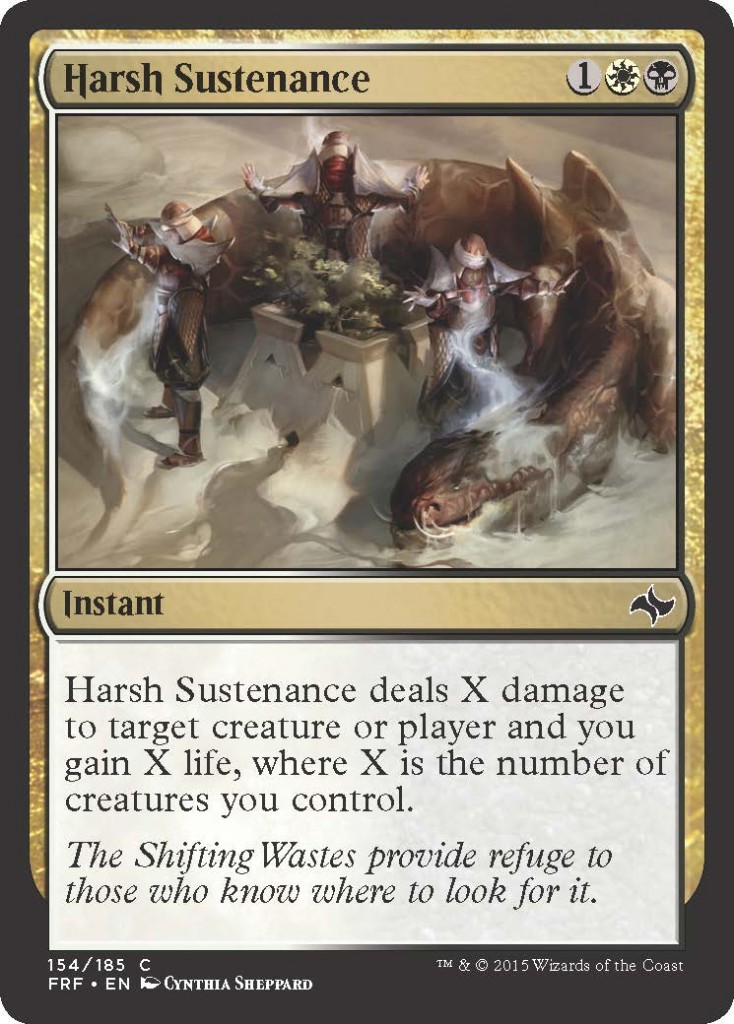
This card immediately brings to mind one of the more powerful Commons to see print: Corrupt. Harsh Sustenance is cheaper, and Instant speed instead of Sorcery, but relies on the number of creatures you have in play rather than the number of Swamps. Even with only three creatures in play, this is the equivalent of Lightning Helix, another extremely powerful card. It's quite strong in a board stall situation, or when swinging in for an alpha strike, and particular strong in any sort of tokens strategy. Granted, it does nothing if you have no creatures in play; your opponent can also destroy your creatures in response. But this card is very strong, and will definitely see widespread play.

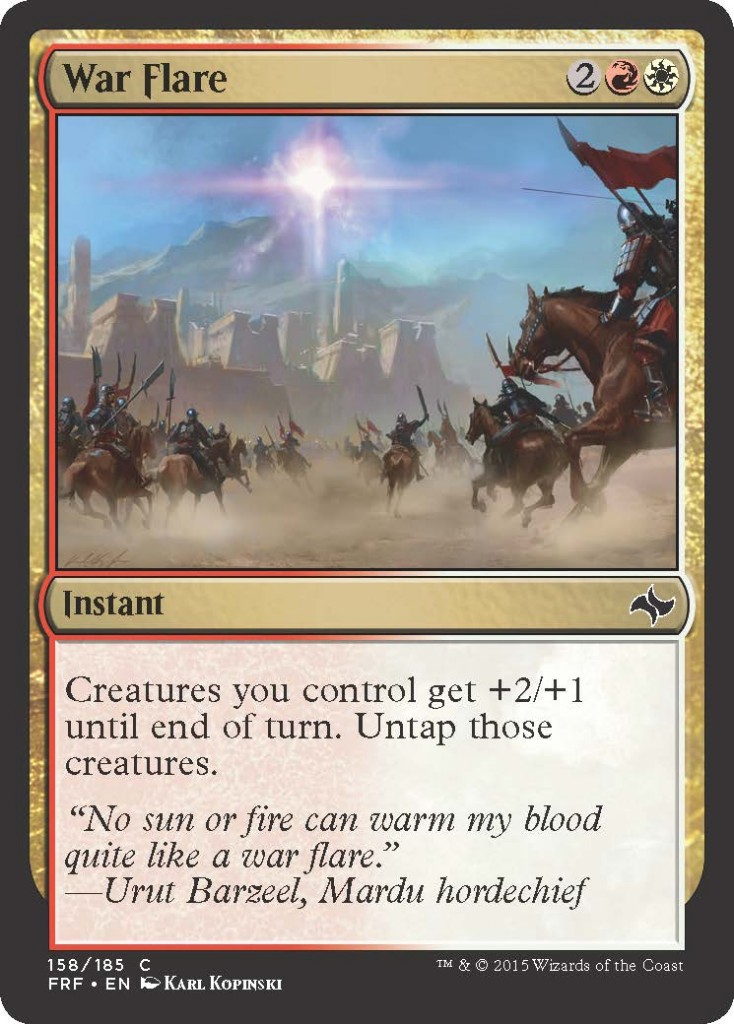
War Flare is also strikingly similar to another card - in this case, Inspired Charge, which was recently printed again in Magic 2015. However, ignoring mana costs, this is strictly better, since it also untaps all of your creatures, making this useful on both offense and defense. There has been a dramatic increase in the number of tokens at Common in both Red and White, and obviously this card would be quite powerful in that sort of strategy. In a board stall, it allows you to swing in freely, knowing that even if you don't finish off your opponent, your creatures will still be able to block on your opponent's turn. It's a bit expensive as a combat trick though, so it will probably only see play in decks specifically designed for it.

Taken as a whole, this is a very powerful cycle of cards at Common. Given the design constraints of New World Order, you can clearly see that these cards were "pushed" to retain this level of power and/or complexity at Common. While requiring two colors does constrain them somewhat, the availability of easy fixing at Common should allow them to see widespread play. I anticipate this cycle will have a strong impact on the Standard Pauper metagame after the release of Fate Reforged.

What do you think of this cycle? Let me know in the comments below.

Thursday, January 8, 2015

Fate Reforged Multicolor Instant Cycle, Part One

Last week, I offered my evaluation of Ethereal Ambush, one of the more powerful of the Manifest cards at Common for Fate Reforged. As it turns out, this card is one of a five card cycle of multicolor Instants at Common, so I thought I would take my next two posts to evaluate the rest of the cycle.

This cycle was also the official preview cards for Limited Resources, who evaluated the cards during Episode 266, which is incidentally also the first show featuring new co-host Luis Scott-Vargas. If you're not already listening to this show, I highly recommend it. In any case, for full disclosure, I am offering my review of these cards after listening to this episode.

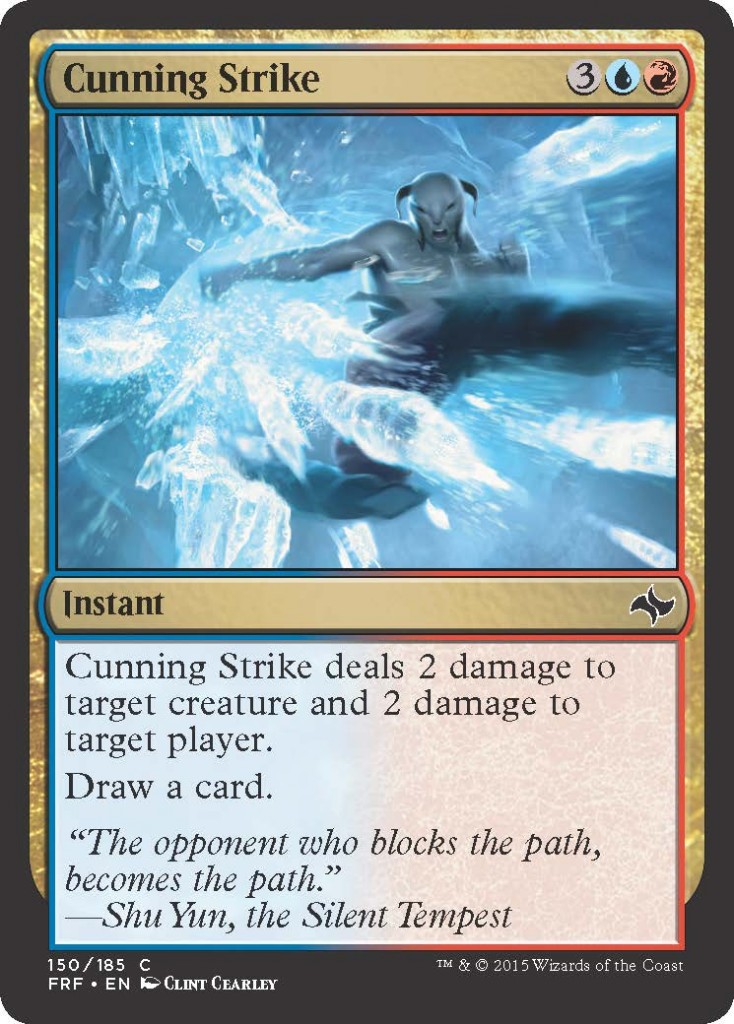
Searing Blaze returns, but now it replaces itself as well? Not quite. Cunning Strike does a lot of small things well. It deals 2 damage to a creature, draws an additional card, and hits your opponent for 2 as well. Problem is, you pay 5 mana to accomplish this. Granted, you do get 4 points of damage for the price, most of the time you'd rather not split it between the creature and the player. Further, while it does have some synergy with Prowess, this mechanic has not made much of an impact in Standard Pauper. Overall, to get full value out of this card, you'll probably need to play it in a Control archetype like Izzet Control, but even there I'm not sure it's worth running over the existing cards in that list.

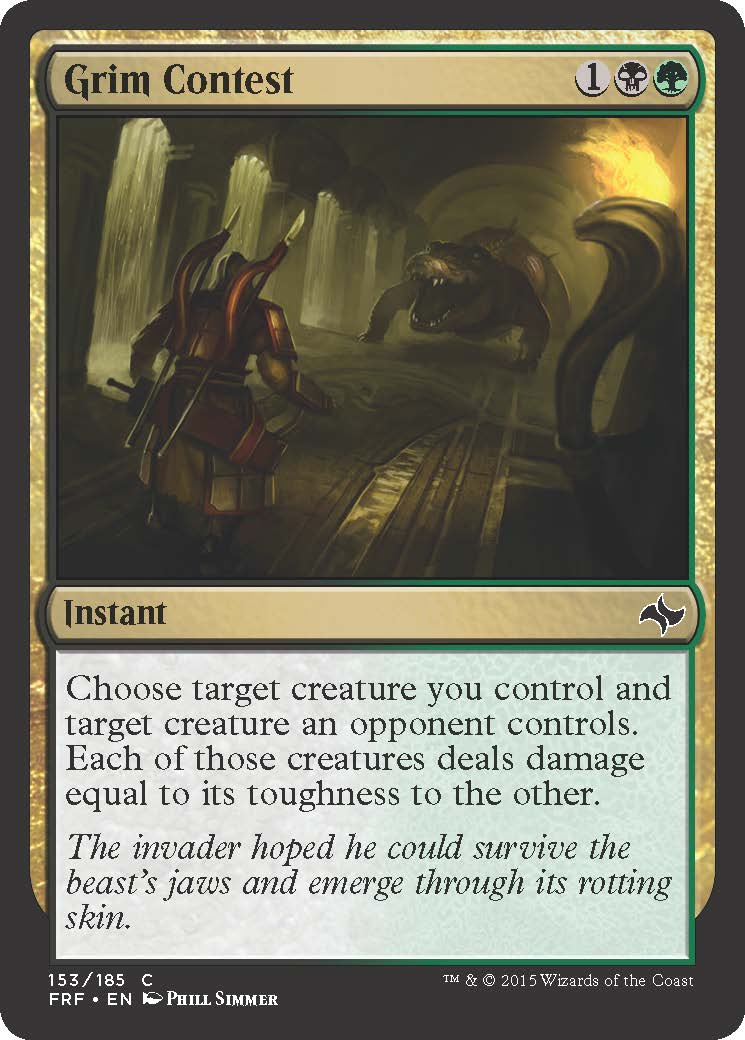
The Fight mechanic continues to see print in several interesting variations at Common, and Grim Contest seems right in line with these cards. But in this case, the damage is based upon both creatures' Toughness rather than Power. This is an odd change, but probably not particularly relevant for the card's overall value. I would evaluate this as being pretty much on par with other Instant-speed Fight effects like Pit Fight or Fall of the Hammer, but with the significant downside of requiring two colors of mana. Additionally, the Black/Green combination hasn't seen much play in Standard Pauper in this metagame, so this card also lacks an obvious deck to slot it into. Thus, while the value is there, I don't anticipate this card making a big impact.

Let me close with a couple other reminders:
  1. My article covering the State of Standard Pauper was published over at PureMTGO earlier this week, and I would appreciate my readers checking it out.
  2. Earlier this week I announced the details for the long anticipated Standard Pauper Sealed League. Don't miss out on this fun and unique event!
See you next time.

Thursday, January 1, 2015

Making Sense of Manifest

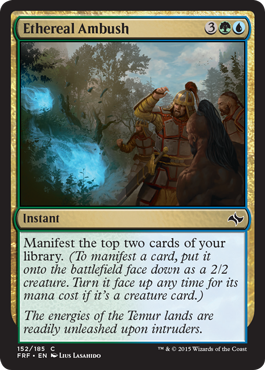
Everyone's favorite season is here again. No, not the holiday season - spoiler season! In this case, the first spoilers for Fate Reforged have been revealed, including seven Commons. While there are several new mechanics that caught my interest, today I wanted to take a quick look at the Manifest mechanic, particularly as it plays out in Ethereal Ambush.

Manifest is an ability that has you take a card from another zone (typically your library), and play is face down on the battlefield as a 2/2 creature. If the card that you play is a creature, you can flip it face up for its mana cost at Instant speed. Interestingly enough, if it's a Morph card, you can also flip it face up for its Morph cost. But if it's not a creature card, the card will continue to be a 2/2 creature until it leaves the battlefield or the game ends.

Now some might intrinsically dislike this ability. After all, the card that gets played face down might have been the one card in your deck that could let you win the game. It might be a powerful Instant or Sorcery, or a creature with a sweet enters-the-battlefield ability, or something or that nature. So rather than getting to play it, now it's relegated to a mediocre 2/2 creature.

But in fact, Manifest plays out almost like a mill-type effect. At its worst, it is equivalent to: place the top card of your library into your graveyard, then put a 2/2 creature token onto the battlefield. In fact, it's actually better than that, because one of the best ways to get rid of tokens is to bounce them, and that won't permanently deal with a Manifest card.

So with that out of the way, how good is Ethereal Ambush in Standard Pauper?

For the sake of argument, imagine instead it was a 4/4 vanilla creature with Flash for 3GU. While you might prefer a 3/3 with evasion (aka Spire Monitor), this would be certainly be playable in the right deck. Now, instead make it an Instant that splits that 4/4 up into two 2/2 creature tokens, and you have a card that is arguably even better. The near equivalent to this, of course, is the powerful Flurry of Horns and Rise of Eagles, trading the french vanilla abilities for the upgrade from Sorcery to Instant speed.

Of course, this does cost you two cards from your deck. But unless Manifest leads you to empty your library, those extra two cards don't really matter anyway. At best, you've gained some interesting options for two creature cards; at worst, you've discarded two cards into your graveyard. 

Obviously the final value of this card will depend a lot on the metagame that surrounds it. But the ability to summon multiple creatures at Instant speed in Standard Pauper is nothing to be overlooked. I evaluate Ethereal Ambush as being playable at worst, and potentially very good in the right deck or circumstances.