Showing posts with label Khans of Tarkir. Show all posts
Tuesday, April 5, 2016
Farewell, Common Duals
As was pointed out to me in the comments section of my previous post, I neglected to call attention to the fact that the Khans Common Dual Lands are about to rotate out of Standard, leaving the format without multicolored lands for the first time since Return to Ravnica. This will obviously have a major impact on what types of decks are viable in the format. Without access to reliable color-fixing, it will be unusual to see decks with three or more colors of cards. And given that such decks have performed well over the past few seasons of our weekly Standard Pauper Player Run Events, it will be interesting to see if this pushes the metagame away from Control once more.
Additionally, with this type of Dual Lands being rarity shifted back to Uncommon in Shadows Over Innistrad, there is the potential that this may not be a temporary situation, but a return to the baseline environment at Common from the more recent color intensive sets. This would be unfortunate, as reliable mana fixing not only allows players access to more colors, but also makes aggressive decks more consistent and thus better able to compete against Control strategies, which in my opinion is more healthy for the format. We shall see.
In the mean time, what Land-based color fixing will exist going into Shadows Over Innistrad? Evolving Wilds will still be available, as will a close variant from Shadows called Warped Landscape, which costs 2 to sacrifice and fetch any Basic Land but also taps for colorless immediately. We also have Crumbling Vestige, which only taps for colorless save for the turn it comes into play, when it adds any single color of mana to your pool. There is also Unknown Shores, which only creates colorless but can essentially filter any mana already in your pool from one color to another. And of course there is Holdout Settlement, which works on a similar basis but demands that you tap a creature rather than another mana source. Finally, Fertile Thicket deserves an honorable mention. While it doesn't actually fix your Lands directly, it does let you search among the next five cards in your library for one basic Land to put on top of your library while returning the other cards to the bottom of your library.
Obviously none of these are anywhere close to the ease and convenience of the Common Duals. Just how good they are will have to be tested before any firm conclusions can be drawn. But it's safe to say the format will definitely look very different.
Friday, April 1, 2016
Farewell to the Clans, Part Two
Last time, I talked about how with the upcoming release of Shadows Over Innistrad that Standard will be rotating soon, with some very significant Commons from Khans of Tarkir and Fate Reforged leaving the format forever. This shift will drastically change the Standard Pauper format, and so I wanted to dedicate my blog posts this week to looking at what I believe are the six cards whose loss will have the biggest impact in the format. I already discussed Disdainful Stroke, Gurmag Angler, and Hooting Mandrills. Today, I'll look at the other three.
4. Jeskai Sage is another card that looked fairly innocuous when it was released, but proved to be a major cornerstone of an archetype in the format. In the right deck, it typically will attack as a 2/2 thanks to Prowess, and is a particularly strong target for combat tricks. But best of all, you can trade it off with your opponent's creatures without regret, since upon death it immediately cycles for a brand new card. That's built-in card advantage for an already decent card, and in a format where every little edge counts, it's little wonder that this little card proved to be such a gem.
5. While White has somewhat fallen out of favor, Sandsteppe Outcast is the perfect card for any White Weenie or similar archetype. For your three mana you get three points worth of Power, which most of the time you will want to split up into two creatures, one of which gets Flying. The fact that the card also had the Warrior subtype was another important boon to this card's versatility and power. Given the Spirit synergy in Shadows Over Innistrad it's a shame to see this go, as it would have been right at home in the new metagame. As is, this card will continue to live on in its color-shifted cousins Eldrazi Skyspawner and Ghirapur Gearcrafter.
6. In this case I definitely saved the best for last. Treasure Cruise turned out to be one of the more broken Commons to see print in recent times, thanks primarily to how routine it was to fill up your graveyard and cast this for half its cost or less. In fact, it's so good that it ended up being banned in Modern, Legacy, and Pauper. This card alone made it almost always worth your while to play Blue, and if so you always wanted the full four copies in your deck. While I still don't think it should have been banned in Standard Pauper, I know many players will be happy to see it go.
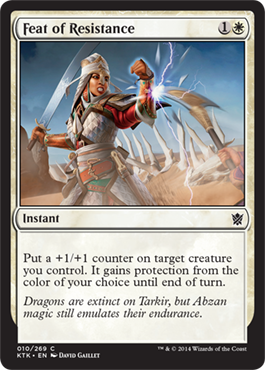
And so those are my top picks from Khans of Tarkir and Fate Reforged that will be leaving the format with the release of Shadows Over Innistrad. Other honorable mentions include Feat of Resistance, Mardu Hordechief, Elusive Spellfist, Sultai Emissary, Whirlwind Adept, and Whisk Away. One thing is for sure - Standard Pauper will look quite different in just a few short weeks!
Tuesday, March 29, 2016
Farewell to the Clans, Part One
With the full spoiler now available for Shadows Over Innistrad, we are mere weeks away from saying farewell to both Khans of Tarkir and Fate Reforged. Khans of Tarkir in particular proved to be quite strong for Standard Pauper, and so seeing these two sets rotate out of Standard is going to be a big shift for the metagame. Given that, I thought I would take some time this week to look at what I believe are the six cards whose loss will have the biggest impact in the format.
I will be looking at these cards in alphabetical order; no overall ranking is implied by the order.
1. Counterspells that cost only two mana have been proven very strong in most formats, and today it is rare to see them printed at any rarity, much less Common. So while Disdainful Stroke certainly wasn't as good even as Mana Leak, it was excellent in Control matchups to prevent your opponent from casting his or her big cards. While this saw more play in the Sideboard than main-deck, it remained a very good option against certain decks, particularly given how strong the Delve mechanic proved to be, since it only cares about the converted mana cost, not how much was actually spent.
2. When I first reviewed Gurmag Angler, I wasn't particularly impressed, since it is just a big dumb, expensive beater. However, two factors made it much better than it appeared. First, the ability to use Delve to cheat it in early made it very difficult to deal with. Second, the fact that you had access to it in Black, which traditionally does not get large creatures, also was a factor in its success. As it turned out, it is ridiculously easy to fill up your graveyard with cards, and with unconditional removal at an all-time low, this card does a good job of dodging most forms of removal.
3. Hooting Mandrills also proved to be quite strong. It's only one mana less than the Angler, and even better has Trample, which makes it much more difficult for your opponent to simply chump-block and ignore it. In a color that already has access to lots of big creatures, this card often was the best of the lot, simply because it was so easy to power it out quickly. It also proved to be a great enabler for Savage Punch and its cousin Epic Confrontation. Finally, 4 Toughness is still enough to sidestep many burn spells and other conditional forms of removal.
Noticing a theme yet? As it turns out, almost all of the Delve cards made a major impact on the format. But all the rest paled in comparison to what proved to be the best Delve card in the set. Which we'll take a look at...next time.
Tuesday, January 13, 2015
Choice and Complexity
As I continue to work on my set review for Fate Reforged, I have made an interesting note about this set. In the past, I have written extensively about Common Design and the tenets of New World Order limit the kinds of cards we can expect at Common going forward. The whole point of this design constraint is to limit complexity and thereby keep the bar of entry for new players as low as possible while still retaining the essentially elements of the game.
But, at least in my opinion, both Khans of Tarkir and Fate Reforged have been pushing up against the constraints of New World Order more than we have seen in some time. Indeed, I would argue that simply by allowing the Morph mechanic (and now Manifest as well) at Common, signals a shift in what kinds of complexity are allowable.
Now, in Fate Reforged, we have the return of modal abilities in a cycle of creatures at Common. The presence of such cards used to be fairly routine in Magic's history; now, they are quite unusual. So while these abilities never disappeared entirely, giving players the choice of two distinct abilities when a card is cast is an unusually high level of complexity, and one that probably would have been red-flagged and then moved up in rarity save that it ties into a particular theme of the set. Additionally, these creatures also would have been red-flagged simply for the amount of text on the card, which easily exceeds the four line limit.
Choice creates complexity. Board states with hidden or hard-to-discern information also create complexity. And yet, both these elements are present at Common. Is this a shift in New World Order philosophy, or simply an oddity due to the specific needs of this block? Time will tell, but at least for now, I am cautiously optimistic about what this means for future Commons.
Saturday, November 8, 2014
Seeing Red in Khans
With the new Standard Pauper metagame taking shape with the inclusion of Khans of Tarkir, it's been interesting to see how some of the new cards are seeing play. While Delve, and in particular Treasure Cruise, have received most of the attention, today I wanted to briefly highlight three Red cards that are seeing increasing play in the format. While I initially judged these three cards to be either borderline or unplayable, it seems my initial evaluation might have been off. Let's take a look at them.
1. Barrage of Boulders seemed pretty lackluster to me on first blush, especially in comparison to Electrickery, a staple from Return to Ravnica block. Dealing 1 damage to creatures you don't control at Sorcery speed for 3 mana seems expensive and too slow. But the ability to prevent all creatures from blocking is surprisingly strong, especially in the RDW or Boros strategies that are seeing widespread play in the Casual room on Magic Online. This is particular true with Prowess creatures, such as this next card.
2. Bloodfire Expert I likewise judged suboptimal, since with 3 mana but only 1 Toughness it would typically trade with less expensive creatures. However, what I failed to recognize is that any spell cast with this expert in play immediately activates Ferocious, activating the secondary ability of Force Away, Savage Punch, or the aforementioned Barrage of Boulders. It can also work defensively in a pinch, keeping most other creatures back until you're ready to swing in for a massive strike.

3. Tormenting Voice is a near reprint of Wild Guess, with the simple change of one R to one colorless mana making a major difference in its playability. While I predicted that this might be just the kind of effect a more mid-range Red deck was looking for, I never would have predicted its usefulness in the Izzet Control archetype, allowing you to pitch the excess Lands drawn from the crazy amounts of card draw that deck generates. While it might seem aggressive, it seems to have found its true home in a strong Control shell.
What cards have you found to be better than expected in Khans of Tarkir? Let me know in the comments below. Thanks for reading!
1. Barrage of Boulders seemed pretty lackluster to me on first blush, especially in comparison to Electrickery, a staple from Return to Ravnica block. Dealing 1 damage to creatures you don't control at Sorcery speed for 3 mana seems expensive and too slow. But the ability to prevent all creatures from blocking is surprisingly strong, especially in the RDW or Boros strategies that are seeing widespread play in the Casual room on Magic Online. This is particular true with Prowess creatures, such as this next card.
2. Bloodfire Expert I likewise judged suboptimal, since with 3 mana but only 1 Toughness it would typically trade with less expensive creatures. However, what I failed to recognize is that any spell cast with this expert in play immediately activates Ferocious, activating the secondary ability of Force Away, Savage Punch, or the aforementioned Barrage of Boulders. It can also work defensively in a pinch, keeping most other creatures back until you're ready to swing in for a massive strike.
3. Tormenting Voice is a near reprint of Wild Guess, with the simple change of one R to one colorless mana making a major difference in its playability. While I predicted that this might be just the kind of effect a more mid-range Red deck was looking for, I never would have predicted its usefulness in the Izzet Control archetype, allowing you to pitch the excess Lands drawn from the crazy amounts of card draw that deck generates. While it might seem aggressive, it seems to have found its true home in a strong Control shell.
What cards have you found to be better than expected in Khans of Tarkir? Let me know in the comments below. Thanks for reading!
Saturday, October 25, 2014
To Delve or Not To Delve
Of all the mechanics in Khans of Tarkir, it appears that Delve is making the biggest splash in just about every format. While Treasure Cruise is taking up most of the headlines, all of the Delve cards at Common are playable in Standard Pauper, and thus it's important to think about how best to utilize them.
Early on, I saw several decklists that were running cards like Necromancer's Assistant or Satyr Wayfinder to quickly dump a bunch of cards into the Graveyard to enable casting these Delve spells as quickly as possible. The problem with this strategy is that these cards tend to not be very good, and thus are generally only good for filling the Graveyard quickly. And if your opponent responds by countering or removing that early Delve creature, you've invested a lot of time and resources into something that your opponent was able to answer with only a single card. Even a simple bounce spell is good enough in these scenarios, since you will rarely be able to recast the creature until several rounds later.
(BTW - this is why Treasure Cruise is easily the best of the Delve cards. Assuming your opponent doesn't counter it, you get an immediate payout for your investment).
A far better way to get maximum value out of Delve is to instead play a bunch of cheap but effective spells that quickly fill up your Graveyard while still having a solid impact on the virtual battlefield. Removal and combat tricks obviously shine in this role, but card draw also works well in this role.
Additionally, all other things being equal, don't just burn through all the cards in your Graveyard at the first opportunity. Wait until you can pay for most of the cost using mana, and utilize Delve only to shave off a few colorless from the cost. Not only does this help mitigate against the effects of having the creature immediately removed; it also saves resources for the next Delve spell as well.
Most of the time, it probably pays to be patient. Sure, you'll win some memorable games where you drop a Turn 4 Hooting Mandrills and your opponent never draws an answer. But more often than not, a good opponent will be able to punish you for such recklessness.
If you've had some experience with Delve in Standard Pauper, let me know in the comments below. Thanks for reading.
Thursday, October 23, 2014
Is Treasure Cruise Broken?
Of all the cards that entered the world with the release of Khans of Tarkir, none has generated more discussion than Treasure Cruise. It has seen immediate and widespread play in both Modern and Legacy, to the point where many are predicting that this Common will be banned in Modern within the new few months. Interestingly enough, from the albeit limited research I've done on the subject, it has seen significantly less play in Standard.
So what does this mean for Standard Pauper?
First, what is it about Treasure Cruise that makes it potentially so good? This, at least, is easy to answer:
When Treasure Cruise becomes (a Sorcery speed) Ancestral Recall, it is officially broken. Which leads us to the next question.
Second, what does it take to push Treasure Cruise to that point? With a casting cost of 7U, you need a reliable means of dumping a whole bunch of cards into the graveyard quickly while simultaneously actually getting value out of said cards. In Modern and Legacy, this is being accomplished two ways:
But whether this is good enough or not remains to be seen.
What do you think? Is there a viable archetype that can push Treasure Cruise to the point of being broken in the format? Let me know in the comments below.
So what does this mean for Standard Pauper?
First, what is it about Treasure Cruise that makes it potentially so good? This, at least, is easy to answer:
When Treasure Cruise becomes (a Sorcery speed) Ancestral Recall, it is officially broken. Which leads us to the next question.
Second, what does it take to push Treasure Cruise to that point? With a casting cost of 7U, you need a reliable means of dumping a whole bunch of cards into the graveyard quickly while simultaneously actually getting value out of said cards. In Modern and Legacy, this is being accomplished two ways:
- Fetchlands - Play a land, sacrifice it, and bring a different land into play. This thins your deck, improves your mana, and places a card into the graveyard.
- Cheap spells - Cast a bunch of spells whose converted mana cost is 2 or less. Typically these are burn spells, counters, or card filtering.
- Synergy creatures - Play efficiently costed creatures that synergize well with castings lots of cheap spells or otherwise interact with the graveyard.
But whether this is good enough or not remains to be seen.
What do you think? Is there a viable archetype that can push Treasure Cruise to the point of being broken in the format? Let me know in the comments below.
Saturday, October 4, 2014
Orzhov Pilgrim Post-Rotation
Looking at the results from the most recent Standard Pauper tournaments, it is clear that the Orzhov Pilgrim deck is the deck to beat for next week's capstone Worlds event. Additionally, this will be one of the archetypes that will be a solid starting point for deckbuilding in the new Standard once Khans of Tarkir is released on Magic Online. So today I want to take a look at this decklist, discuss how it will be affected by rotation, and offer some initial thoughts on what new cards might find a home here.Let's start by taking a look at Forli's build of this archetype, which he piloted to an undefeated 1st place finish in MPDC 26.06:
WB Pilgrim
| Creatures 4 Akroan Skyguard 4 Auramancer 4 Heliod's Pilgrim 4 Hopeful Eidolon 4 Wingsteed Rider 2 Keening Apparition 22 cards Other Spells 4 Ethereal Armor 4 Gods Willing 4 Pacifism 2 Font of Return 2 Stab Wound 1 Ajani's Presence 17 cards |
Lands 11 Plains 4 Evolving Wilds 4 Orzhov Guildgate 2 Swamp 21 cards
Sideboard
4 Celestial Flare 4 Duress 2 Keening Apparition 2 Beckon Apparition 1 Pillar of Light 1 Feast of Dreams 1 Ajani's Presence 15 cards |
|
Of these 75 cards, only 43 cards will survive rotation. Gone are Auramancer, Beckon Apparition (SB), Celestial Flare (SB), Duress (SB), Ethereal Armor, Keening Apparition, Orzhov Guildgate, Pacifism, and Stab Wound. Of these, the loss of Auramancer, Ethereal Armor, Keening Apparition, and Pacifism are probably the most significant: Auramancer for its recursion of the deck's numerous Enchantments; Ethereal Armor for its ability to turn any creature into a massive threat; Keening Apparition for its ability to act as a creature and also Enchantment-hate; and Pacifism as excellent spot removal that could be searched up using Heliod's Pilgrim. So what does Khans of Tarkir bring to the mix?
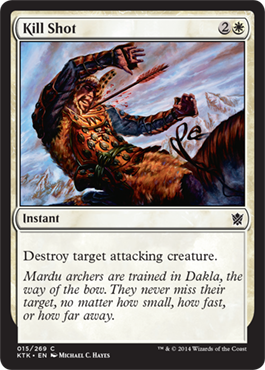
2. Kill Shot is probably the best stand-in for Pacifism. While it can't be tutored up using Heliod's Pilgrim, it does allow you to kill anything as long as your opponent actually attacks with it. Most of the time that won't be a problem, since Standard Pauper rarely includes solid utility creatures. Kill Shot also has the advantage of not be vulnerable to Enchantment hate.
3. With most of the relevant Auras leaving the format, Auramancer wouldn't be as effective as it was previously. This means that Font of Return should be able to perform a similar role. Again, having this effect tied to a creature is obviously much better, but in a longer game Font of Return can generate a ton of value. And since it's an Enchantment, it can still be fetched by Heliod's Pilgrim.
4. Sadly, there simply is no replacement that even comes close to the value of Ethereal Armor. Molting Snakeskin is probably the closest analog, in that it pumps the creature's power, is cheap, and allows it to survive combat with Regeneration. Eternal Thirst has also seen some play already in this deck, and is also a decent substitute.
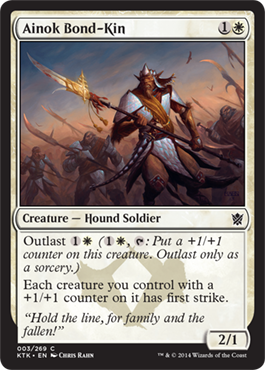
Other cards from Khans of Tarkir that might be worth considering for this deck include: Ainok Bond-Kin, Bitter Revelation, Sultai Scavenger, and Unyielding Krumar.
If you've got other ideas for this archetype, I'd love to hear them! Let me know in the comments below.
Tuesday, September 30, 2014
Ponyback Brigade
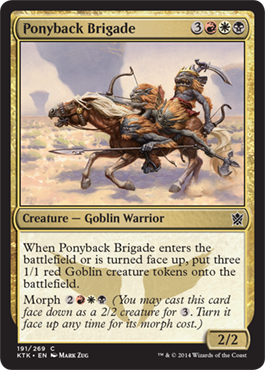
Today the final installment of my Khans of Tarkir set review for Standard Pauper was published over at PureMTGO. In my previous installment, I reviewed the multicolor Morph cycle at Common. I ended up rating Ponyback Brigade as the worst of the cycle, although I did assign it a borderline grade, meaning I felt it was playable but not great.
I received the following response in the comments:
Ponyback Brigade is as close to Siege-Gang Commander as Pauper will ever see, and the Efreet Weaponmaster dies to a simple Lightning Strike. In fact, I'm finding it very difficult to believe that you directly rated ("[...]the worst card in the cycle[...]") ... Do you not really grasp how powerful it is to get four bodies for one card? Midrange can use this to gum up the ground like no one's business, control can stabilise with a single card (and keep in mind that it kills in four turns on it's lonesome on an empty board against an untouched opponent), and even aggro might see some use for it postboard.
I appreciated the feedback, and promised that I would clarify my thoughts in a blogpost. So here we go.
First, let's take a look at Siege-Gang Commander, which he compared it to:
You can see why it's a fitting comparison. Siege-Gang Commander also gives you four creatures, three of which are 1/1 Goblin tokens and the other a 2/2. Siege-Gang costs one less mana, and most of the time will be easier to cast, since it only has two colored mana symbols instead of three. It also can't be played as a 2/2 for 3 early and then later flipped over at an advantageous time.
However, the big difference is Siege-Gang's secondary ability: for 1R each, it can turn those 1/1 Goblins into Shocks at Instant speed. This is a major difference, as it takes those tokens from marginal to always relevant.
Second, let's talk about the value of a 1/1 without any abilities. Generally speaking, a 1/1 is worth somewhere between half and a third of a card. Krenko's Command gives you two such tokens for 1R at Sorcery speed. Getting three tokens at Instant speed would be very strong at 2R, and at Common is more likely to cost at least 3R (based on Captain's Call). But unless you're playing a dedicated Tokens build, most of the time a bunch of 1/1s is not going to be that relevant. Yes, they can chump-block several attacking creatures; yes, they can get in for some significant damage once or twice; but generally, this is a niche effect for a niche deck, not an all-around all-star.
So I would evaluate Ponyback Brigade (disregarding Morph for the moment), as a 2BW Captain's Call tacked onto a 2/2 creature for 1R. The total effect is nice, but for six mana with triple color requirements, even at Common we can expect more. Of course, you add Morph back into the mix, and you have a solid card, perfectly playable. But here again, the setup cost is pretty high. Hence my rating: playable, but not amazing.
What do you think?
Tuesday, September 23, 2014
Miscellaneous Musing
Today will be a somewhat random assortment of small updates regarding what I've been working on the past week or so.
1. It turns out I missed my weekend update this past week (did anyone notice? Is this thing on?). As a result, I will be writing an extra post this week, probably tomorrow.
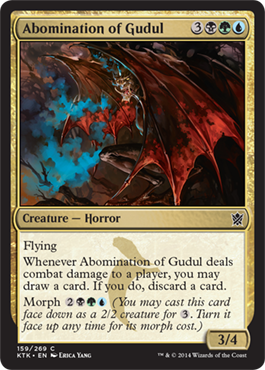
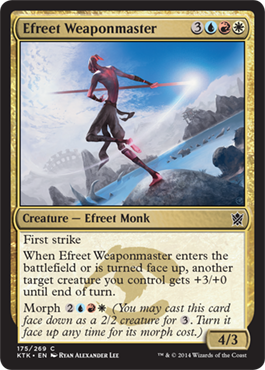
2. Part One and Part Two of my review of Khans of Tarkir for Standard Pauper have been published over at PureMTGO.com. I hope to have Part Three up no later than next Monday. Thus far the most interesting cards look to be the multicolor Morphs. I think they are all playable, but Abomination of Gudul and Efreet Weaponmaster seem to be the best in terms of raw power. I've also heard some excitement about Ponyback Brigade, but thus far I'm not convinced.
3. I've been playing a lot of a great new freeware game called Heroine's Quest, which is an adventure game in the classic style of the old Quest for Glory series. I should have a review up for it later this week.
4. The Hunter deck I piloted to great success recently in Hearthstone has been decimated by the nerfing of Starving Buzzard. If you've got suggestions on what deck I should play next, I'd enjoy hearing them.
See you tomorrow.
Thursday, September 18, 2014
Khans of Tarkir: Outlast
Khans of Tarkir brings with it five new mechanics, and based on my review for Standard Pauper, it's a good bet that at least four of them will make their presence felt pretty quickly in the new metagame. Today, I want to take a look at the Abzan mechanic: Outlast.
In some ways, Outlast reminds me of the Level Up mechanic from Rise of the Eldrazi. Like Level Up, Outlast requires a small to moderate investment of mana to increase the power of the creature. In general, the Power and Toughness boost you get from each activation is much better value than you received from the Level Up mechanic, and there is no limit to the number of times you can gain this effect. However, the creature never gains any additional abilities, and worse, Outlast requires you to tap the creature in order to generate the effect.
Outlast would have been amazing at Instant speed; so amazing, in fact, that it probably could not have seen print at Common. So the question is, how good is it at Sorcery speed?
While time will tell, in general I think it's still pretty good. At Common, having something to do with your extra mana every turn is quite good if you're playing more of a Control build. Even better, two of the four Outlast Commons include a secondary ability that grants a evergreen keyword ability to all creatures with a +1 / +1 counter, including itself. So, you get fairly good value from the first activation. After that, you can utilize the creature as long as it remains relevant on the board, and when its no longer effective in combat, spend the extra mana each turn to pump it up until it's big enough to be a threat again.
The biggest downside is the potential for you to take a major tempo hit when you go to activate Outlast but your opponent kills it with Instant speed removal. To get good use out of this mechanic, you'll need to have the ability to protect the creature at Instant speed, since it will take an entire turn after you pump it before you get any utility out of it. Savage Surge will be particularly good in this spot, since it also untaps the creature.
Thus, while it will take some work to get the most value out of Outlast, I would say that the potential is there for this to be quite relevant in Standard Pauper. What do you think?
Tuesday, September 16, 2014
Khans of Tarkir: Morph
As I have been working on the set review for Standard Pauper for Khans of Tarkir, I have had some difficulty in evaluating just how good the Morph cards are in this set. Today, rather than looking at specific cards, I want to evaluate the mechanic as a whole.
Typically, Morph cards have three major advantages over other creatures:
- Your opponent doesn't know what creature you played. Since all Morph cards cost the same to play face-down, your opponent has no real information to go on. Unless he is playing Lens of Clarity, the only way your opponent learns what card you played either when you flip it over or when it leaves the battlefield or the game ends.
- You can always play the card as soon as you have three mana available. Playing them facedown doesn't require any specific colored mana. Additionally, most of the time this is cheaper than the actual casting cost of the creature, allowing you to get value out of the card much earlier than you otherwise could.
- You control when the creature is flipped over. This means that you can effectively surprise your opponent in combat, allowing you to block a creature you might not have been able to block or setup a favorable block that your opponent couldn't foresee.
For those of you who have played with Morph cards before, what do you think of them in general? Are you excited to get your hands on them in Khans of Tarkir? Let me know in the comments below.
Saturday, September 13, 2014
Khans of Tarkir: Full Spoiler and Contest Results
That didn't take long.
Probably timed to coincide with the start of the Community Cup, the full spoiler for Khans of Tarkir has been released. The timing is also convenient for me, since it allows me to immediately announce the results of the contest I held right here at Write Adept in my previous blog post.
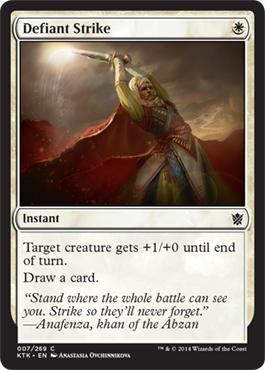
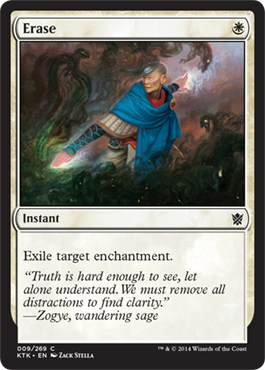
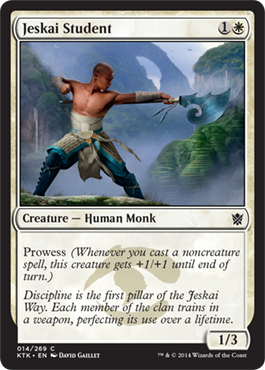
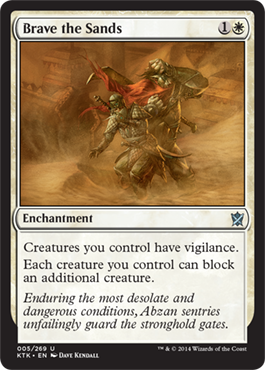
For those who missed it, MTGSalvation had a slew of unofficial spoilers, including a bunch of White cards that included the full rules text but not the rarity of the cards. I posted them and asked my loyal readers to try to figure out which ones could be Common based on power-level. For reference, here are the cards in question (click on the image for a larger version):
For reference, I should have numbered them, particularly since they ended up out of any logical order due to my unusual copy/paste from the site. For today's post, I will simply refer to them from left to right, finishing the whole row before moving down to the next row. The correct rarity for the cards is as follows: Uncommon, Common, Uncommon, Common, Common, Rare, Uncommon, Common, Common, Common, Common, Common.
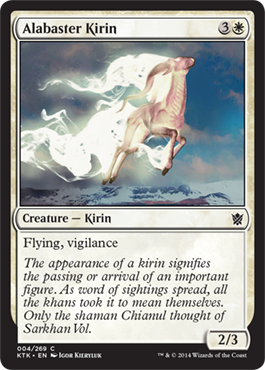
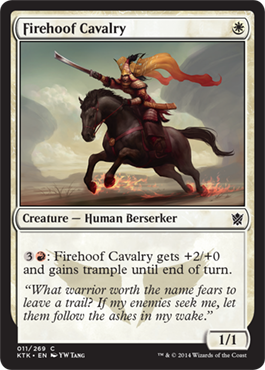
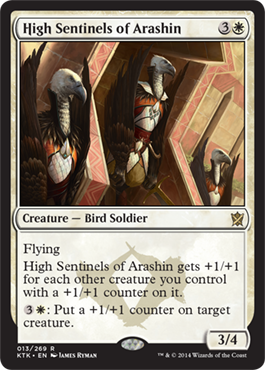
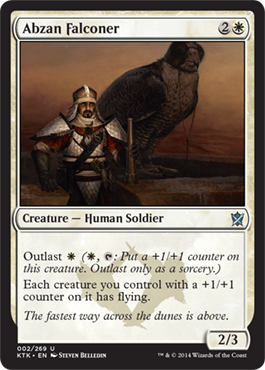
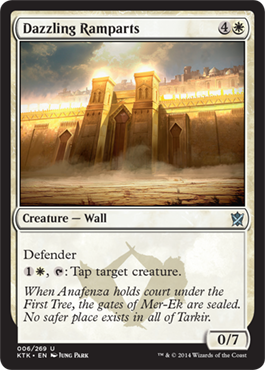
Out of these eleven cards, I thought six of them were obviously Common: Alabaster Kirin, Feat of Resistance, Firehoof Calvary, Defiant Strike, Erase, and Jeskai Student. These six cards represent elements almost always found at White at Common: simple combat tricks, "fair" costed creatures with a single ability, a single-target protection spell, and a reprinted Enchantment hate. Additionally, both Brave the Sands and High Sentinels of Arashin were clearly not Commons, since both add significant complexity to combat with the latter also requiring you to keep an accurate understanding of the board to determine the Sentinel's Power and Toughness. That left Abzan Falconer, Dazzling Ramparts, and Kill Shot as the more tricky to evaluate.
Under the right circumstances, I would vouch that all three could be potential Commons, at least with minor tweaks. Abzan Falconer is probably too efficiently costed to be a Common, both for its Outlast cost and its casting cost, and granting Flying is arguably too strong at Common. However, it isn't that different than Ainok Bond-Kin, and so is borderline between Common and Uncommon. Dazzling Ramparts is even closer, as White often gets a tapper at Common, and an 0/7 Defender for 1W is not particularly efficient. Finally, Kill Shot, while clearly better than the classic Divine Verdict, is a functional reprint of Rebuke from Innistrad.
As far as my evaluation, I actually missed only one, placing Dazzling Ramparts as a Common instead of an Uncommon. Chris Baker, one of only two entries, got them all correct, and so Writer Adept will be awarding him a single ticket for his victory!
I hope you enjoyed this exercise. Thanks for reading.
Thursday, September 11, 2014
Khans of Tarkir: Could It Be Common?
Another spoiler season for a new set, another set of unofficial spoilers, this time courtesy of MTGSalvation. In this case user nal2 posted the text of a bunch of cards from Khans of Tarkir, without artwork or even the rarity. As I was perusing the spoiled cards, I found myself trying to figure out which ones could be Common. It was such an interesting exercise, I thought I would post it up here on the blog for my readers. But rather than focusing on all of them, I decided to limit it to White.
Since the information could change quickly (especially with Sealed Clans of Tarkir as a Community Cup event this weekend), here are the White cards that were spoiled in this batch (click on the image for full size resolution):
Based on what we know about Common Design, can you pick out which of these cards are Common? Actually, I would divide them into three categories, based on the fact that sometimes rarity is determined by factors other than power level or complexity.
- Probably Common
- Definitely Common
- Not Common
Tuesday, September 9, 2014
Khans of Tarkir: Refuge Lands
It's spoiler season once again, which means we are finally getting our first glance at the Commons for the upcoming fall release of Khans of Tarkir. While the entire Common pool won't be known until the full set is finally spoiled, this week a new Common cycle was disclosed that will have a major impact on the upcoming metagame.
With this set emphasizing multicolor by means of three-color wedges, a major emphasis in the design is mana-fixing. According to Erik Lauer's article this week, at one point R&D was strongly considering actually released three color lands at Common. This would have been a major milestone, but sadly it was not to be, as tri-color lands at Common pushed too many developers to play four or five color decks rather than sticking to one of the wedges. Which meant that these tri-color lands ended up at Uncommon, and instead at Common we got these:
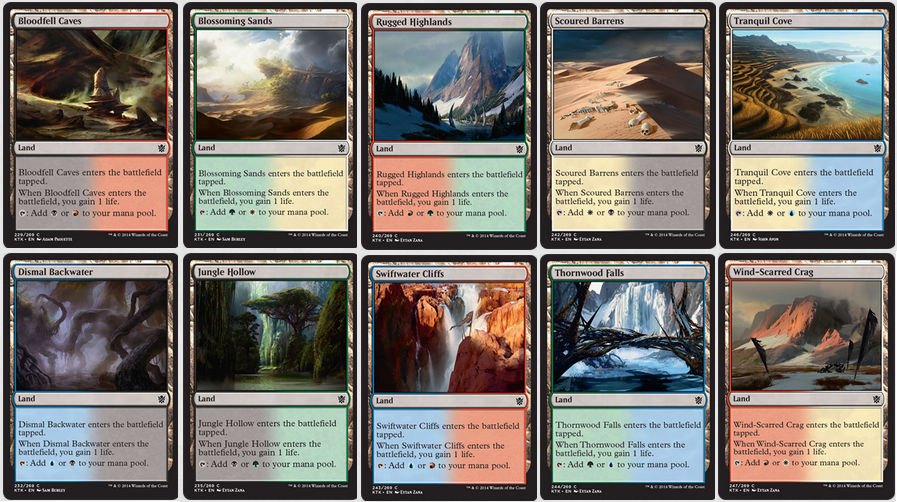
Called 'Refuge Lands' (from an identical cycle of Uncommon Lands from Zendikar), these ten duals will replace the Return to Ravnica Gates when they rotate out of Standard this fall. While not technically strictly better than the Gates (since Gate is a sub-type that affected other permanents), for all intents and purposes these will functional almost exactly the same, other than the small but not insignificant incidental lifegain when they enter the battlefield.
The inclusion of this cycle is significant for Standard Pauper in at least three ways:
- It solidifies that dual-colored, enters-the-battlefield tapped, Lands can be printed at Common, even with a minor beneficial effect.
- It weakens Aggro strategies, in that it not only incentivizes players to play multiple colors, it also rewards them with extra life for doing so, helping them to survive early aggression. The latter is particularly potent in a format that already will include Radiant Fountain.
- It should allow players to utilize the best of the wedge and/or multicolor cards from the block effectively. Since such cards tend to be stronger (and thus more expensive), this will also push the format away from Aggro.
Subscribe to:
Posts (Atom)


.gif)