Showing posts with label Hidden Strings. Show all posts

Saturday, May 3, 2014

Playing AzAgCon

Last time, I discussed the decklist I piloted to Top 4 in the latest MPDC event. I nicknamed the deck AzAgCon, which stands for Azorius Aggro Control. The deck is based upon the Crouching Cipher Hidden Strings deck that has become fairly popular in the metagame of late, including taking the trophy for MPDC 24.10. If you're interesting in my rationale for the changes I made, you can find my explanations here.

As promised, today I want to give you a quick strategy primer for the deck. For reference, here is my current list:


While this strategy is specifically geared for my life, most of this applies to any of the Crouching Cipher Hidden Strings lists.

The key to the deck is getting several good Heroic cards into play and then targeting them with Hidden Strings to either quickly boost their Power and Toughness or to lock down a key creature on your opponent's side of the board. With multiple ways of protecting your creatures that cost a single mana, it's worth waiting to play one of your Heroic creatures until you've got the extra mana to protect it. Cloudfin Raptor is also quite strong on Turn 1, as you often can pump it up to a 2/3 fairly quickly and force your opponent to deal with it instead of your more potent creatures. Syndic of Tithes also pairs extremely well with Hidden Strings, as you get a "free" trigger whenever the Cipher ability of Hidden Strings resolves.

Knowing when to cast Hidden Strings is probably the key to success with this deck. It can be used for a variety of purposes, especially on the turn it is initially cast:
  • Tapping down an opponent's creature to enable you to activate Cipher that same turn
  • Untapping your Lands to give you additional resources that turn
  • Targeting (but not necessarily tapping) your own Heroic creatures; remember, just because you target it, doesn't mean you actually have to tap or untap it!
  • Tapping down an opponent's untapped Land to cut her off from a color
When to use Essence Scatter is also tricky. Most of the time, I don't want to hold it up until Turn 4 or 5, hoping to net a powerful target like a Gatekeeper or Gray Merchant that could otherwise pose a major problem for the deck. While not particularly good against other Aggro decks, Mono Black shows up with such regularity that it's worth including in the main.

The Sideboard is fairly straightforward. It includes some great Enchantment hate (Keening Apparition, Disperse), some spot removal (Celestial Flare), a bit of Graveyard recursion hate (Beckon Apparition) that can sometimes do double-duty against other aggressive archetypes, some helpful Lifegain (Hopeful Eidolon), and some additional counterspells (Essence Scatter, Negate, Dispel).

As I said last time, if you've never played this deck, it is both fun and surprisingly complex, with some interesting timing decisions to be made. Give it a try. Also, have a plan to deal with this archetype, as it seems to have grown in popularity!

Thanks for reading.

Thursday, May 1, 2014

Top 4 in MPDC 24.10

Over the past couple weeks, I have been writing  about the Crouching Cipher Hidden Strings decklist that has emerged into the Standard Pauper metagame. I presented my own take on the deck and discussed my rationale for the changes that I made.

I ended up running the deck with just a few tweaks in MPDC 24.10, and finished in the Top 4. A build similar to the original version of the deck actually took home the trophy, and I played that deck twice - once in Round 1 where I won 2-1, and then again in Top 4 when I lost 0-2.

Here's the version that I ran:


Overall I was pretty happy with my build. Adding 2 lands to the deck seems to have worked out, as the deck mulliganed much better than previous versions. Essence Scatter also proved it worth several times, and am more confident now that it deserves its place in the main deck. I also was pleased with my decision to add both Swift Justice and Hopeful Eidolon back into the decklist. However, playing 3 copies of Wavecrash Triton seems to be a mistake - I would definitely swap the 4th copy of Vaporkin in its place.

If you haven't tried out this deck before, you should sleeve it up and give it a try. It's surprisingly fun. Later this week, I'll write up a quick deck-tech on exactly how the deck works.

If you've played against this archetype successfully, I'd love to hear what you think works well against it. Let me know in the comments below.

Tuesday, April 22, 2014

AzAgCon

What the heck is AzAgCon?

Perhaps it's not the most evocative of names. But it is a simple abbreviation for Azorius Aggro Control. As I discussed last week, I have been trying to utilize Hidden Strings to its full potential by taking ChrisBaker's Crouching Cipher Hidden Strings decklist and transforming it into more of an Aggro-Control archetype, inspired by the successful Delver Blue list of the past.

Here's the build I ran in yesterday's MPDC 24.09:


For all my efforts, the deck didn't end up that different than the original Crouching Cipher Hidden Strings decklist (which ended up taking 2nd place in this same event). Let me explain why I changed what I did.
  • To achieve a more controlling build, I added 4x of Essence Scatter and 2x Negates. Essence Scatter is particularly good against MonoBlack Control, which I expected to face.
  • After testing, I felt like Loyal Pegasus wasn't a good fit. It typically can't attack until Turn 3 anyway, and is terrible when it's the only creature in play. So I swapped them out for 4x Vaporkin.
  • I swapped out 1x Wingsteed Rider and 1x Syndic of Tithes for 2x Wavecrash Triton. The Triton is quite the combination with Hidden Strings, allowing you at times to completely lock down an opposing creature. It is also easier to cast than the Rider.
  • I also ended up cutting both Hopeful Eidolons, despite their usefulness in the deck. This did have the slight advantage of sidestepping all Enchantment hate, which is quite prevalent in the metagame.
  • When I was done, the list was evenly split between Blue and White, and I was worried about having equal color demands with only 20 Lands. I ended up cutting 1x Hidden Strings to make room for a Traveler's Amulet. I'm still undecided whether 3 or 4 Hidden Strings is correct, as they can be a dead card at times.
Sadly, the deck did not perform well. In my defense, I thought my draws were pretty poor. I did manage to easily defeat MonoBlack control in Round 1, but then completely tossed away a game during Round 2 to lose 1-2, and then never got going against two above-average draws against White Weenie Auras. I ended up in 9th place even still, and I still think the deck is better than its mediocre performance.

So what do you think of my changes? Let me know in the comments below.

I am hard at work on my Standard Pauper review of Journey Into Nyx, and so Thursday I will be reviewing a card that I think will be perfect in this deck. See you then.

Tuesday, April 15, 2014

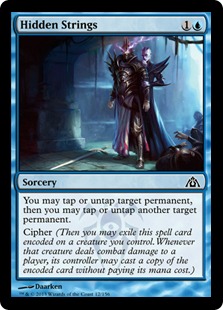
Hidden Strings

Sometimes a card that once was written off as little more than chaff turns out to be quite good in the right deck.

As it turns out, I believe Hidden Strings is just such a card. About a month ago now, Chris Baker blogged about several decks that he was considering playing and/or recommending for the ongoing Standard Pauper Gauntlet. One such deck he entitled Crouching Cipher Hidden Strings. Fast-forward several weeks, and player rbernardinello won MPDC 24.07 with this exact decklist. And that's where I first saw it. I was intrigued by the inclusion of Hidden Strings, and decided to build the deck and see what it could do.

It didn't take me long to discover just how powerful Hidden Strings is in that decklist.

At first blush, I didn't see a lot of value in this card. Sure, it had an interesting effect, but ultimately didn't seem to produce enough value to be worth a card. On its initial casting, you could use it to tap down an opponent's creature, untap one of your own attackers to give it pseudo-Vigilance, untap two of your lands to generate extra mana, or even tap down your opponent's mana sources. But its Cipher effect was much less useful, since it didn't do anything until after combat was already over for your turn.

The release of Theros changed all of that. As it turns out, the ability to target multiple targets with one effect pairs up perfectly with the Heroic mechanic. In fact, you don't even have to actually tap or untap the creature in question; merely targeting it is enough. Similarly, with the release of Born of the Gods, Hidden Strings allows you to potentially tap or untap a creature with the Inspired mechanic.

A study of the existing card pool reveals 16 potential creatures with either mechanic; but of those, the greatest concentration is in White and Green. With White Weenie already showing great success in the format, splashing Blue for Hidden Strings and a few other support cards seemed the best way to support this synergy.

Yesterday, it seemed several players were experimenting with this card in various colors, although I did not see anyone playing Chris Baker's original list other than myself. Despite the fact that Hidden Strings didn't show up at all in the Top 8, I believe this card has the potential to be a significant role player in the weeks ahead, especially if Journey to Nyx brings into the cardpool a few more decent Heroic or Inspired creatures. We shall see.