Showing posts with label Channel Fireball. Show all posts

Tuesday, June 28, 2016

Pauper as a GP Format

Recently over at ChannelFireball, their weekly show Magic TV tackled the question, "Should Pauper Be a Grand Prix Format?" The final week of the Community Super League featured the format, and that was enough to get a lot of players and content creators talking more about the format and examining whether or not it was a good enough format to support premiere play. If you haven't watched the video, it's worth a few minutes of your time (the specific discussion starts at about the 8:40 mark):


Essentially, they lay out four positive reasons why Pauper could be a good Grand Prix format:
  1. The format has a healthy amount of diversity, with a wide variety of decks.
  2. The format is cheap, making it accessible to just about anyone.
  3. The format is tons of fun to play.
  4. The format has the potential to sell what are otherwise undesirable cards.
On the other hand, they do note that the format is almost exclusively online only, and even there doesn't enjoy widespread popularity. They also question whether or not this would be good or bad for stores and/or players if previously unplayable cards suddenly came into higher demand.

Interestingly enough, these are the exact SAME reasons myself and others have used to argue that Standard Pauper should be an official, sanctioned format on Magic Online. Granted, it is certainly less diverse than Classic Pauper, but makes up for that by being a rotating format. But otherwise, I would argue these arguments apply just as well to Standard Pauper as they do to Classic Pauper.

I wonder what it would take to make Wizards reevaluate the viability of Standard Pauper as a supported format?

Saturday, December 19, 2015

Deck Flashback: Kuldotha Hawk, Take Two

Earlier this week, Jacob Wilson of ChannelFireball posted a decklist and videocast of a Classic Pauper deck he ran through a recent Pauper League he entitled Pauper Jeskai. Its built around a card advantage engine of recurring artifacts that draw you a card through Kor Skyfisher and Glint Hawk in order to power out a massive suite of burn spells. It also utilizes several White staples from the original Zendikar block, including Journey to Nowhere, Kor Sanctifiers, and Lone Missionary, along with a splash for the perennial most-powerful Common, Mulldrifter. Here's the full decklist, in case you're curious:


Interestingly enough, the deck is highly reminiscent of one of my favorite Standard Pauper decks from long ago, a build known as Metalhawk, that relied on many of the same synergies and strategies for its own victory plan. Just look at the similarities!


Given how absurdly high the power level is in Classic Pauper in comparison to Standard Pauper, it's great to see these cards seeing play in tournament-level Pauper. If you're interested in what makes the Standard Pauper version work, check out this old video of mine below:


Enjoy, and thanks for reading!

Tuesday, December 30, 2014

Why I Won't Boycott Magic Online

On Sunday, Twitter exploded with rage over a bug with Magic Online where the renown Luis Scott-Vargas had his win-condition shuffled away by Ponder even though he clearly clicked no on the client. Of course, this happened during an evening stream with hundreds of people watching, so it got immediate widespread attention. Lots of people were quite upset by this, and rightly so. But by far the most widespread comment I saw was that the best solution was simply to boycott Magic Online until things get better. Here's a small sampling of the tweets:


Despite all this rage, I don't believe that boycotting Magic Online is the right solution to the problem. Here's why:
  1. It offers what I can't get elsewhere. At the end of the day, Magic Online is really my only outlet to play Magic the Gathering in general, and Standard Pauper in particular. Magic Online allows me to do that on my own schedule and from the comfort of my home. And even though the client is plagued with bugs currently, it still offers me an experience I can't get anywhere else.
  2. I've invested too much. Interestingly enough, this isn't really a financial issue for me. In fact, I've probably spent less than $50 total on Magic Online; maybe less than $30. But I've devoted countless hours to hosting MPDC, writing articles, making videos, chatting with players, and enjoying Limited and Standard Pauper matches. Boycotting Magic Online essentially means throwing all that way.
  3. Having a voice requires keeping a seat at the table. Who is Wizards more likely to listen to? Someone who quit the games months ago and is still angry about the whole thing, or a current player who periodically gives feedback (both positive and negative)? If I want things to get better, I have to be willing to be part of the solution.
  4. I support vendors who depend on Magic Online revenue. So many of my positive experiences on Magic Online came because of sites like PureMTGO, ChannelFireball, MTGOAcademy, and MTGOTraders. These sites depend on Magic Online (at least in part) for their revenue. It's not their fault that the client is a mess. I want to do my part to support these great organizations and the people behind them.
And of course, as I've written about earlier this month, Magic Online is the best hope for Standard Pauper. There's no way I'm giving up on that!

So that's why I won't boycott Magic Online. I'm invested for the duration. And I think you should be too.

Tuesday, April 29, 2014

What's What in Standard Pauper Right Now

With the release of Journey Into Nyx on the horizon, there's a lot of great content on Standard Pauper available right now. Today I wanted to take this post to share with you some of the highlights, in case you've missed it.

1. The Colors of Standard: Standard Pauper enthusiast and veteran of MPDC Mundisv has a great article on the most dominant decks in the format right now. This could easily serve as a primer for what to expect from the upcoming MPDC Season 24 Worlds. You should definitely give it a read.

2. Journey Into Nyx Standard Pauper Review + Italian Game Primer: Chris Baker of ChannelFireball fame posted his review of the new set for Standard Pauper, even before the full set was officially spoiled. Chris has had a ton of success in the format, and his thoughts on the new cards are well worth your time. And if you're a fan of drafting, check out his intriguing "Italian Game Primer" towards the end of his article for a great way to resolve who gets what cards at the end of a draft.

3. The Standard Pauper Show, Ep 8 Journey Into Nyx Review: Brennon of MTGOstrat.com just published the eighth episode of his "The Standard Pauper Show." He reviews the winning decklist from MPDC 24.09 and then devotes most of an hour to reviewing all of the Commons from Journey Into Nyx. Unlike many podcasts, his is more of a video cast, with great visual information that supplements the audio.

4. Writer Adept: Standard Pauper Review of Journey into Nyx, Part One: And if you still can't get enough info on the new set for Standard Pauper, check out my review over at PureMTGO.com. Part One includes all of the mechanic cards and Common cycles, while Part Two (which is forthcoming) will cover the rest of the set. If you enjoy bad puns, this is the review for you!

5. Blackout ! Mais comment allez-vous?: Finally, Adner, captain of the largest Magic Online clan devoted exclusively to Standard Pauper announces that he is effectively stepping down from his role as clan captain. While he will continue to participate in the format, he has been somewhat disappointed by the lack of involvement by the clan members in promoting the format as a whole. If you're looking for someway to give back to this great community, this would be a fantastic opportunity.

If you know of any other recent content that I missed related to Standard Pauper, let me know in the comments below, and I'll make sure it gets included. Thanks for reading!

Tuesday, January 7, 2014

Mana Bases

Today I want to write about mana bases. What's a mana base? Here's how it's defined over on  the MTG Salvation Wiki:

The Mana base of a deck consists of all the cards which produce mana to cast spells. This obviously includes lands, but also counts artifacts, creatures, and even enchantments that have a mana ability attached to them.

Further, and I quote, "The mana base is...the most essential part of a deck as a deck that is unable to achieve the requirements to cast its spells is rendered effectively useless."

While the complexity of a mana base is obviously directly related to the complexity of the deck itself, to construct a proper mana base you need to answer three questions:
  1. How many Lands do I need to reliably cast my spells on time?
  2. How many different color-sources do I need to reliably cast my spells on time?
  3. What options do I have that would allow me to use a single card as a source for more than one color?
Needless to say, constructing a solid mana base is essential to success in Magic. And unless you're copying a well-tested deck from someone else, it can be one of the most difficult aspects of deckbuilding.

This past week I read an excellent article over at ChannelFireball by Frank Karsten about mana-bases. While I am certainly familiar with some of the theory behind mana-bases, this was the first time I saw anyone attempt to mathematically demonstrate the numbers behind some of the theory. If you have the time, I strongly suggest you read his article. But if you just want the gist of his analysis, read on:
Obviously this is taken directly from his article, so full credit goes to Frank Karsten.

So what's the baseline? For a simple two color deck that wants access to both color by Turn 3 (with only one of a particular colored mana symbol in any spell in the decklist), you should play 12 basics for each color, leaving you with a reasonable 24 Lands in your deck. But what about a three color deck? If all you have access to are Basic Lands, you would need to play 36 of them to have access to all three by Turn 3! Obviously that's not going to work.

Which is why Lands that produce more than one color mana are so important. For that same three color deck, if you have 4 Nylea's Presence and 8 Gates covering all three colors, you squeeze in 8 colored sources for each color, leaving you with only 4 basics of each color needed to reach the requirements. Once again, this leaves you with 24 Lands in your deck.

Of course, if you have one or more spells that require multiple instances of a single color mana to cast, the calculation becomes even more complex!

I will leave you to these calculations for now. But next time, I want to use this information to analyze some recent decklists from Standard Pauper and see how the theory holds up! In the meantime, if you have some advice or resources to share about mana bases, I'd love to see it in the comments below.

See you next time.

Friday, November 22, 2013

Mono Red-Blitz

So the other day, as I was browsing the latest content from ChannelFireball, I came across a video by Caleb Durward featuring a list he called Standard Mono-Red Blitz. While as a rule I don't follow much Standard, I still enjoy watching content on this format and sometimes even pick up ideas for Standard Pauper.

As the video began, I was intrigued by Durward's list. With only a few exceptions, the deck was mostly Commons. Take a look for yourself:


So immediately I wanted to find out whether this archetype would work in Standard Pauper. Obviously I had to remove the non-Commons, which included the playsets of Firedrinker Satyr, Legion Loyalist, Rakdos Cackler, and Ash Zealot. The only replacement one-drop worth playing is Bellows Lizard, but Rakdos Shred-Freak, Skinbrand Goblin, and Goblin Shortcutter seemed natural replacements, along with a full set of Gore-House Chainwalkers.

I tested and tweaked the deck, finally arriving at this list:


So what do you think of this list? How well do you think it would fare in the current metagame? As always, I'd love to hear your thoughts.

Tuesday, June 11, 2013

Izzet Blitz

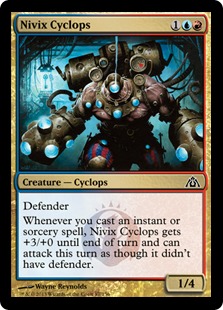
Even though I currently don't play much in the way of Standard or Limited, I am a huge fan of Channel Fireball and regularly keep up with their articles and videos. Today on their site, Travis Woo posted a brand new deck entitled Izzet Blitz. Normally, this wouldn't be something I would pay much attention to, since even though it is built around Nivix Cyclops (a Common from Dragon's Maze), it is clearly a Standard deck.  However, a quick look at the actual decklist revealed something quite surprising. It turns out that the majority of the deck is made up of Commons - 24 out of a total of 40 cards, not including Lands. This is surprisingly high percentage. Let's take a quick look at Travis' decklist:


For more information about exactly how this deck works, I would encourage you to check out the full article. But for now, I want to briefly look at how this deck might be tweaked for Standard Pauper. Here are my initial thoughts, in no particular order:
  1. Replacing Guttersnipe with Delver of Secrets seems like a no-brainer. While not quite as reliable, given the 28 spells in the deck, flipping Delver should be trivial.
  2. Boros Charm doesn't have any parallel at Common, but according to the article it is primarily used either to protect your creatures or give the Nivix Cyclops double strike. Unfortunately, the latter is currently impossible in Standard Pauper. My initial choice then is to replace Boros Charm with Blue protection spells like Negate or Dispel.
  3. Similarly, nothing in the format is as versatile as Izzet Charm. Since Travis mentions uses for all three modes, one could conceive of a mix of additional counters, burn spells like Brimstone Volley or Thunderbolt, or even another cheap Flashback card such as Geistflame, Think Twice, or Silent Departure.
  4. Another playset of a single creature seems warranted, particularly one that gains some advantage from hitting an opponent for damage. Stealer of Secrets seems like a decent possibility, as does Heirs of Stromkirk. Alternatively, one could simply run the perennial favorite Frostburn Weird.
  5. The original build splashes White not only for Boros Charm but also for Sideboard options. White cards that might be worth considering include Feeling of Dread, Keening Apparition, Beckon Apparition, or Smite.
Next time, I will continue my look at this deck and offer up a complete decklist for testing! But for now, I'd love to hear your thoughts on the deck and any potential improvements. Thanks for reading.