Tuesday, October 18, 2016

Magic Digital Next

Yesterday my good friend joekewwl tipped me off to the fact that Wizards of the Coast is somewhere in process of creating a brand new Magic the Gathering digital initiative. He referenced this article published earlier this year, which in turn is based on a press release from Hasbro. joekewwl also mentioned that this project, which is referred to as Magic Digital Next, may already be looking for a select group of players to playtest this at some point in the future.

As you can see from the above graphic, this new digital project would be geared for casual and competitive players looking for a well polished digital experience but that isn't quite as all encompassing as Magic Online. The article states that this is no doubt driven by the success of Hearthstone, which is streamed around the clock, available on just about every platform, and has a very successful e-sport franchise. Furthermore,

"while the paper version of Magic may be doing better than ever before, its digital offerings are weirdly split between two products which at best are kinda-sorta OK. Magic Duels is their free to play side which is largely targeted towards players new to the game, but judging by reactions of hardcore Magic players, many of the restrictions the game has keeps them from getting invested. Meanwhile, Magic Online exists in a constant state of jank and inexplicably is only available for the PC."

I for one would love to see Wizards of the Coast actually launch a well-polished and competitive digital product that could be favorable compared to games like Sol Forge, Hearthstone, or Eternal. Unfortunately, Wizards has a proven track record of bad decisions when it comes to digital offerings, so unless Hasbro is willing to make a significant investment in such a product, I feel that any such new game may come as too little too late.

Thursday, October 13, 2016

Playing RPGs with Cards Instead of Dice

This week I came across a fascinating new twist to bring to your roleplaying game - use playing cards instead of dice. While I encourage you to check out the original article linked above, the basic idea is that you deal out a card array of 12 cards to be shared among the players as well as a hand of 5 cards that the GM keeps concealed in his hand. Then, any time that a roll is required from the players, they instead pick a card from the array in front of them and use that result instead. That player then draws a new card and adds it to the array.

However, the card that was just played isn't discarded. Instead, that player hands it to the GM, who adds it to his own hand of cards. Whenever the GM would normally roll a dice, he or she also picks a card in hand, plays it, and then discards it into the discard pile, where it will eventually be shuffled back in once the entire draw pile has been used up. The GM is also limited to only twelve cards in hand.

This obviously creates some interesting tension for the players. While they are free to use their highest cards to guarantee success, they are also giving the GM that same ability.

Now obviously you have to do some adjustments depending on the game system you're using, especially if you also include the face cards in the mix. For D&D or other games that resolve around a d20, the simplest solution (and the one advocated in the original post) is to use red cards for their face value (with aces counting as a one) and black cards as being worth ten plus their face value. The author also has the following rules for face cards:
  • King:  Succeed at cost.  You automatically succeed, but some complication, error, or unintended consequence is introduced by the GM.  After playing a King, do not give it to the GM.  Place it in the players' discard pile directly to be shuffled back in if .
  • Queen:  Failure, gain 1 treasure, placing the Queen in the score pile for the rest of the session.
  • Jack:  Failure, gain 1 experience, placing the Jack in the score pile for the rest of the session.
  • Joker:  Critical failure, gain 1 experience and 1 treasure.  The GM describes how your action went horribly wrong or caused additional foul consequences.  Place the Joker in the score pile for the rest of the session.
These treasures or experience are then tallied up at the end of the gaming session, giving the players some additional rewards for having played these cards. Alternatively, you could just use all face cards the same way as a King, or simply don't include the face cards at all.

I love the tactical strategies and considerations that this opens up for players and can't wait to try this out with my own gaming group. Thanks to Run A Game for such a great idea!

Tuesday, October 11, 2016

More Eternal

As I mentioned back at the end of August, I had the opportunity to join the closed beta for Eternal, a brand new digital card game by Dire Wolf Digital. Since then I have played a ton of it, and probably spent a similar amount of time watching videos and reading articles about this brand new game.  If you haven't seen or heard anything about this game, its being designed and developed by some of the best Magic the Gathering pros, including Luis Scott-Vargas, Conley Woods, and Patrick Chapin, just to name a few. Needless to say, it comes highly recommended.

It is still in closed beta, but the company seems to be pretty generous in distributing new beta keys. In addition, close beta will soon be coming to an end soon, and then the game will be available to the general public.

But even while it's still in beta, there's already a ton of content already available. Today I want to highlight the work of two of this fledgling community's best: aReNGee and Sir_Rhino.
  1. aReNGee has created a great website with articles, draft pick orders, and a frequently updated metagame summary. He also has a YouTube channel where you can watch him play.
  2. Sir_Rhino is a very active streamer on Twitch, and you can view all of his past videos on his channel. In addition, he is also a frequent guest on a podcast called Eternal Cast, where he, aReNGee,  and the host Neon have done a full set review of the cards for draft. This is a great resource for getting up to speed with all of the cards and their power level in the current environment. 
This game is a ton of fun. If you end up in the beta (or are already on there), let me know. I'd love to hear your thoughts on it. Thanks for reading!

Thursday, October 6, 2016

Presenting the Champions of Season 32

This past week we had the capstone events for this season of both SPDC and MPDC, generally referred to as our WORLDS event. Although the rotation of Standard means that a lot of this past season's metagame won't be directly relevant, I still thought it was worth taking one last look by highlighting the two champions from our WORLDS events. Storm_blade took the trophy in SPDC with his Simic Eldrazi deck, while rremedio1 took the trophy in MPDC with a 4 color Sultai Control deck. Let's take a look at their lists:

Simic Eldrazi
SPDC 34 Champion Storm_blade
Creatures
4 Eldrazi Skyspawner
4 Elvish Visionary
4 It of the Horrid Swarm
4 Primal Druid
4 Scion Summoner
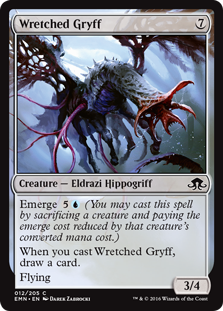
4 Wretched Gryff
1 Monastery Loremaster
2 Eldrazi Devastator
27 cards

Other Spells
4 Epic Confrontation
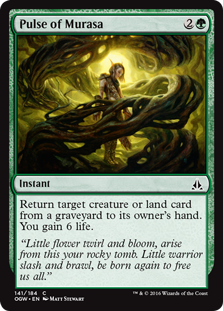
4 Pulse of Murasa
2 Might of the Masses
1 Cathar's Shield
11 cards
Lands
11 Forest
11 Island
22 cards

Island

The strategy of this deck is to play lots of early creatures like Elvish Visionary and Primal Druid, generate mana ramp via the Eldrazi Scions from Eldrazi Skyspawner and Scion Summoner, then leverage all that mana to Emerge either It of the Horrid Swarm or Wretched Gryff, or simply power out the Eldrazi Devastator to overwhelm your opponent. It's mostly a creature-based deck, but it does have a smidgen of removal with Epic Confrontation. It also plays Pulse of Murasa (and Monastery Loremaster as a virtual fifth copy) to keep itself alive and recur its creatures, a couple Might of the Masses to give it an additional angle to win, and a Cathar's Shield to help protect its best creatures from burn-based removal.


rremedio1's build relies on a surprisingly similar base of creatures, but having access to Black gives the deck access to a whole host of powerful removal spells like Reave Soul, Oblivion Strike, and Complete Disregard, as well as generating even more sacrifice synergy with the excellent Vulturous Aven. Rather than the big Eldrazi, rremedio instead chose Ruin Processor, which serves a similar role but also sometimes gives you an important boost of Life as well. Brilliant Spectrum is probably the most surprisingly card in the deck, but when you have access to four colors, it becomes quite strong. Finally, it's worth noting that in order to support all those colors, the deck runs two Pilgrim's Eyes as well as Holdout Settlement and Unknown Shores.

Congrats to both Storm_blade and rremedio1 on their victories! I personally can't wait to see what the new format has in store once Kaladesh is released on Magic Online - which, if I recall correctly, starts today!

Tuesday, October 4, 2016

Isle of Skye

One of the great new games I got to playtest this year at GenCon is a board game called Isle of Skye: From Chieftain to King. In this game, you take on the role of one of five chieftains seeking to grow your kingdom and accumulate the most victory points at the end of the game. You do this by placing tiles that you either randomly select or purchase from the other players and arranging those tiles to maximize your score based upon four victory conditions randomly selected for each game.

The most interesting part of the game isn't placing your tiles though. Rather, each round you randomly draw three tiles from the bag.  Then, each player secretly decides to discard one tile and set a price on the other two. Once every one has made their choices, you all reveal them, and starting with the player whose turn it is, you can choose to buy one of the tiles from another player at the price he or she has selected. And here's where things get interesting.

Price your tile too low, and your opponent gets a valuable tile that they may be able to score with over multiple rounds. But price your tile too high, and not only do you not get any income when no one buys it, but you also have to pay that money to keep the tile for yourself. Furthermore, based on the way the buying works, it's possible that all of your tiles get purchased, leaving you with just one new one, while your opponent each place two tiles that round. Of course, most of the time the quality of your tiles is much more important than the quantity - but still, that's not typically a winning strategy.

The game is played over five rounds, with only one or two of the victory conditions actually scoring for that round. If you find yourself falling behind in points, after round two you do earn some additional funds to help you catch up. While these funds can be converted into points at the end of the game, ultimately they are a pretty poor source of points, so in practice this doesn't always balance the scales as much as you might think.

The components of the game are beautifully illustrated and solid craftsmanship. The markings on the tiles are easy to identify, and the different victory conditions do a solid job of demonstrating exactly what counts for points for that condition without making you consult the rulebook to read how they work. Speaking of which, the rulebook is short and sweet, and you probably won't need more than 15 minutes or so to teach a new player how to play.

Overall I enjoyed this game very much. This is a great example of a game that is simple to learn and play, but has a surprisingly level of depth as you get into it. The game comes with a good selection of different win conditions and a huge bag of tiles, so there's a lot of replay value. Additionally, from my experience, the game plays quite well with anywhere from 2-5 players. If you like tile-placement games or are looking for a simple but also subtly complex game, definitely give Isle of Skye a try!

Thursday, September 29, 2016

Getting Ready for WORLDS

It's hard to believe, but the 34th season of our two weekly Standard Pauper tournament comes to an end early next week. This will also be the last event where the Commons from Dragons of Tarkir and Magic Origins will be legal. As a result, next time I'll take a look back at what proved to be the top hits from those two sets. But for today, as we get ready for the final events of the season, I wanted to set aside my normal Thursday state of the metagame and instead talk about what you should be prepared to face as you enter the capstone events on Sunday and Monday.
  1. While they are by no means the only contenders, the most important decks in the metagame right now are Izzet Spells, Simic Eldrazi, Pulse Control, and Tremors. If you're just looking to pick up a strong deck and run with it, you're best bet is to pick one of these.
  2. Even if you're not playing one of those four decks, it would be wise to understand each of them. You should be familiar with the cards they play and the basic strategy for each archetype. If you're looking for help in this area, you can check out my Deck Techs for each of these decks.
  3. Removal is going to be key in almost any match-up. But not just any removal will do. You want:
    •  Instant speed, cheap removal to help deal with early critical threats like Thermo-Alchemist.
    • Beating token strategies is also best accomplished by having access to Red for Boiling Earth, even if you can only find room for it in the Sideboard. 
    • Finally, having the ability to exile creatures with Touch of the Void can also be an excellent way to sidestep Graveyard recursion.
  4. I'm not seeing many players using hard counters, but I also think that this might be a great way to get an edge, since most people won't be playing around them. While everyone is including Negate and Turn Aside, especially in the Sideboard, Spell Shrivel is something that will catch a lot of people by surprise.
I doubt there's a deck that can do all of that, but if there is, that's what I'd play this coming week. Hope to see you on the other side of the virtual table soon!

Tuesday, September 27, 2016

The Activated Artifact Cycle

As is always the case when a new set comes out, the Magic community is abuzz about the new cards from Kaladesh. The Standard Pauper community is no exception, and I personally am hard at work on my set reviews which will be published over at PureMTGO.com over the next few Mondays. As I've mentioned the past couple Tuesdays, one of the things I love about this set is that it includes not one but three different cycles at Common. I've covered both the Puzzleknot Cycle and the Thriving Creature Cycle; today we'll take a look at the third and final one.


Unlike the other cycles I've covered, these cards don't have that much in common (pun intended). They have different casting costs, different stats, and a variety of activated abilities. But each one is an Artifact Creature with an ability that is activated by paying one colored mana, and each ability is tied thematically to the corresponding color. Interestingly enough, each one also has the Power and Toughness you would generally expect for the casting cost - a 4/5 for 5, a 2/4 for 4, a 2/3 or 3/2 for 3, and a 2/1 for 2.

Of the five, Dukhara Peafowl is probably the best. A 2/4 for 4 with Flying is pretty good, and the fact that it's an Artifact has additional synergy in the format. You do have to keep paying the single Blue mana to give it Flying, but that's a very reasonable price to pay. The Narnam Cobra is also decent, since it's a 2 drop that will be able to trade with any ground creature, and you only have to pay the Green mana when you're ready to make that trade. As far as Weldfast Monitor goes, Menace is a great ability, but it's pretty lackluster on a 3/2, since most of the time that won't be enough to allow it to kill both creatures that block it. Bastion Mastodon is just too expensive with a mediocre ability, while Prakhata Pillar-Bug might as well just give you 2 Life when it dies.

I don't expect these will make much of an impact, but in a deck that's looking for some reasonable Artifact Creatures, the peafowl or the cobra might make the cut.