Tuesday, September 30, 2014

Ponyback Brigade

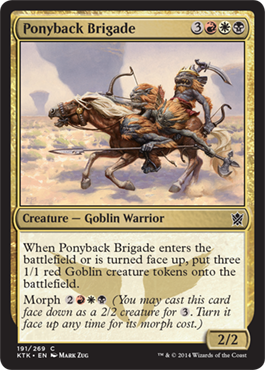
Today the final installment of my Khans of Tarkir set review for Standard Pauper was published over at PureMTGO. In my previous installment, I reviewed the multicolor Morph cycle at Common. I ended up rating Ponyback Brigade as the worst of the cycle, although I did assign it a borderline grade, meaning I felt it was playable but not great.

I received the following response in the comments:

Ponyback Brigade is as close to Siege-Gang Commander as Pauper will ever see, and the Efreet Weaponmaster dies to a simple Lightning Strike. In fact, I'm finding it very difficult to believe that you directly rated ("[...]the worst card in the cycle[...]") ... Do you not really grasp how powerful it is to get four bodies for one card? Midrange can use this to gum up the ground like no one's business, control can stabilise with a single card (and keep in mind that it kills in four turns on it's lonesome on an empty board against an untouched opponent), and even aggro might see some use for it postboard.

I appreciated the feedback, and promised that I would clarify my thoughts in a blogpost. So here we go.

First, let's take a look at Siege-Gang Commander, which he compared it to:

You can see why it's a fitting comparison. Siege-Gang Commander also gives you four creatures, three of which are 1/1 Goblin tokens and the other a 2/2. Siege-Gang costs one less mana, and most of the time will be easier to cast, since it only has two colored mana symbols instead of three. It also can't be played as a 2/2 for 3 early and then later flipped over at an advantageous time. 

However, the big difference is Siege-Gang's secondary ability: for 1R each, it can turn those 1/1 Goblins into Shocks at Instant speed. This is a major difference, as it takes those tokens from marginal to always relevant.

Second, let's talk about the value of a 1/1 without any abilities. Generally speaking, a 1/1 is worth somewhere between half and a third of a card. Krenko's Command gives you two such tokens for 1R at Sorcery speed. Getting three tokens at Instant speed would be very strong at 2R, and at Common is more likely to cost at least 3R (based on Captain's Call). But unless you're playing a dedicated Tokens build, most of the time a bunch of 1/1s is not going to be that relevant. Yes, they can chump-block several attacking creatures; yes, they can get in for some significant damage once or twice; but generally, this is a niche effect for a niche deck, not an all-around all-star.

So I would evaluate Ponyback Brigade (disregarding Morph for the moment), as a 2BW Captain's Call tacked onto a 2/2 creature for 1R. The total effect is nice, but for six mana with triple color requirements, even at Common we can expect more. Of course, you add Morph back into the mix, and you have a solid card, perfectly playable. But here again, the setup cost is pretty high. Hence my rating: playable, but not amazing.

What do you think?

Saturday, September 27, 2014

The Most Expensive Common in Standard

Pop quiz, get out your number two pencil!

Without looking, can you tell me what the most expensive Common is in Standard right now for Magic Online? Go ahead, think about it for a minute. I'll wait.

Ready for the answer? If you guessed Centaur Courser, you guessed correctly. Believe it or not, the Magic 2015 version of this card, as of this post, is going for $1.35 a piece. What in the world is that all about?

Let me give you a hint. The next five cards are also all from Magic 2015, and the cheapest is 63 cents for a Magic 2015 Cancel. For comparison, the next most expensive card after that is Electrickery, which is currently listed for a measly 8 cents.

When I found this out, I was completely baffled. Fortunately Pauper enthusiast Alex Ullman came to my rescue:


Of course. If you recall, Magic 2015 included 6 reprints that were technically part of the set but would not be included in any of the set's booster packs. Since these cards will never be opened in a draft, they are somewhat rare online, but are necessary for those who want to redeem a paper set of Magic 2015.

So now you know. The Magic 2015 Centaur Courser is the most expensive Common in Standard on Magic Online.

Thursday, September 25, 2014

Heroine's Quest

As I mentioned earlier this week, I've spent a lot of time recently playing the independent game Heroine's Quest, published by Crystal Shard. The game is a clear spiritual successor of the 90s cult classic Quest for Glory series. Indeed, I would go so far as to say it could easily have been a reboot of it, so similar are the two games. Here a few similarities, in no particular order:

1. You play an aspiring hero whose starting class is immediately chosen from Fighter, Mage (Sorceress), or Thief. This choice not only affects the RPG elements, but also changes the options you will have to solve the various puzzles in the game.

2. You are trapped in a small town, where the local nobility is powerless against the evil forces that have beset it. It is thus your quest to save the town from these evil forces and be awarded the title 'hero.'

3. Your character is defined by a set of attributes and skills that you slowly increase through logically connecting activities. Climbing a wall increases the Strength attribute and the Climb skill; dodging the bite of a wolf increases the Agility attribute and the Dodge skill; talking to random animals increases your Wisdom attribute and the Animal Ken skill, and so forth, although not all attributes are necessary tied to a skill, and some of them are tied to multiple ones.

4. The gameplay is a hybrid of adventure and RPG. You solve puzzles using conversation and items you find in the world; but you also climb walls, defeat foes, cast spells, and befriend small animals.

5. Sprinkled throughout the game are a variety of humorous bits, real world jokes, and cameos; this was one of the hallmarks of the Quest for Glory series.

6. You even start off by finding the Adventurer's Guild and signing the logbook, which is about as classic Quest for Glory as you can get.

Despite being almost identical to the Quest for Glory series mechanically, Heroine's Quest has much to set it apart. First, it's got an amazing amount of lore to the game. It's set in a Norse culture, and the lore of frost giants, dark elves, multiple realms, trolls, and the like all play a part, as do such legendary deities as Thor and Loki. Additionally, the game is also much bigger than any of the Quest for Glory games, with two fully fleshed out worlds to explore and a huge cast of characters that can be interacted with. You can even use the Thief class to skip through most of the puzzles in the game simply by stealing all the items you need from the major NPCs rather than solving them through traditional means.

The production values are also excellent. While rendered in classic 320x200 resolution with 16 bit graphics, the artwork is done well. All of the characters are also voiced with surprisingly good voice acting considering that the game is free. The storyline plays out at a good pace, rarely leaving you without multiple things to be working on at a time. The puzzles can be a bit obtuse at times, but never so obscure that you can't figure it out. And even then, their website includes a full play-through of the game, with solutions to every problem and a guide to earning every point.

If you were at all a fan of the Quest for Glory series, you need to try this game. You won't be disappointed.

Wednesday, September 24, 2014

Hearthstone: Shaman

Yesterday, I mentioned the nerf to the Hunter Hero in Hearthstone and the fact that I was looking for a new deck to play. I ended up browsing through the decklists from Blizzcon European Qualifier. Hunters and "Handlock" Warlocks dominated the list, but surprisingly Shaman also seemed to  be a favorite. Even better, many of the Shaman lists didn't include much in the way of expensive Legendaries; typically, only Loatheb and Al-Akir the Windlord.

Now Shaman has always been my nemesis Hero. For whatever reason, I found myself losing to it more often than not. This class is surprisingly good at control, and has a variety of subtle but powerful options at its disposal. So, if I was ever to improve my game against Shaman, I would need to actually get some first-hand experience with it.

So, here's the list I ended up with:

As I mentioned before, one of the great things about this list is that it's relatively cheap. It only has one Epic - Doomhammer - and the only Legendary is Loatheb, which you get for "free" in the Naxxramas expansion. All of the rest of the cards are Rares and Commons.

This archetype is all about value and Control. Haunted Creeper, Harvest Golem, Mana Tide Totem, Azure Drake, and Fire Elemental are all excellent in this department, acting as virtual two-for-ones almost all the time. This deck can also create a wall of defenders using Defender of Argus and Sludge Belcher, slowing down most aggro decks to give you the breathing space you need. It also includes the excellent Lighting Storm as mass removal, as well as Earth Shock, Lightning Bolt, Rockbiter Weapon, and Doomhammer as spot removal. Hex is also amazing in this role, in that it's essentially unconditional hard removal for only three mana. Finally, the deck can put out a ton of damage unexpectedly with Flametongue Totem and Bloodlust.

The hardest part of playing Shaman is sequencing your plays. Overload means you need to carefully think about how your play this turn will effect your options on the following turn. The Shaman's Totemic Call Hero ability also randomly chooses between four different options (although the fact that you can never have two of the same kind does help cut down on the randomness), which also leads to tricky decisions. All other things being equal though, activating Totemic Call each turn is rarely a bad call. And while it can be tempted to using Earth Shock, Rockbiter Weapon, and Flametongue Totem early, often holding onto them into the mid to late game is a better strategy.

Anyway, I've had a lot of early success with this archetype. So give it a try. It may take a few games to get the hang of it. But once you do, I think you'll be pleasantly surprised.

Tuesday, September 23, 2014

Miscellaneous Musing

Today will be a somewhat random assortment of small updates regarding what I've been working on the past week or so.

1. It turns out I missed my weekend update this past week (did anyone notice? Is this thing on?). As a result, I will be writing an extra post this week, probably tomorrow.

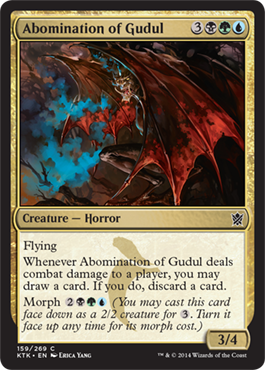
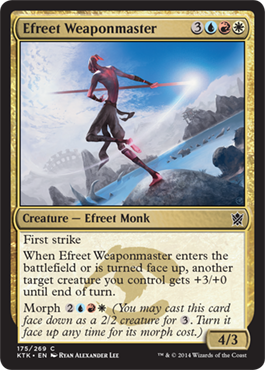
2. Part One and Part Two of my review of Khans of Tarkir for Standard Pauper have been published over at PureMTGO.com. I hope to have Part Three up no later than next Monday. Thus far the most interesting cards look to be the multicolor Morphs. I think they are all playable, but Abomination of Gudul and Efreet Weaponmaster seem to be the best in terms of raw power. I've also heard some excitement about Ponyback Brigade, but thus far I'm not convinced.

3. I've been playing a lot of a great new freeware game called Heroine's Quest, which is an adventure game in the classic style of the old Quest for Glory series. I should have a review up for it later this week.

4. The Hunter deck I piloted to great success recently in Hearthstone has been decimated by the nerfing of Starving Buzzard. If you've got suggestions on what deck I should play next, I'd enjoy hearing them.

See you tomorrow.

Thursday, September 18, 2014

Khans of Tarkir: Outlast

Khans of Tarkir brings with it five new mechanics, and based on my review for Standard Pauper, it's a good bet that at least four of them will make their presence felt pretty quickly in the new metagame. Today, I want to take a look at the Abzan mechanic: Outlast.

In some ways, Outlast reminds me of the Level Up mechanic from Rise of the Eldrazi. Like Level Up, Outlast requires a small to moderate investment of mana to increase the power of the creature. In general, the Power and Toughness boost you get from each activation is much better value than you received from the Level Up mechanic, and there is no limit to the number of times you can gain this effect. However, the creature never gains any additional abilities, and worse, Outlast requires you to tap the creature in order to generate the effect.

Outlast would have been amazing at Instant speed; so amazing, in fact, that it probably could not have seen print at Common. So the question is, how good is it at Sorcery speed?

While time will tell, in general I think it's still pretty good. At Common, having something to do with your extra mana every turn is quite good if you're playing more of a Control build. Even better, two of the four Outlast Commons include a secondary ability that grants a evergreen keyword ability to all creatures with a +1 / +1 counter, including itself. So, you get fairly good value from the first activation. After that, you can utilize the creature as long as it remains relevant on the board, and when its no longer effective in combat, spend the extra mana each turn to pump it up until it's big enough to be a threat again.

The biggest downside is the potential for you to take a major tempo hit when you go to activate Outlast but your opponent kills it with Instant speed removal. To get good use out of this mechanic, you'll need to have the ability to protect the creature at Instant speed, since it will take an entire turn after you pump it before you get any utility out of it. Savage Surge will be particularly good in this spot, since it also untaps the creature.

Thus, while it will take some work to get the most value out of Outlast, I would say that the potential is there for this to be quite relevant in Standard Pauper. What do you think?

Tuesday, September 16, 2014

Khans of Tarkir: Morph

In case you somehow missed it, the returning mechanic for Khans of Tarkir is Morph. Morph was first introduced way back in Onslaught, and is certainly one of the stranger mechanics in Magic's history. The ability to essentially play a 2/2 token for 3 mana by putting the card face-down introduces a whole new element of hidden knowledge from your opponent, and the complexity is even higher given that you can flip a Morph card over at any time, assuming you have enough mana to pay the Morph cost. It is also worth pointing out here that the act of turning the card face-up doesn't use the stack, and thus cannot be responded to. In other words, if your opponent pays the Morph cost and goes to flip over her creature, you can't cast Shock to remove it as a 2/2 creature.

As I have been working on the set review for Standard Pauper for Khans of Tarkir, I have had some difficulty in evaluating just how good the Morph cards are in this set. Today, rather than looking at specific cards, I want to evaluate the mechanic as a whole.

Typically, Morph cards have three major advantages over other creatures:
  1. Your opponent doesn't know what creature you played. Since all Morph cards cost the same to play face-down, your opponent has no real information to go on. Unless he is playing Lens of Clarity, the only way your opponent learns what card you played either when you flip it over or when it leaves the battlefield or the game ends.
  2. You can always play the card as soon as you have three mana available. Playing them facedown doesn't require any specific colored mana. Additionally, most of the time this is cheaper than the actual casting cost of the creature, allowing you to get value out of the card much earlier than you otherwise could.
  3. You control when the creature is flipped over. This means that you can effectively surprise your opponent in combat, allowing you to block a creature you might not have been able to block or setup a favorable block that your opponent couldn't foresee.
These are pretty significant advantages. Honestly, given the complexity that this introduces, I am surprised Morph is being reprinted at Common. This also means that we should expect that the Morphs at Common will probably only be vanilla or french-vanilla creatures, since additional complexity would easily push the card into Uncommon or Rare.

For those of you who have played with Morph cards before, what do you think of them in general? Are you excited to get your hands on them in Khans of Tarkir? Let me know in the comments below.