As I mentioned in my previous post, the Finals for the Standard Pauper Double League ended up going to three matches, which is something that I believed was possible in a Double Elimination format. However, it has come to my attention that my understanding of how this played out is not typical. So I thought I would take some time to post about how this particular variation works, and then use it to get some feedback from the players in Phase Two to make sure everyone is on the same page.
So, most of you are familiar with how Double Elimination tournaments work. Quite simply, you play until you've lost two matches, and then you're eliminated. At your first loss, you move to the so-called "loser's bracket," where you only play against other people who have lost a game. Meanwhile, those without a loss continue to play in the "winner's bracket," until both brackets have played out. Then, the two surviving players are paired against one another in the finals.
Typically, since the remaining player in the winner's bracket has not lost a match, he or she is not immediately eliminated if they lose the finals match, since that is their first loss. Instead, in that case, both players must play out a second match to determine who is the winner. And here is where the confusion or discrepancy came from.
The final match can play out in three different scenarios. First, the player from the winner's bracket (henceforth abbreviated W) wins the match; in that case, the finals is over, and W is the winner. Second, the player from the loser's bracket (abbreviated L) wins the match; in that case, since that is W's first loss, W and L play out a second match. If L wins that second match, then the finals is over, and L is the winner. So far, nothing controversial here. This is exactly how I understand the rules to work.
But it is in the third scenario where the confusion arises. In this case, L wins the first match, and thus W and L play in a second match. This time, W is the winner of that match. So what happens next? On the one hand, L now has two losses, and thus some would argue that the finals is over and W is the winner. On the other hand, both W and L have won a match during the finals, resulting in somewhat of a tie.
This third scenario is exactly what happened in the match between ZombieNeko and tikimunkee. Once both players had won a match in the finals (with tikimunkee winning the first and ZombieNeko winning the second), I asked them to play out a third match to determine the winner. For whatever it is worth, this is the way that Double Elimination tournaments have worked in the past for MPDC, even before I was the host. I believed at the time that this was normal practice.
Also, for whatever it is worth, this does NOT take away the advantage that the player in the winner's bracket should have. Remember, if W wins the initial match, then the finals is over. L still has to win two matches in order to be the winner. The only difference is that if W drops the first game, then W has to win the next two matches to become the champion.
So here's the question: in the third scenario (W loses the first match but wins the second), with both players having won a match during the finals, is the finals over with W getting the win. Or should the players have to play one final match to determine the winner? While I think this variant is better, I recognize now that it is not as widely used as I thought.
While you're welcome to voice your opinion below, I will be asking all of the players in Phase Two of the Double League to E-mail me back and let me know which way they would prefer. Thanks so much, and sorry for the lengthy post.
Thursday, December 31, 2015
Wednesday, December 30, 2015
Jund Allies
Phase One of the Standard Pauper Double League wrapped up yesterday, with ZombieNeko's Jund Allies deck being crowned the winner. The final match actually went to a 'best-of-three' matches, with both players dropping a match before ZombieNeko came from behind to take 1st place. I was able to record all three matches, and I am working on a article for PureMTGO with full decklists and commentary on the match. But for today, I thought I would offer a quick preview of the winning decklist:
When I first previewed the Allies from Battle for Zendikar, I was pretty skeptical that there was enough power level to make a dedicated Allies build work. But in this case I am glad to be proven wrong, although technically the Allies is only a small part of what makes this deck work. Tajuru Stalwart in a three color deck is an excellent 3/4 for 3, while the combination of Kalastria Healer and Kalastria Nightwatch makes the latter a very powerful card. The deck also benefits from the excellent Elvish Visionary, the late game value of Valakut Invoker, and the best of the new Landfall creatures in Valakut Predator. The deck also has just enough card draw, combat tricks, and removal to help clear the way when need be or survive against early game aggression.
Have you played with or against this deck? If so, what do you think of it? Let me know in the comments below.
Also, don't forget that I am seeking feedback on what topics YOU would like to see me write about in the upcoming year. Please let me know by commenting on the linked post. Thanks so much!
Jund Allies
1st place by ZombieNeko in Double League Phase One
| Creatures 4 Elvish Visionary 4 Kalastria Healer 4 Kalastria Nightwatch 4 Tajuru Stalwart 3 Valakut Invoker 3 Valakut Predator 22 cards Other Spells 3 Read the Bones 2 Butcher's Glee 2 Seek the Wilds 2 Touch of the Void 2 Twin Bolt 1 Stonefury 1 Unholy Hunger 13 cards |
Lands 5 Forest 4 Evolving Wilds 4 Mountain 3 Bloodfell Caves 3 Jungle Hollow 3 Rugged Highlands 3 Swamp 25 cards
Sideboard
2 Boiling Earth 2 Complete Disregard 2 Douse in Gloom 2 Fetid Imp 2 Unholy Hunger 1 Duress 1 Flatten 1 Read the Bones 1 Reave Soul 1 Twin Bolt 15 cards |
|
When I first previewed the Allies from Battle for Zendikar, I was pretty skeptical that there was enough power level to make a dedicated Allies build work. But in this case I am glad to be proven wrong, although technically the Allies is only a small part of what makes this deck work. Tajuru Stalwart in a three color deck is an excellent 3/4 for 3, while the combination of Kalastria Healer and Kalastria Nightwatch makes the latter a very powerful card. The deck also benefits from the excellent Elvish Visionary, the late game value of Valakut Invoker, and the best of the new Landfall creatures in Valakut Predator. The deck also has just enough card draw, combat tricks, and removal to help clear the way when need be or survive against early game aggression.
Have you played with or against this deck? If so, what do you think of it? Let me know in the comments below.
Also, don't forget that I am seeking feedback on what topics YOU would like to see me write about in the upcoming year. Please let me know by commenting on the linked post. Thanks so much!
Sunday, December 27, 2015
Blogging Moving Forward
So this post is several days late. I apologize, but as I mentioned previously, travel and my holiday schedule is making it difficult to get these done in a timely fashion. I should have been more proactive about scheduling so as to avoid this issue. Speaking of which...
As we approach the end of another year, I find myself rethinking how I want to use this blog space moving forward. Rest assured that despite all the turmoil that Standard Pauper has gone through over the past few months, I certainly intend to continue writing about the format, especially as new cards come into Standard.
But beyond that, I am curious as to what my readership would enjoy reading about. In the past, I've covered everything from fantasy authors to espresso to board games to writing tools. I know from the feedback I've received that many of you have enjoyed my looks at other video games, and that is certainly something I will continue to promote. However, I would love to hear what else you would enjoy reading about.
Specifically...
- What have been some of your favorite posts or topics outside of Magic?
- Do you prefer shorter or longer posts?
- How often do you prefer to see content on Standard Pauper vs. other topics?
- Would you enjoy seeing guest posts from other bloggers?
Wednesday, December 23, 2015
Medieval Demographics Made Easy
I'm going to be traveling for Christmas and New Years, so my blog posts may be a bit sporadic over the next couple weeks. Rest assured I will do what I can to get two posts in each week, but the timing may not be as consistent as normal. Sorry about that.
Between my halting endeavors at writing fantasy and my resurgent involvement in Dungeons and Dragons, I am always on the lookout for helpful resources when it comes to world-building. Today I want to highlight one such resource - an article entitled "Medieval Demographics Made Easy," written by one S. John Ross. In this article, Ross looks at real world examples of medieval demographics and then uses those examples to extrapolate what an pseudo-European fantasy setting might look like.
The articles examines several key factors for world-building:
So next time you've got some questions about what medieval demographics might look like, you've got an easy resource at your fingertips!
Between my halting endeavors at writing fantasy and my resurgent involvement in Dungeons and Dragons, I am always on the lookout for helpful resources when it comes to world-building. Today I want to highlight one such resource - an article entitled "Medieval Demographics Made Easy," written by one S. John Ross. In this article, Ross looks at real world examples of medieval demographics and then uses those examples to extrapolate what an pseudo-European fantasy setting might look like.
The articles examines several key factors for world-building:
- Population Density - in other words, how many people (on average) live within a square mile of the kingdom in question.
- Population of the Cities, Towns, and Villages - in other words, given that population density, how many cities, towns, and villages would be expected, and what would the population of those settlements be.
- Merchants and Services - in other words, given the population of a particular settlement, what kinds of goods and services would be available there. After some general guidelines, the article looks in more details about agriculture, castles, law enforcement, institutions of higher learning, and livestock.
So next time you've got some questions about what medieval demographics might look like, you've got an easy resource at your fingertips!
Saturday, December 19, 2015
Deck Flashback: Kuldotha Hawk, Take Two
Earlier this week, Jacob Wilson of ChannelFireball posted a decklist and videocast of a Classic Pauper deck he ran through a recent Pauper League he entitled Pauper Jeskai. Its built around a card advantage engine of recurring artifacts that draw you a card through Kor Skyfisher and Glint Hawk in order to power out a massive suite of burn spells. It also utilizes several White staples from the original Zendikar block, including Journey to Nowhere, Kor Sanctifiers, and Lone Missionary, along with a splash for the perennial most-powerful Common, Mulldrifter. Here's the full decklist, in case you're curious:
Interestingly enough, the deck is highly reminiscent of one of my favorite Standard Pauper decks from long ago, a build known as Metalhawk, that relied on many of the same synergies and strategies for its own victory plan. Just look at the similarities!
Enjoy, and thanks for reading!
Interestingly enough, the deck is highly reminiscent of one of my favorite Standard Pauper decks from long ago, a build known as Metalhawk, that relied on many of the same synergies and strategies for its own victory plan. Just look at the similarities!
Given how absurdly high the power level is in Classic Pauper in comparison to Standard Pauper, it's great to see these cards seeing play in tournament-level Pauper. If you're interested in what makes the Standard Pauper version work, check out this old video of mine below:
Enjoy, and thanks for reading!
Thursday, December 17, 2015
A Future with Azorius
I've been fairly ill this week, which is why I not only missed my Tuesday post but was absent entirely from MPDC as well. I'm slowly getting back on my feet, and I should have another post Saturday to make up for the one I missed on Tuesday. Thanks for your patience!
A couple weeks ago, I was discussing the dominance of the Izzet Control archetype in Standard Pauper right now and examining whether or not Azorius might have the right tools to combat it. After that post, I spent some time experimenting with a very aggressive build that relied on powerful 2-drops and a great deal of spot removal to try and put a lot of early pressure on Izzet Control. And while the build seemed to have promise, ultimately it wasn't proving to be very effective. So I went back to the drawing board, and starting looking at ways to delay and sidestep Izzet's plan through effects that tap down creatures rather than removing them. This lead to playing quite a few more spells, which pushed the deck more towards the midrange and made Prowess creatures particularly attractive. Here's where I ended up:
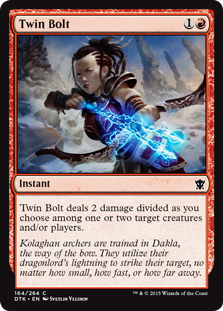
These five creatures represent some of the stronger ones in Azorius colors, play well with spells, and have the added benefit of being immune to Twin Bolt and other 2 point damage spells. The deck can also sift through its library very quickly thanks to Anticipate and Treasure Cruise, all the while casting plenty of spells to keep fuel for Delve. Send to Sleep has proven to be quite strong as long as you have Spell Mastery active, and this deck also finally gives Skyline Cascade a chance to shine. It's quite capable of locking down the worst creatures for two or three turns in a row, giving you plenty of time to power through with your Prowess-enabled creatures for the win.
Thus far I've had great success with this build against Izzet Control specifically. I also had three very close games against the sacrifice-themed Rakdos deck that is seeing more play. I wouldn't say I'm totally satisfied with this build, but I'm certainly pleased so far.
What changes or additions would you make? Let me know in the comments below.
A couple weeks ago, I was discussing the dominance of the Izzet Control archetype in Standard Pauper right now and examining whether or not Azorius might have the right tools to combat it. After that post, I spent some time experimenting with a very aggressive build that relied on powerful 2-drops and a great deal of spot removal to try and put a lot of early pressure on Izzet Control. And while the build seemed to have promise, ultimately it wasn't proving to be very effective. So I went back to the drawing board, and starting looking at ways to delay and sidestep Izzet's plan through effects that tap down creatures rather than removing them. This lead to playing quite a few more spells, which pushed the deck more towards the midrange and made Prowess creatures particularly attractive. Here's where I ended up:
Azorius
by gwyned
| Creatures 4 Elusive Spellfist 4 Jeskai Student 4 Lotus Path Djinn 4 Mardu Hordechief 2 Student of Ojutai 18 cards Other Spells 4 Anticipate 4 Send to Sleep 4 Treasure Cruise 2 Crippling Chill 2 Whisk Away 1 Clutch of Currents 1 Feat of Resistance 1 Sheer Drop 19 cards |
Lands 7 Plains 4 Evolving Wilds 4 Island 4 Skyline Cascade 4 Tranquil Cove 23 cards
Sideboard
4 Pacifism 3 Cleric of the Forward Order 3 Felidar Cub 2 Disdainful Stroke 2 Negate 1 Whirlwind Adept 15 cards |
|
These five creatures represent some of the stronger ones in Azorius colors, play well with spells, and have the added benefit of being immune to Twin Bolt and other 2 point damage spells. The deck can also sift through its library very quickly thanks to Anticipate and Treasure Cruise, all the while casting plenty of spells to keep fuel for Delve. Send to Sleep has proven to be quite strong as long as you have Spell Mastery active, and this deck also finally gives Skyline Cascade a chance to shine. It's quite capable of locking down the worst creatures for two or three turns in a row, giving you plenty of time to power through with your Prowess-enabled creatures for the win.
Thus far I've had great success with this build against Izzet Control specifically. I also had three very close games against the sacrifice-themed Rakdos deck that is seeing more play. I wouldn't say I'm totally satisfied with this build, but I'm certainly pleased so far.
What changes or additions would you make? Let me know in the comments below.
Thursday, December 10, 2015
Collaborative Story-First Character Creation Results
A couple weeks back, I wrote about a character creation process for D&D 5th edition that I adapted from the Fate Core System. Essentially, this was a "story-first" approach where each character creates their own background and first adventure, and then each other character assigns themselves a role in two of the other character's adventurers, immediately creating a sense of connection and camaraderie among the party.
So I went through this process with a group of my college buddies, none of whom have ever played Dungeons and Dragons before (although they are all very familiar with the fantasy genre in general). Between the creative free-writing assignments for their backstory, first adventure, and secondary role in two other adventurers, as well as the actual process of rolling up the stats for the characters, it took us almost four hours, which is a long time for a session dedicated to character creation. But as my design document states, this is a highly collaborative form of group storytelling, and it should come as no surprise that it took us a whole play session to complete.
We ended up with four separate backgrounds (one for each character), plus three tales that were the result of their collaborative storytelling. If you're interested in seeing the results, feel free to check them out here. But overall I was very happy with the process. I've got several great threads that tie the characters together, the potential for some very interesting interactions between the players, and several hooks that will tie into the story that my players are already telling. While it's a lengthy process, it's one that I highly recommend you try. If you're interested, you can download my detailed description of the process here.
This group will be meeting next Friday night, so in a few weeks I'll be sure and recount the highlights of this experience. I'm certainly looking forward to it!
Subscribe to:
Posts (Atom)